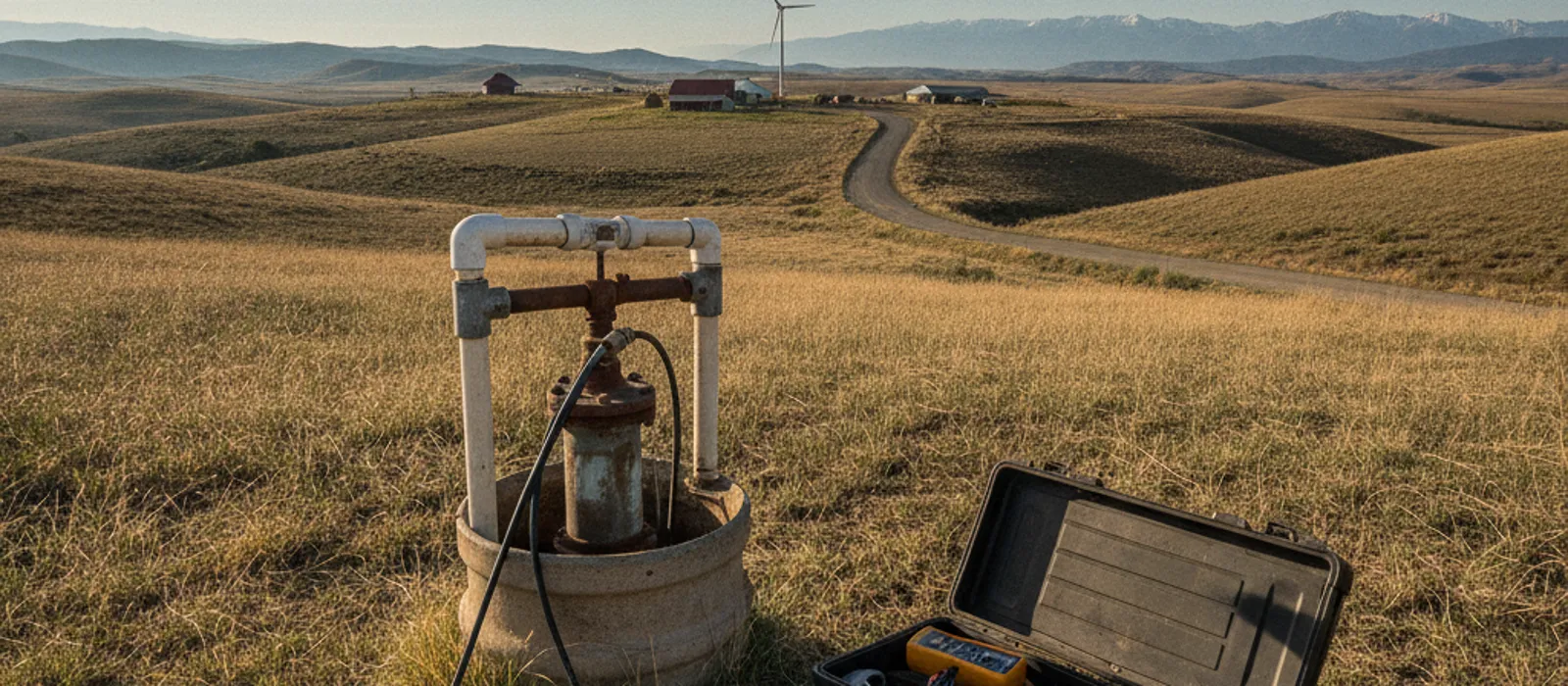
Here’s a number that surprises most well owners around Wenatchee: a healthy half-horsepower well pump usually costs less than $3 a month to run. Less than a coffee at the drive-through on Wenatchee Avenue.
So if your power bill jumped $40 last month and you’re eyeing the pump house, you’re asking the right question. Well pump electricity usage is small when everything’s working right. When something’s wrong, that same pump can quietly become one of the biggest power hogs on your property. The good news is the math isn’t hard, and the warning signs are easy to spot once you know them.
In this guide, we’ll walk through what a typical well pump actually uses, how to calculate your own numbers in about five minutes, why our local PUD rates change the picture, and the five problems that turn a cheap pump into an expensive one.
The Quick Answer: Most Well Pumps Cost $2 to $10 a Month
For a typical home in Chelan, Douglas, or Grant County, here’s the short version.
A standard 1/2 HP submersible pump draws roughly 800 watts while it’s running. A family of four uses somewhere around 300 to 400 gallons of water a day. With a 10 gallon-per-minute pump, that’s only 30 to 40 minutes of actual run time daily.
Do the math and you get about 15 to 20 kWh per month. At the national average of around 16 cents per kWh, that’s $2.50 to $3.25. Here in North Central Washington, where Chelan and Douglas PUD rates run around 3 to 4 cents per kWh, it’s often under a dollar.
Bigger pumps and deeper wells cost more, but rarely dramatically more for household use. Irrigation pumps are a different animal, and we’ll get to those.
The catch: those numbers assume a healthy system. A waterlogged pressure tank, a failing pump, or a leak in the drop pipe can triple or quadruple your pump’s run time without you noticing, until the bill shows up. If your pump seems to run all the time or your bill doesn’t make sense, give us a call at (509) 300-5151 and we’ll help you figure out whether the pump is the problem.
How to Calculate Well Pump Electricity Usage at Your Place
You don’t need an engineering degree for this. You need three numbers: your pump’s wattage, its daily run time, and your electric rate.
Step 1: Find your pump’s wattage
Check the paperwork from the install, or the label on the control box in your pump house. If all you know is horsepower, use this rough rule: a submersible pump draws about 1,000 to 1,400 watts per horsepower while running. A 1/2 HP pump lands around 700 to 900 watts.
Step 2: Estimate run time
Here’s the trick most people miss. Your pump doesn’t run whenever you use water. It runs to refill the pressure tank after the pressure drops. Total run time depends on how much water your household uses, not how often you open a tap.
The USGS estimates each person uses 80 to 100 gallons per day at home. You can check their figures at the USGS Water Science School. Multiply by the people in your house, then divide by your pump’s flow rate in gallons per minute. Four people at 90 gallons each is 360 gallons. A 10 GPM pump covers that in 36 minutes of run time per day.
Step 3: Do the math
Watts ÷ 1,000 × hours per day × 30 days = kWh per month. Then multiply by your rate per kWh.
Example: 800 watts × 0.6 hours × 30 days = 14.4 kWh per month. At 4 cents per kWh, that’s 58 cents. At 16 cents, it’s $2.30.
One more wrinkle: starting current. A standard pump motor pulls 3 to 5 times its running wattage for a second or two at every startup. That surge barely registers when the pump starts 10 to 20 times a day. When a bad pressure tank makes it start 200 times a day, it adds up, and it chews through the motor too.
Well Pump Power Consumption by Size: A Cost Table
Here’s what different pumps typically use for normal household duty, assuming a family of four and a properly working system. Local rate is based on typical Chelan and Douglas County PUD residential pricing.
| Pump size | Running watts | Typical kWh/month | Cost at $0.16/kWh (US avg) | Cost at $0.04/kWh (local PUD) |
|---|---|---|---|---|
| 1/2 HP submersible | 750 to 900 | 13 to 18 | $2 to $3 | $0.50 to $0.75 |
| 3/4 HP submersible | 1,000 to 1,300 | 18 to 26 | $3 to $4 | $0.75 to $1 |
| 1 HP submersible | 1,300 to 1,600 | 24 to 32 | $4 to $5 | $1 to $1.30 |
| 1.5 HP submersible | 1,800 to 2,200 | 33 to 44 | $5 to $7 | $1.30 to $1.75 |
| 5 HP irrigation pump | 4,500 to 5,500 | 400 to 900+ | $65 to $145 | $16 to $36 |
Notice the jump on that last line. Irrigation pumps run for hours at a stretch, not minutes. If you’re watering a few acres of pasture or orchard outside Quincy or Moses Lake, your pump can easily pull more power in July than your whole house does in January.
Take the Hendersons in Quincy. They run a 5 HP irrigation pump on three acres of alfalfa, about 7 hours a day through the hot months. That’s roughly 1,000 kWh a month from the pump alone. On Grant PUD’s low rates it pencils out, but when their pump started losing prime and running 10 hours to move the same water, their summer bill jumped almost $30 a month before they caught it. A worn impeller was the culprit. If you run a big irrigation setup, our post on irrigation well pumps covers sizing and efficiency in more detail.
Why North Central Washington Rates Change Everything
Here’s our local advantage. Chelan County PUD and Douglas County PUD sell some of the cheapest residential electricity in the United States, thanks to hydropower from the Columbia. Grant PUD isn’t far behind. While much of the country pays 15 to 20 cents per kWh, most of our service area pays a fraction of that.
What does that mean for well pump electricity usage in practice?
It means a normal household pump is almost never the reason your bill is high. If you’re in East Wenatchee or Cashmere paying 3 to 4 cents per kWh, your pump costs you less per month than a gallon of milk. So when a customer tells us their bill spiked and they suspect the well, we take it seriously, because at our rates a noticeable spike means the pump is running a lot. Something is wrong.
It also means efficiency upgrades pencil out differently here. A high-efficiency setup that saves $80 a year in Spokane might save $20 here. You buy upgrades for comfort, pressure, and pump longevity, not mainly for power savings. We break that down in our guide to constant pressure well systems.
One more local note. Our deep wells work against us a little. Plenty of wells in the foothills around Leavenworth and up the Entiat run 300 to 500 feet deep. Lifting water from 400 feet takes more horsepower than lifting it from 80 feet, so deep-well homes often run 1 or 1.5 HP pumps where a valley home gets by with a 1/2 HP. Even then, you’re talking a few dollars a month at PUD rates.
When a Well Pump Starts Eating Electricity: 5 Warning Signs
A failing well system doesn’t usually announce itself. It just runs longer and starts more often. Here’s what to watch for.
1. The pump kicks on every minute or two
This is short cycling, and it’s the most common power waster we see. Usually the cause is a waterlogged pressure tank that’s lost its air charge. Instead of the tank storing a few gallons between cycles, the pump starts every time you crack a faucet.
Dale in Cashmere learned this one the expensive way. He noticed a clicking sound from his pump house in March and ignored it for two weeks. That click was his pressure switch firing every 90 seconds, all day. His pump was starting more than 400 times a day instead of about 20. His next PUD bill was up $38, and worse, all those starts cooked his pump motor two years early. A new pressure tank ran him $850 installed. The pump replacement he needed eighteen months later ran a lot more. If your tank is suspect, read up on waterlogged pressure tank symptoms or check out our pressure tank replacement service.
2. The pump never shuts off
A pump that runs constantly is either chasing a leak, fighting a dropping water table, or wearing out and unable to build pressure. All three waste serious power. A 1 HP pump running 24/7 burns about 1,000 kWh a month. Even at our cheap rates that’s $35 to $40 of pure waste, and the pump won’t survive long running dry or deadheaded. Our post on why a well pump runs constantly walks through the causes.
3. Your water pressure is fading
Weak pressure with normal usage often means the pump is working harder to deliver less. Worn impellers, a clogged intake screen, or a partially failed motor all draw full power for partial output. You pay the same per hour, you just need more hours.
4. The breaker trips
A pump that trips its breaker is pulling more amps than it should. That could be a failing motor, a damaged wire, or a seized pump. Resetting the breaker once is fine. If it trips again, stop there. Don’t keep resetting it and don’t open the control box. This is where DIY ends and a pro with a meter begins. See well pump tripping breaker for what’s safe to check yourself.
5. Your bill jumped and nothing else changed
Rob in East Wenatchee called us last fall because his bill was up $55 with no new appliances and no change in habits. We found a split in his drop pipe 180 feet down. His pump was lifting water that mostly fell right back into the well, running close to nine hours a day to keep up with a job that should take 40 minutes. New drop pipe and fittings, and his next bill was back to normal.
If any of these sound familiar, don’t wait for the pump to finish dying in August when everyone’s irrigating. Schedule a free estimate and we’ll test the system, measure the actual amp draw, and give you straight numbers before anything gets replaced.
How to Cut Your Well Pump’s Power Bill
Even at low rates, there’s no reason to waste power or pump life. A few moves that actually help:
Fix leaks first. A running toilet can waste 200 gallons a day, which means an extra 20 to 30 minutes of pump run time daily, every day. The EPA’s WaterSense program estimates household leaks waste nearly 10,000 gallons per home per year. Your pump pays for every one of those gallons.
Check your pressure tank’s air charge yearly. A properly charged tank means fewer starts, less surge current, and a pump that lasts years longer. It takes ten minutes with a tire gauge with the power off and the tank drained.
Right-size your pump. An oversized pump short cycles and wastes startup current. An undersized one runs forever. If you’re replacing a pump anyway, get the sizing right. Our guide to well pump sizing explains how depth, flow, and household demand fit together.
Consider a constant pressure system for big or variable demand. Variable speed pumps ramp up and down instead of slamming on at full power. The energy savings are modest at PUD rates, but the soft starts extend motor life and the steady pressure is a genuine quality-of-life upgrade.
Water smarter outside. Lawn and garden irrigation dwarfs indoor use in our hot, dry summers. Watering at dawn instead of mid-afternoon means less evaporation, less pumping, and a happier well.
And know when the pump itself is the problem. A pump that’s 15-plus years old, drawing high amps, and limping through summer isn’t worth babying. Sometimes well pump repair gets you years more service for a few hundred bucks. Sometimes replacement is the honest answer. We’ll tell you which, with numbers, not pressure.
The bottom line: a healthy well pump is one of the cheapest appliances you own, especially on North Central Washington power rates. A sick one wastes money twice, once on your power bill and again when it dies early. If something about your system seems off, call (509) 300-5151 any time, day or night. We answer 24/7, estimates are free, and we’re licensed and insured in Washington.
Frequently Asked Questions
How much electricity does a well pump use per day?
A typical 1/2 to 1 HP residential pump uses about 0.5 to 1 kWh per day for a family of four, since it only runs 30 to 60 minutes total. That’s roughly 15 to 30 kWh per month. At Chelan or Douglas PUD rates, that’s often under $1.50 a month.
Why did my well pump suddenly make my electric bill go up?
The usual suspects are a waterlogged pressure tank causing short cycling, a leak somewhere between the pump and your faucets, a failing pump motor drawing extra amps, or a dropping water level making the pump work longer. All of them make the pump run far more than the normal 30 to 60 minutes a day. A spike worth noticing on our low local rates means a lot of extra run time, so it’s worth getting checked promptly.
Does a deeper well use more electricity?
Yes, but less than you’d think for household use. A 400-foot well needs a bigger pump than an 80-foot well, often 1 to 1.5 HP instead of 1/2 HP, and each gallon takes more energy to lift. In practice that might mean $3 a month instead of $1 at local rates. Depth matters much more for irrigation pumping, where run times are long.
Will a generator run my well pump during an outage?
Usually yes, if it’s sized for the pump’s startup surge, which is 3 to 5 times running wattage. A 1 HP pump that runs at 1,500 watts may need 4,500 to 6,000 watts to start, so a small 2,000-watt portable won’t cut it. Our guide to choosing a generator for your well pump covers sizing and safe hookup, and the transfer switch is a job for an electrician, not a DIY afternoon.