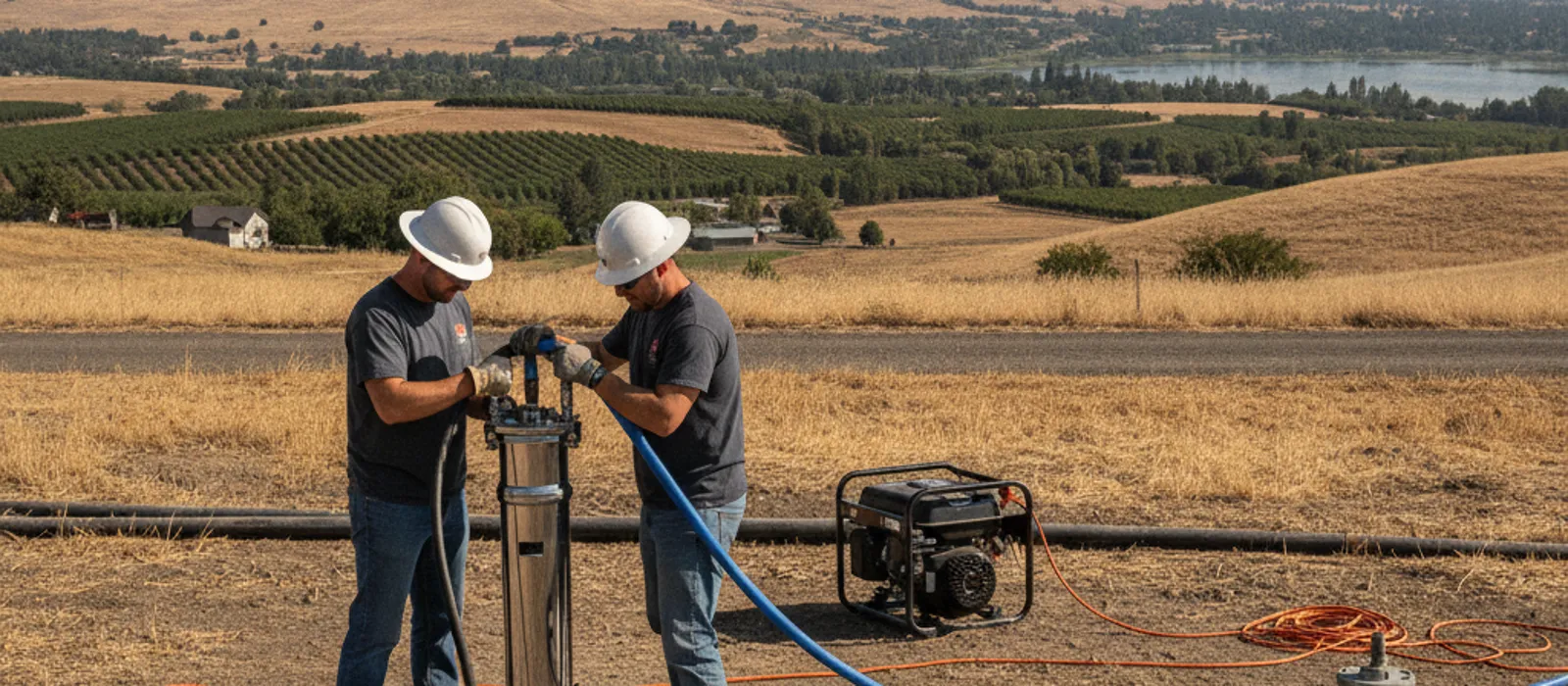
A half horsepower well pump only draws about 1,000 watts while it runs. So why does it stall a 2,000 watt generator dead in its tracks? One word: starting current.
If you live on a private well anywhere from Cashmere to Moses Lake, you already know the deal. When the power goes out, your water goes out with it. No flush, no shower, no stock tank, nothing. A generator for well pump backup is one of the smartest investments a rural homeowner in North Central Washington can make, but only if you size it right. Buy too small and the pump won’t start. Buy without a plan and you can cook a $1,500 motor.
This guide gives you the real numbers. You’ll learn why starting watts matter more than running watts, what size generator fits each pump, which type of generator makes sense for your place, and how to hook it up without hurting your pump or a lineman down the road.
Why a Generator for a Well Pump Needs Extra Muscle
Every electric motor pulls a big surge of current the instant it starts. Engineers call it inrush or locked rotor current. For a typical submersible well pump, that surge runs 3 to 5 times the normal running load, and it lasts less than a second.
That fraction of a second is where small generators die. Your 1/2 HP pump might cruise along at 1,000 watts, but it can demand 3,000 watts to get spinning. If the generator can’t deliver, one of two things happens. Either the generator’s overload protection trips, or worse, the voltage sags and the pump motor sits there straining on low power. That second scenario is the one that burns windings.
There’s another catch most folks miss. Almost every submersible pump around here runs on 240 volts, not 120. The little suitcase inverter generators that are so popular for camping only put out 120 volts. They can’t run your well pump at any wattage. You need a generator with a 240 volt outlet, usually a four prong L14-30 twist lock.
Dale in Cashmere learned this the hard way during the December windstorm in 2024. Power went out for 41 hours across his stretch of the valley. He had a nice 2,200 watt inverter generator in the shop, so he figured he was set. It ran the fridge and some lights fine, but it had no 240 volt outlet and nowhere near the surge capacity for his 1/2 HP pump. His family hauled water in buckets from a neighbor’s stock tank for two days. He called us the following week, and now he’s got a properly sized 6,500 watt unit and a transfer switch. Total cost was about $2,100 installed, less than one ruined holiday weekend.
Not sure what size pump is in your well? Call us at (509) 300-5151 and we’ll pull it from your well records or check it on site, free of charge. Knowing your pump’s horsepower is step one, and guessing wrong is expensive.
What Size Generator to Run a Well Pump: The Numbers
Here’s the sizing chart we hand to customers. Find your pump’s horsepower, then look at the minimum generator we’d actually recommend. The recommendation includes headroom for voltage stability and a few extra circuits like a fridge and some lights, because nobody buys a generator to run only the well.
| Pump size | Running watts | Starting watts | Minimum generator we recommend |
|---|---|---|---|
| 1/3 HP | ~750 | 1,500 to 2,000 | 3,500 W with 240V outlet |
| 1/2 HP | ~1,000 | 2,100 to 3,100 | 4,500 to 5,000 W |
| 3/4 HP | ~1,500 | 3,000 to 4,200 | 5,500 to 6,500 W |
| 1 HP | ~2,000 | 4,000 to 6,000 | 7,500 to 8,000 W |
| 1.5 HP | ~2,500 | 5,000 to 7,500 | 9,500 to 10,000 W |
| 2 HP | ~3,000 | 6,000 to 9,000 | 12,000 W or standby unit |
A few notes on reading that table. Generator makers advertise two numbers, running watts and peak or surge watts. The surge rating only lasts a few seconds, which is fine, because that’s all your pump needs. But don’t size right at the edge. A generator surging at its absolute limit lets voltage droop, and low voltage is harder on a pump motor than no voltage at all.
Deeper wells in our area change the math too. A home outside Leavenworth with a 400 foot well often runs a 1 or 1.5 HP pump, while a shallow well near the river in East Wenatchee might get by with 1/2 HP. If you’re curious why depth drives horsepower, our guide on how well pump sizing works breaks it down. And if you don’t know your well depth at all, it’s worth finding out before you buy anything.
One more wrinkle: pump age. An older pump with worn bearings draws more starting current than its nameplate suggests. If your pump is already showing its age, learn the warning signs of a failing well pump before you spend generator money propping it up.
Portable, Inverter, or Standby: Picking the Right Type
You’ve got three realistic options, and the right one depends on how often you lose power and how much hassle you’ll tolerate at 2 a.m. in January.
Open frame portable, 5,000 to 8,000 watts
This is the workhorse choice for most well owners around Wenatchee. Figure $700 to $1,500 for a quality unit with a 240 volt outlet. You wheel it out, fire it up, plug into a transfer switch or inlet box, and you’ve got water plus essentials. Downsides are noise, manual startup, and storing fuel. Run it outside only, at least 20 feet from the house, exhaust pointed away.
Large inverter generator, 6,500 watts and up
Quieter and easier on electronics, with cleaner power than open frame units. The catch is price. A 240 volt capable inverter unit big enough for a 1 HP pump runs $2,500 to $4,500. Worth it if your power flickers a lot and you also work from home off the same generator.
Standby generator, 10 to 22 kW
Permanently installed, runs on propane or natural gas, starts itself within seconds of an outage. For orchard properties, folks with livestock, or anyone out toward Chelan or Quincy where outages can stretch past a day, this is the gold standard. Installed cost typically lands between $7,000 and $15,000. Your well pump becomes a non-issue because the whole panel stays live.
Marcy, who runs a small horse property up Chumstick Highway outside Leavenworth, went through an ice storm in January 2025 that knocked her power out for 36 hours. Two horses drink 20 to 25 gallons a day between them, and she was melting snow on a propane burner by hour twelve. She put in a 12 kW standby unit that spring for $9,800. The next outage that fall lasted 14 hours, and she says the only way she knew was the text alert from the generator.
If you’re weighing options for your property, reach out for a free generator readiness assessment. We’ll check your pump’s horsepower, your pressure tank setup, and your panel, then give you straight numbers for each path. No pressure, no upsell.
Hooking It Up Without Frying Your Pump or Hurting Someone
This is the part where we get serious, because we see dangerous setups after every big outage.
Never backfeed your panel. That’s the trick where someone plugs a generator into a dryer outlet with a homemade double male cord. It energizes your whole panel, sure. It also pushes power backward through the utility transformer and out onto the lines, where it can kill a lineman working to restore your power. It’s illegal in Washington, it’s a fire risk, and there’s zero excuse for it when proper equipment is cheap.
The right ways to connect a generator for well pump duty:
- Manual transfer switch. A small subpanel next to your main panel with your critical circuits, including the well pump, wired through it. You plug the generator into an outdoor inlet box, flip the switch, done. Installed cost typically runs $500 to $1,000.
- Interlock kit. A metal slider on your main panel that physically prevents the main breaker and generator breaker from being on at the same time. Cheaper, usually $300 to $600 installed, and it lets you choose which circuits to run.
- Automatic transfer switch. Standard with standby generators. Power drops, the switch flips, the generator starts. You do nothing.
All three of those require an electrician. Pulling your well pump’s pressure switch wiring apart yourself is a fast way to create a bigger problem, and the pressure switch is fussy enough on its own without amateur wiring in the mix. Your safe lane as a homeowner is checking breakers, plugging cords into proper inlets, and flipping transfer switches. Leave everything past that to a licensed pro.
Rob, who farms 15 acres of alfalfa south of Quincy, found out what marginal power does to a motor. During a 2023 outage he ran his 1.5 HP pump on a borrowed 5,000 watt generator, right at the surge limit. The pump would groan, half start, trip the overload, and try again. He let it cycle like that for an afternoon. The low voltage starts overheated the windings, and three weeks later the motor failed at 11 years old, probably a couple of years early. New pump, installed at his depth, came to $3,400. We handled the well pump replacement, but a right sized generator would’ve been a tenth of that bill.
Mistakes We See After Every Big Outage
After fifteen plus years working wells from Lake Chelan down to Moses Lake, the same five mistakes show up every time the grid takes a hit.
Sizing off running watts only. The number one error. The pump label says 8 amps at 240 volts, someone multiplies that out to 1,920 watts, buys a 3,500 watt generator, and it won’t start a 1 HP motor. Always size off starting watts.
Forgetting the 240 volt requirement. Covered above, but it bears repeating. No 240 volt outlet, no well pump, period.
Letting the generator run out of gas under load. When a generator sputters and dies, voltage drops gradually instead of cutting clean. That brownout moment is rough on the pump motor. Refuel on a schedule, with the unit off and cool.
Ignoring the pressure tank. A healthy pressure tank means your pump starts less often, which means fewer of those demanding surge events on generator power. A waterlogged pressure tank can force the pump to kick on every time someone washes their hands. If your pump short cycles on utility power, fix that before an outage, not during one.
Skipping a test run. The middle of a February outage with frozen pipes threatening the pump house is a bad time to learn your setup doesn’t work. Test the whole chain twice a year. Start the generator, transfer over, run a faucet until the pump kicks on, confirm pressure recovers.
The Washington Department of Health recommends every household store at least one gallon of water per person per day for emergencies, and on a well that advice matters double. Their drinking water emergency guidance is worth a read. Stored water buys you time. A generator buys you normalcy.
And if an outage ends but your water doesn’t come back, don’t assume the pump is toast. Tripped breakers and pressure switch hangups after power events are common and cheap to fix. Our 24/7 emergency well service exists for exactly these moments, and the truck carries the parts that usually fail. You can also call (509) 300-5151 any hour and talk to a real tech, not an answering service.
The Bottom Line on Backup Power for Your Well
Here’s the short version. Find your pump’s horsepower. Multiply running watts by three to five for the starting surge. Buy a generator with a 240 volt outlet and surge capacity above that number, with room to spare. Connect it through a transfer switch or interlock installed by a licensed electrician, never a backfed outlet. Test the setup before you need it.
Private wells serve more than 40 million Americans according to the USGS overview of groundwater wells, and every one of those households is one storm away from the same problem. The difference between a rough week and a minor inconvenience is a machine you can size correctly in an afternoon.
We’ve helped hundreds of families across Chelan, Douglas, and Grant counties set up reliable backup water. We’ll tell you the honest minimum, not the biggest unit on the lot. Estimates are always free, and we’re licensed and insured in Washington.
Frequently Asked Questions
What size generator do I need for a 1/2 HP well pump?
Plan on a 4,500 to 5,000 watt generator with a 240 volt outlet. The pump runs at roughly 1,000 watts but needs 2,100 to 3,100 watts to start, and you want headroom so voltage stays stable. That size also leaves capacity for a fridge and some lights.
Can I run a well pump on a portable inverter generator?
Only if it’s a large unit with a 240 volt outlet, which usually means 6,500 watts or bigger. The small 2,000 to 3,000 watt suitcase inverters are 120 volt only and can’t power a standard submersible pump at all. Check the outlet panel before you buy, not after.
Do I need a transfer switch to run my well pump on a generator?
Yes, either a transfer switch or an interlock kit installed by a licensed electrician. Backfeeding through a dryer or welder outlet is illegal in Washington and can electrocute utility workers. A basic interlock install often costs $300 to $600, which is cheap insurance for something you’ll use for years.
Will running my well pump on a generator damage it?
Not if the generator is sized right and producing steady voltage. Damage happens when an undersized generator lets voltage sag during startup, forcing the motor to strain and overheat. If your pump groans, stutters, or trips the generator’s overload repeatedly, shut it down and step up to a bigger unit before you cook the motor.