Your faucets quit on the coldest morning of the year. Around here, that timing is almost never a coincidence.
When an arctic blast settles into the Columbia River valley and overnight temps drop into the single digits, frozen well pipes become the number one call we get. It’s stressful, especially on a rural property where there’s no city crew coming to help. The good news? Most freeze-ups can be thawed safely in a few hours, and almost all of them can be prevented for less than a couple hundred bucks.
This guide walks you through how to confirm the freeze, where to look first, how to thaw the line without burning down your pump house or burning up your pump, and how to make sure it never happens again. We’ll also cover what freeze damage actually costs in Chelan, Douglas, and Grant counties, with real numbers from real jobs.
If you’ve got no water right now and the thermometer reads 10 degrees, you can skip the reading and call us at (509) 300-5151. We run 24/7 emergency well service across the Wenatchee Valley, and frozen lines don’t wait for business hours.
How to Tell You’ve Got Frozen Well Pipes (Not a Dead Pump)
Before you grab a hair dryer, make sure freezing is actually the problem. A pump can fail in January just as easily as July, and the fix is completely different.
Here’s the quick test. Frozen pipes almost always follow a pattern:
- It happened overnight or during a cold snap. Water worked at 9 p.m., gone at 6 a.m., and the low was 15 degrees or colder. That’s the classic signature.
- The pump still runs. Stand near the pressure tank. If you hear the pump kick on and the pressure gauge climbs to its normal cut-off (usually 50 or 60 psi), water is reaching the tank. The blockage is downstream, somewhere between the tank and your faucets.
- Only some fixtures are dead. If the kitchen sink on an outside wall is dry but the bathroom works, you’ve got a localized freeze in the house plumbing, not a well problem at all.
- The pressure gauge reads zero and the pump won’t build pressure. Now the freeze may be upstream, in the pitless adapter, the line from the wellhead, or inside an unheated pump house. This is the more serious version.
If it’s not freezing weather and you’ve lost water, you’re probably looking at a different failure entirely. Our guide on what to check when you suddenly have no water covers breakers, pressure switches, and the other usual suspects.
One more warning sign worth knowing: a pump that runs and runs without building pressure against a frozen line can overheat fast. Submersible pumps are cooled by the water moving past them. Block that flow and the motor cooks. If your pump is running constantly with no water coming out, shut it off at the breaker before you do anything else. That one step can save you a $3,000 replacement.
Where Well Lines Freeze Around Wenatchee
In North Central Washington, the frost line runs roughly 24 inches deep, and properly buried supply lines sit below it. So the line itself, out in the yard, almost never freezes. The trouble shows up at the weak points where pipe gets close to cold air.
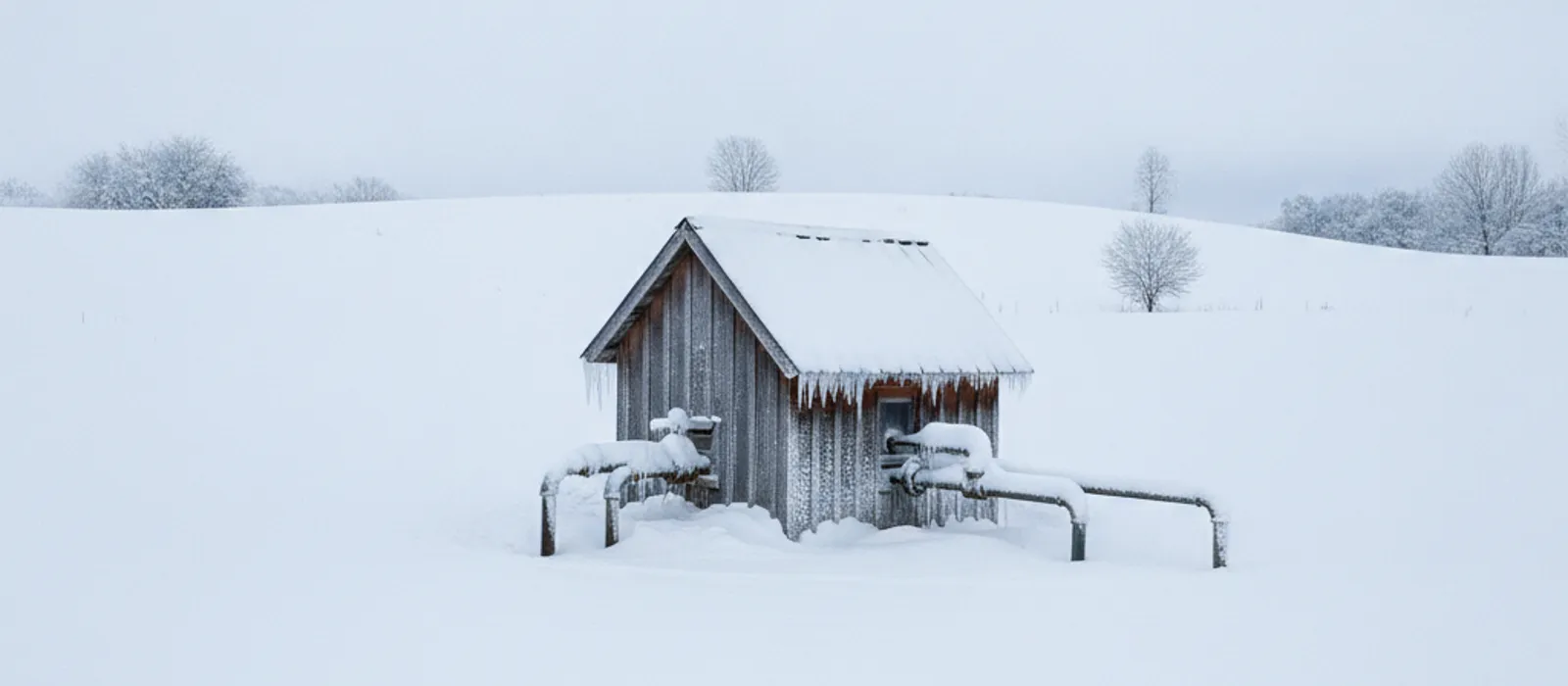
The pump house. Half the rural properties from Cashmere to Quincy have a small wellhead shed with a pressure tank inside. If the heat lamp bulb burned out in November and nobody noticed, the first hard cold snap freezes everything in that shed. This is far and away our most common freeze call.
The wellhead and pitless adapter. Older wells, especially pre-1980s setups, sometimes have shallow connections or above-grade plumbing at the casing. Wind chill on an exposed wellhead does real damage.
Crawl spaces and under mobile homes. The supply line comes up out of the ground into a vented crawl space, and that 3 feet of exposed pipe is the whole problem. Skirting gaps under manufactured homes around Moses Lake and East Wenatchee catch people every winter.
Frost-free hydrants that aren’t draining. A yard hydrant with a hose left attached can’t drain back, and it’ll freeze and split underground where you can’t see it until spring.
Marlene runs a vacation rental outside Leavenworth. During the January 2025 cold snap, lows hit minus 8 for four straight nights. Her guests left, the house sat at 50 degrees, and the supply line froze in the crawl space where insulation had fallen off a 4-foot run of pipe. The pump kept trying to push against the blockage and short-cycled itself for two days before anyone noticed. Total bill: $2,640 for a new pump and a thaw-out, all traceable to one missing piece of $12 foam insulation.
How to Thaw Frozen Well Pipes Safely
Thawing isn’t complicated, but doing it wrong is expensive. Follow this order.
Step 1: Shut off the pump
Flip the well pump breaker off, or unplug the pump if it’s a jet pump on a cord. You don’t want the pump running against a blocked line, and you don’t want it surging the second the ice lets go while you’re not ready.
Step 2: Open a faucet
Open the cold tap closest to where you think the freeze is. This gives melting water and steam somewhere to go, relieves pressure, and tells you the moment you’ve won. The first sputter from that faucet is your progress report.
Step 3: Add gentle, steady heat
Safe heat sources, in order of usefulness:
- A space heater in the pump house or crawl space, set a few feet from the pipe, never touching anything flammable.
- A hair dryer waved along the suspect pipe, starting from the faucet end and working back toward the well.
- Heat tape wrapped on the pipe and plugged in, which thaws and then prevents.
- Towels soaked in hot water wrapped around metal pipe, swapped every few minutes.
What’s never safe: open flame. No propane torches, no heat guns on high held in one spot, no charcoal anything. Every winter somebody in the valley melts a PVC fitting or starts a pump house fire trying to rush it. Plastic pipe fails around 140 degrees. A torch hits that in seconds.
Dale in Cashmere learned this one the hard way two winters back. His pump house line froze at 5 a.m., he was late for work, and the propane torch was right there on the shelf. He melted a 1-inch PVC elbow, flooded the pump house when the line thawed, and shorted his pressure switch. The freeze itself would’ve been a $200 fix. The torch turned it into $1,400.
Step 4: Be patient, then restore power
A typical pump house freeze takes 1 to 3 hours to thaw with a space heater. Once water flows steadily at your open faucet, turn the pump breaker back on, let the system build to full pressure, and check every joint and fitting you can see for drips. Ice expands about 9 percent as it forms, and it loves to split copper and crack fittings quietly. A pinhole leak you miss today is a flooded pump house next week.
If two or three hours of heat gets you nowhere, the freeze is probably underground or at the pitless adapter, and that’s specialized work. Request a free estimate and we’ll bring the right equipment instead of you guessing in the cold.
What Freeze Damage Costs in North Central Washington
Here’s what we actually see on invoices across Chelan, Douglas, and Grant counties. Prevention is the cheapest line on this table by a mile.
| Item | Typical cost (Wenatchee area) |
|---|---|
| Heat tape, insulation, heat lamp (prevention) | $50 to $300 |
| Professional thaw-out service call | $150 to $450 |
| Burst pipe repair, accessible above-ground | $250 to $900 |
| Pressure switch or gauge replacement | $150 to $350 |
| Pressure tank replacement after freeze split | $600 to $1,600 |
| Submersible pump replacement after dry-run damage | $1,800 to $4,500 |
| Pump house repair after flood or fire | $500 to $3,000+ |
The pattern is obvious. A $40 roll of heat tape protects you from a four-figure February. And freeze events tend to stack damage: the pipe splits, which floods the pump house, which soaks the pressure switch, which strands the pump. If your system took a hard freeze this past winter, even if it seems fine now, it’s worth having the pressure tank and fittings checked. Our well pump repair team in Wenatchee sees spring leaks from winter freezes every single year.
How to Prevent Frozen Well Pipes Next Winter
Every freeze call we run was preventable. Here’s the checklist we give our own neighbors, roughly in order of bang for the buck.
Insulate and heat the pump house. Foam board on the walls, weatherstripping on the door, and a thermostat-controlled heater or heat lamp set to kick on at 38 degrees. A thermo cube outlet costs about $15 and turns any lamp into a freeze guard. We wrote a full walkthrough on insulating a pump house properly if you want the details.
Wrap exposed pipe with heat tape. Anywhere supply line sees air, in the crawl space, at the wellhead, behind skirting, wrap it with UL-listed heat tape and cover it with foam pipe insulation. Follow the manufacturer’s instructions, and don’t overlap heat tape on itself.
Put a remote thermometer in the pump house. A $25 wireless sensor on your phone tells you the heat lamp died before the pipes do. Rick in Quincy installed one after a close call in 2024. Last December it pinged him at 11 p.m. when his pump house dropped to 34 degrees. Burned-out bulb, five-minute fix, zero damage. That sensor has already paid for itself a hundred times over.
Disconnect hoses and check hydrants. Pull every garden hose by Halloween so frost-free hydrants and spigots can drain.
Seal crawl space vents for winter. Close foundation vents and patch skirting gaps before the first hard freeze, then open them back up in spring.
Winterize vacant properties for real. Cabins around Lake Chelan and rentals in Leavenworth need either maintained heat or a full winterization with the lines drained. Half measures are how Marlene got her $2,640 bill. Our step-by-step well winterization guide covers the whole process.
The EPA’s private well owner resources are worth bookmarking too, since you’re the water utility on your own property. The Washington State Department of Health drinking water program also publishes good guidance for well owners statewide, including post-emergency steps.
One more thing on water quality. If a freeze cracked your well cap or flooded the wellhead, melting snow can carry bacteria into the well. After any freeze event that involved a damaged cap or standing water at the casing, test the water before you trust it.
When to Stop and Call a Pro
DIY thawing makes sense for accessible pipe in a pump house or crawl space. Stop and pick up the phone when:
- The pump won’t build pressure even after hours of heat, which points to a freeze at the pitless adapter or underground.
- You find a split pipe, a cracked tank, or water spraying anywhere.
- The pump breaker trips when you restore power. Don’t keep resetting it. Repeated trips mean electrical or motor trouble, and that’s not a homeowner job beyond the first reset.
- The pump ran dry against the blockage for more than a few minutes. It may have thermal damage even if it seems to work now.
- Anything electrical got wet. Pressure switches, control boxes, and standing water don’t mix, and 240 volts doesn’t give second chances.
We’ve thawed lines at 2 a.m. in Cashmere and swapped freeze-split tanks on Christmas Eve in East Wenatchee. It’s part of living in a valley where summer hits 100 and winter hits zero. If you’re staring at dry faucets right now, our emergency well service runs around the clock, and the estimate is free. Call (509) 300-5151 and we’ll get your water back.
Frequently Asked Questions
How cold does it have to get for well pipes to freeze?
Exposed pipe can freeze in 4 to 8 hours once air temps drop below about 20 degrees, faster with wind. Buried lines below the 24-inch frost line in our area are safe in any normal winter. The danger zones are pump houses, crawl spaces, wellheads, and anywhere pipe meets open air.
Will frozen pipes damage my well pump?
They can, and it’s usually the most expensive part of a freeze event. A submersible pump running against a blocked line loses its water cooling and can overheat in minutes. If your pump is running but nothing’s flowing, shut it off at the breaker immediately and thaw the line before restoring power.
Should I let a faucet drip during cold snaps?
Yes, on nights below about 10 degrees, a pencil-thin stream from the faucet farthest from the pressure tank keeps water moving and relieves pressure. It’s not a substitute for insulation and heat tape, though, and it makes your pump cycle more. Treat it as a backup, not the plan.
Can I pour hot water on a frozen well line?
On metal pipe, hot towels or careful hot water work fine as gentle heat. Never pour boiling water on frozen PVC or PEX, since the thermal shock can crack it, and never use an open flame on any pipe. A space heater or hair dryer is slower but doesn’t add a repair bill to the thaw.