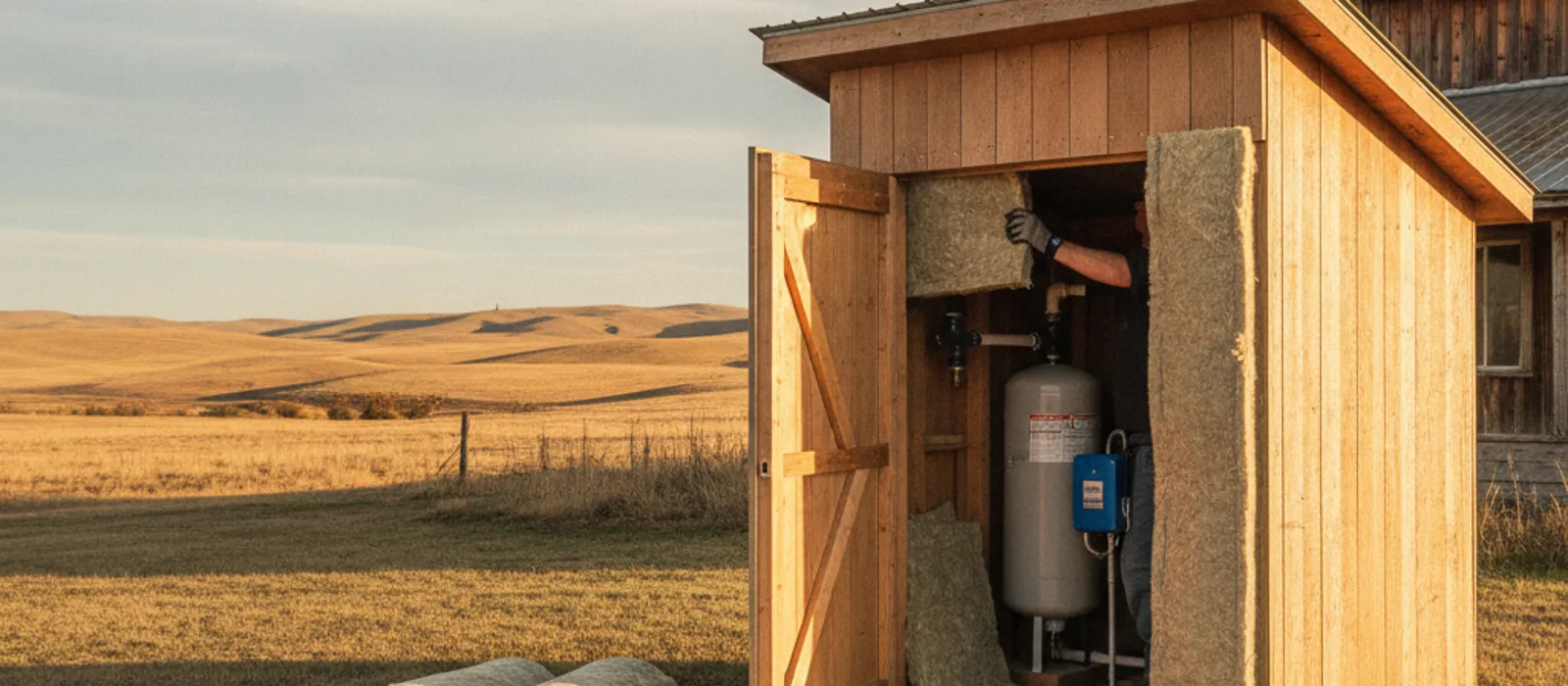
An uninsulated pump house in the Wenatchee Valley can drop below freezing in under three hours once the sun goes down in January. That’s all the time it takes to turn a $40 pressure switch and a few feet of pipe into a $1,500 emergency repair and a weekend with no water.
If you live on a private well out here, you already know our winters don’t mess around. Cashmere hit 9 below in the December 2022 cold snap. Quincy and Moses Lake sit out on open flats where the wind strips heat off a small building fast. The good news is that pump house insulation is one of the cheapest, highest-payoff projects a well owner can do. Most setups can be properly insulated for $150 to $600 in materials, and a weekend of work.
This guide covers what your pump house actually needs to stay above freezing, which insulation materials work best, when insulation alone isn’t enough, what it all costs, and the mistakes we see every winter that undo good work. If your gear already froze and you’re standing in a cold pump house right now, skip the reading and call us at (509) 300-5151. We run 24/7 emergency well service across Chelan, Douglas, and Grant counties.
Why Pump Houses Freeze in North Central Washington
Your well itself almost never freezes. The water table around Wenatchee typically sits 100 to 400 feet down, where ground temperature holds steady in the low 50s year-round. The danger zone is everything above ground: the pitless adapter connection, the supply line where it enters the building, the pressure tank, the pressure switch, the gauges, and all the copper or PEX plumbing inside that little shed.
Here’s what makes our area tough on pump houses:
- Big temperature swings. A sunny 38-degree afternoon in Wenatchee can fall to 8 degrees overnight when a cold front slides down the Columbia. Buildings that coast through mild cold get caught off guard.
- Wind. East Wenatchee bench properties and the open ground around Quincy and Moses Lake get steady winter wind. Wind doesn’t just lower the temperature, it forces cold air through every gap in the siding.
- Arctic outbreaks. Two or three times most winters, we get a stretch of single digits or below zero that lasts three to five days. That’s the event your insulation has to be built for, not the average December night.
- Neglect. Most pump houses were slapped together decades ago from scrap plywood. Nobody looks inside until the water stops.
Water expands about 9 percent when it freezes. Inside a rigid pipe or a pressure switch housing, that expansion has nowhere to go. The pipe splits, the switch cracks, and you find out at 6 a.m. when the shower runs dry. If that’s how you found this article, our post on what to do when you suddenly have no water walks through the first 15 minutes step by step.
What Pump House Insulation Actually Needs to Do
A pump house has one job in winter: hold the inside temperature above 32 degrees, every hour of every night, including the worst night of the year. Insulation does that by trapping two free heat sources you already have.
Ground heat. The earth under your pump house radiates heat all winter. A dirt or gravel floor is actually your friend here. That’s why old-timers built pump houses small and low. Less air to heat, more ground influence per cubic foot.
Equipment heat. Every time your pump runs, the motor and the pressure switch contacts give off a little warmth. A pump that cycles normally adds meaningful heat to a small, tight building.
Good pump house insulation keeps that heat in. The targets we recommend for our climate:
- Walls: R-13 minimum. R-19 if you’re in Leavenworth, Plain, or anywhere above 1,500 feet where cold pools in the valleys.
- Ceiling or roof: R-19 to R-30. Heat escapes up. The roof is the most important surface in the building and the one most often skipped.
- Air sealing everywhere. Insulation without air sealing is a sweater with no windbreaker. Foam or caulk every gap, especially where pipes and wires pass through walls.
- An insulated, weatherstripped door. A plywood door with daylight around the edges will erase everything else you did.
One thing insulation can’t fix: a pressure tank that’s already failing. A waterlogged tank makes the pump short cycle constantly, and while that extra run time technically adds heat, it’s burning up your motor to do it. If your pump clicks on every time you open a tap, read up on waterlogged pressure tank symptoms before winter, or have us check it during an insulation visit.
Don’t Forget the Floor Perimeter
If your pump house sits on a slab or skids, cold attacks from below and from the edges. Rigid foam board around the perimeter, buried 12 inches or skirted down to grade, blocks the wind from washing heat out from under the building. On dirt floors, leave the center open to the ground but seal the rim where walls meet earth.
Best Insulation Materials for a Pump House
Not all insulation belongs in a damp little building full of plumbing. Here’s how the common options stack up for insulating a pump house in our area.
| Material | Cost (8x8 pump house, walls + roof) | R-value per inch | Moisture tolerance | Best use |
|---|---|---|---|---|
| Rigid foam board (XPS/polyiso) | $250 - $450 | R-5 to R-6.5 | Excellent | Walls, roof, door. Our top pick. |
| Closed-cell spray foam (pro installed) | $600 - $1,200 | R-6 to R-7 | Excellent | Odd-shaped or leaky buildings |
| Fiberglass batts | $120 - $250 | R-3.2 | Poor when damp | Dry, well-built pump houses only |
| Mineral wool batts | $200 - $350 | R-4 | Good | Solid all-around choice |
| Foam pipe sleeves + tank blanket | $40 - $90 | R-2 to R-4 | Good | Always, on top of wall insulation |
Rigid foam board is the workhorse. It shrugs off the humidity a pump house generates, mice don’t nest in it the way they tunnel through fiberglass, and a homeowner can cut it with a utility knife. Glue or screw it to the studs, tape the seams, done.
Fiberglass is cheap but risky. A pump house is a humid space, and wet fiberglass loses most of its R-value and sags off the wall. If you go that route, cover it with a vapor-smart membrane and make sure the building sheds water properly.
Whatever you choose for the walls, also wrap the vulnerable parts directly. Foam sleeves on every exposed pipe, an insulating blanket on the pressure tank, and a foam box or insulated cover over the pressure switch (leave service access). Those small parts freeze first because they have the least thermal mass.
Want a second set of eyes before you buy materials? We do free estimates and we’ll tell you exactly what your setup needs, nothing more. Request a free pump house checkup here.
Insulation Alone Isn’t Always Enough: Add a Heat Source
In a typical Wenatchee or East Wenatchee winter, a tight, well-insulated pump house with a dirt floor often holds above freezing on its own. But “often” isn’t the standard. The standard is the minus-10 night with a 25 mph wind. For that, most pump houses need a small backup heat source.
Thermostatically controlled utility heater. A 250 to 500 watt heater with a built-in thermostat set around 40 degrees is the gold standard. It only runs during real cold, so it might cost you $10 to $30 in electricity for the whole winter. Buy one rated for unattended use, keep it off the floor, away from anything flammable, and plug it into a proper outlet, never a cheap extension cord coiled on the ground.
Heat tape on pipes. Self-regulating heat tape is excellent insurance on the supply line and any pipe run against an exterior wall. Install it under the pipe insulation, not instead of it, and replace it every 3 to 5 years. Old heat tape is a known fire starter.
The classic heat lamp. A 250-watt heat lamp works, and half the pump houses in the valley have one. The problem is the single point of failure. Here’s how that goes wrong.
Ray, who runs a small orchard outside Quincy, had a heat lamp that had kept his pump house safe for 11 winters. The bulb burned out on January 14th. He didn’t know until January 16th, when his pressure gauge, switch, and 4 feet of one-inch pipe had all split. The repair came to $1,180, plus two days hauling water for his house and shop. A $35 thermostat heater with a pilot light he could see from the kitchen window now backs up the lamp.
If you do use a lamp, use two bulbs on separate fixtures, or add a remote thermometer that alerts your phone. A $25 WiFi sensor is the cheapest well insurance you’ll ever buy.
One safety line we won’t cross, and you shouldn’t either: don’t rewire circuits, add outlets, or hardwire heaters yourself unless you’re qualified. Checking a breaker is fine. Beyond that, bring in an electrician. A burned-down pump house freezes very effectively.
What Pump House Insulation Costs Around Wenatchee
Here’s the math that should settle any hesitation. Compare prevention against what we actually charge to fix freeze damage.
| Item | Typical cost |
|---|---|
| DIY rigid foam insulation, full small pump house | $250 - $450 |
| Thermostat-controlled heater + WiFi temp sensor | $60 - $120 |
| Pro insulation and freeze-proofing visit | $400 - $900 |
| Replace cracked pressure switch + gauge (our service call) | $250 - $450 |
| Repair split pipes in pump house | $350 - $1,200 |
| Replace freeze-cracked pressure tank | $800 - $2,000 |
| Burst pipe floods pump house, pump motor damage | $1,500 - $4,000+ |
A full freeze event commonly hits two or three of those bottom lines at once. We’ve written up freeze-damaged systems over $5,000 when a split line ran all night and drowned the electrical. Meanwhile the entire prevention package, insulation, heat, and monitoring, usually lands under $600 if you do the labor yourself.
Marcy in Leavenworth learned the price difference the hard way two winters ago. Her pump house looked insulated, old fiberglass batts stapled up in the 80s. Mice had hollowed out the bottom two feet of every wall cavity. When it hit minus 8 over Christmas, her pressure tank tee and switch froze and cracked. Total bill: $1,420, on a holiday emergency rate. The following spring she spent $380 on foam board and a small heater. Last winter, the remote sensor in her pump house never read below 38.
Already past prevention and into damage? Our well pump repair team in Wenatchee handles freeze damage all winter, and if the tank took the hit, we do pressure tank replacement too, usually same-day. Frozen solid right now with no water? Call (509) 300-5151, we answer around the clock.
Five Mistakes That Undo Good Pump House Insulation
We inspect a lot of pump houses between October and March. The same five problems show up over and over.
1. Insulating the walls and skipping the roof. Warm air rises and leaves through an uninsulated roof like a chimney. If you only have budget for one surface, do the ceiling.
2. Sealing the building so tight the equipment can’t breathe, in summer. A pump house needs to be tight in winter but ventilated in summer, or condensation rusts your tank and fittings. Install a closable vent. Shut it in November, open it in April. Put it on your fall list along with the rest of our well winterization checklist.
3. Ignoring rodents. Mice destroy fiberglass, chew heat tape, and pack nesting material against heat lamps. Carl in East Wenatchee found that out when his heat tape failed in February. Mice had stripped the jacket off an 8-inch section. Steel wool and foam in every gap, and check inside twice a winter.
4. Leaving the door loose. Weatherstrip it, insulate it, latch it. A door that blows open on a windy night defeats the whole building. We’ve seen exactly that cause a freeze-up on a property near Chelan where everything else was done right.
5. No monitoring. You can’t see cold. A $25 wireless thermometer on a shelf in the pump house tells you the system is working, and warns you the night it isn’t. Pair it with a phone alert set at 36 degrees and you’ll always have a few hours to react.
One more thing worth saying: if the pipes between the pump house and your home run shallow, insulating the building won’t protect them. Supply lines in our area should be buried at least 4 feet down. If yours freeze underground, that’s a different fix, covered in our guide to thawing and preventing frozen well pipes.
For broader cold-weather guidance on protecting private well systems, the EPA’s private well owner resources are solid, and the Washington State Department of Health’s private well pages cover state-specific maintenance and water safety basics.
Frequently Asked Questions
What temperature should I keep my pump house at?
Set your thermostat or heater to hold 40 degrees. That gives you an 8-degree buffer above freezing without wasting electricity. The equipment doesn’t need to be warm, it just needs to stay above 32 every hour of the coldest night.
Can I just use a heat lamp instead of insulating?
You can, but you’re betting your plumbing on one bulb and one uninterrupted power supply. Insulation works with no electricity and no moving parts, then a small heat source covers the extreme nights. Do both, and add a temperature sensor so you know if the heat fails.
Does the well itself need insulation?
No. The well bore and the pump down in it sit far below the frost line where ground temperature stays in the 50s. Insulation matters from the pitless adapter up: the supply line entry, the pressure tank, the switch, and the exposed plumbing inside the pump house.
What if my pump house already froze and I have no water?
Shut off power to the pump at the breaker so it doesn’t run dry against a frozen or split line. Never thaw pipes with a torch or open flame. Gentle heat from a space heater can work if nothing has split, but if you see cracked fittings, ice in the switch, or water leaking as things thaw, stop and call us at (509) 300-5151. We handle frozen well systems across the valley 24/7.