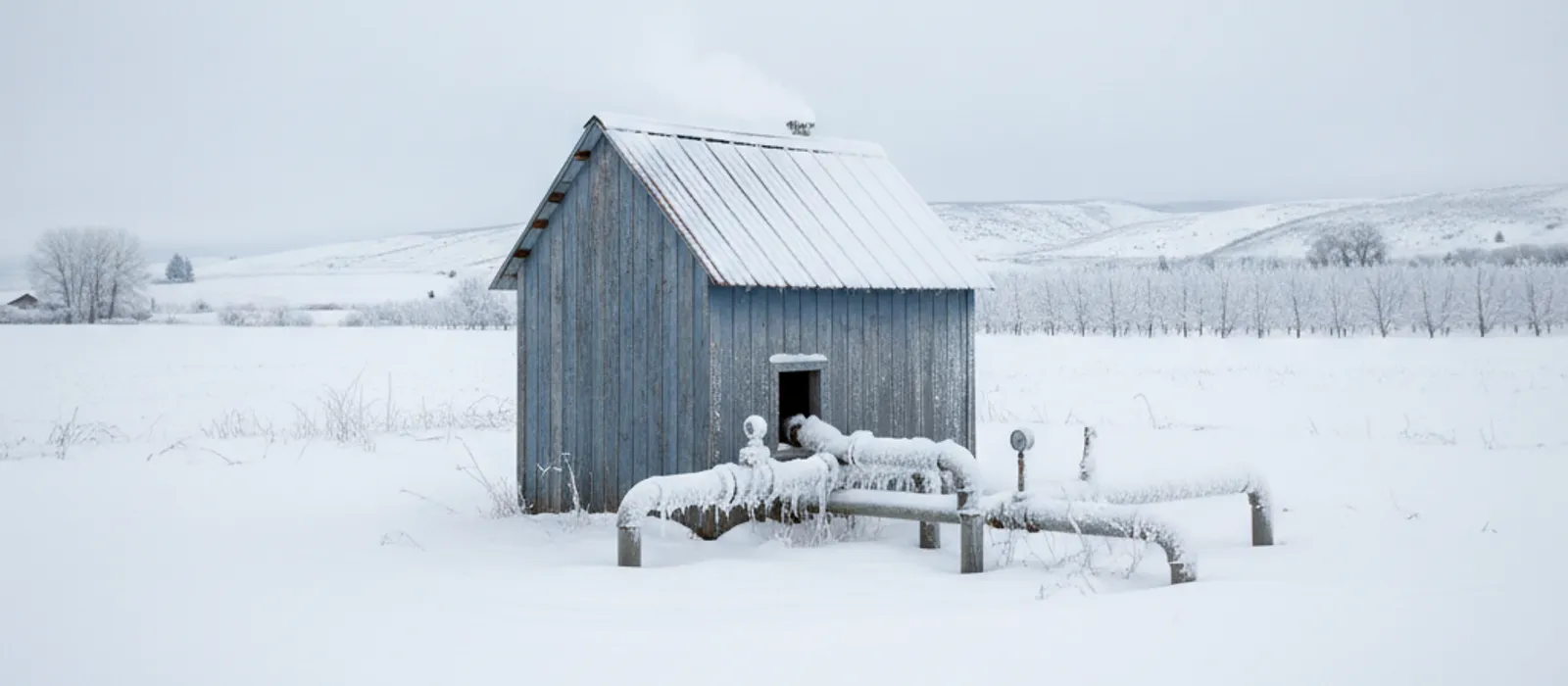
Last December, the temperature in Wenatchee dropped from 38 degrees to 4 degrees in less than 36 hours. Our phones didn’t stop ringing for five days straight.
Almost every one of those calls had the same story. No water, a frozen pipe somewhere between the well and the house, and a homeowner who’d been meaning to get to winterization “next weekend.” Here’s the good news: if you winterize your well pump and the lines around it before the first hard freeze, you can skip almost all of that misery. Most of the work takes one Saturday afternoon and costs less than a tank of gas.
In this guide, we’ll walk through why North Central Washington freezes are so rough on well systems, the exact steps to winterize your well pump and pressure tank, what it costs to prep versus what it costs to fix, and what to do if a cold snap is rolling in tonight and you’re not ready.
Why Wenatchee Freezes Hit Well Systems So Hard
Our climate is the problem. Wenatchee, East Wenatchee, and the whole Columbia River valley get hot, dry summers and then real winters. We routinely see stretches in the single digits, and up toward Leavenworth and Lake Chelan it gets colder still. Out in Quincy and Moses Lake, the wind makes everything worse by stripping heat off pump houses and exposed plumbing.
Water expands about 9 percent when it freezes. That expansion doesn’t care if it’s inside a 79 cent piece of PVC or a $600 pressure tank. It splits whatever it’s in.
The most vulnerable spots on a typical well system around here are:
- The pitless adapter and well cap area, if the casing sticks up and the frost line work was done poorly
- Above-ground pipe runs between the wellhead, the pump house, and the home
- The pressure tank, pressure switch, and fittings in an unheated pump house or crawl space
- Jet pumps mounted above ground, which hold water in the pump body itself
Submersible pumps sit 100 to 400 feet down the well, where groundwater stays around 50 degrees year round. The pump itself is safe down there. It’s everything between the pump and your kitchen faucet that freezes.
One more local wrinkle: a lot of homes in our valley are older orchard properties. The well was drilled in the 60s or 70s, the pump house was framed up out of leftover lumber, and the insulation is a horse blanket somebody draped over the tank in 1994. Those setups fail first, every single cold snap.
If you’d rather have a pro look the whole system over before the cold hits, schedule a free winterization checkup. It takes us about 45 minutes and you’ll know exactly where you stand.
How to Winterize Your Well Pump: A 7-Step Checklist
Here’s the same checklist our techs run for customers every October. Do these in order and you’ll have covered the failures that cause 90 percent of our winter emergency calls.
1. Inspect the well cap and casing
Walk out to your wellhead. The cap should be tight, undamaged, and sealed against the casing. A cracked or loose cap lets cold air pour straight down toward the pitless adapter, and it also lets mice and insects in, which is its own problem. If the cap is damaged, replace it before winter. It’s a $40 to $150 part in most cases.
2. Insulate every exposed pipe
Any pipe you can see above ground needs foam pipe insulation, minimum. That includes the line from the wellhead to the pump house, lines inside the pump house, and the pipe entering your home’s crawl space. Foam sleeves run about $3 to $6 per 6-foot section at the hardware stores in Wenatchee. Tape every seam. Gaps in pipe insulation are where freezes start.
3. Add heat tape to high-risk runs
For pipes in unheated spaces that have frozen before, foam alone isn’t enough. Self-regulating heat tape costs $25 to $80 per run and only draws power when temps drop. Wrap it per the manufacturer’s directions, plug it into a GFCI outlet, and put the insulation over the top. Test it in October, not in January.
4. Protect the pressure tank and switch
Your pressure tank holds 5 to 25 gallons of water at all times, and the pressure switch beside it has a small tube that freezes faster than anything else in the system. If the tank lives in an unheated pump house or crawl space, insulate the tank, the switch, and all the fittings. An insulated tank blanket costs about $30 to $60. While you’re in there, check the tank’s air charge. A waterlogged tank makes the pump cycle constantly and wears it out early.
5. Upgrade the pump house itself
A pump house should hold above freezing on a 0 degree night. That usually means insulated walls, a sealed door, no gaps at the pipe penetrations, and a thermostatically controlled heater or a simple heat lamp rated for the space. A 250-watt heat lamp on a thermo cube (it switches on at 35 degrees) costs about $35 total and has saved more well systems in Chelan and Douglas counties than we can count. We wrote a full guide on pump house insulation if yours needs more than a quick fix.
6. Drain anything you won’t use all winter
Irrigation lines, frost-free yard hydrants that aren’t actually frost-free anymore, hose bibs, and stock water lines should be drained and shut off. Disconnect every garden hose. A hose left attached traps water in the bib and freezes the pipe behind it, even on “frost-proof” spigots.
7. Make a cold snap plan
Know where your pressure tank shutoff valve is. Know where the well pump breaker is. Tape our number, (509) 300-5151, inside the pump house door. When something freezes at 11 pm on a Friday, you don’t want to be figuring this out from scratch.
Gary up in Leavenworth learned step 3 the expensive way two winters ago. His pipe run from the wellhead crossed about 18 feet of unheated crawl space with nothing but 30-year-old fiberglass batts sagging above it. The pipe froze on December 19th, split in two places, and dumped roughly 400 gallons under his house before he noticed the pressure drop. Between the pipe repair, the emergency call, and the crawl space cleanup, he was out about $2,300. The heat tape that would’ve prevented it: $55.
Don’t Forget the Pressure Tank, Pump House, and Power
Winterizing the pump lines is half the job. The other half is the equipment and the electricity that runs it.
Pressure switch failures spike in winter
The pressure switch is a small gray box, usually mounted near the tank, with a 1/4-inch tube feeding it. That tiny tube freezes first. When it does, the switch can’t read pressure, so it either never turns the pump on (no water) or never shuts it off (a pump running dry until it burns up). If your pump has been clicking on and off rapidly, deal with it before winter.
Power outages are part of winter here
Ice storms and heavy snow knock out power across Chelan, Douglas, and Grant counties every winter. No power means no pump, and no pump means no water and no moving water in the lines, which freezes faster. If outages hit your area regularly, a generator with a transfer switch sized for your pump is worth a hard look. Don’t wire it yourself. Pump circuits run 230 volts, and that’s licensed electrician territory.
Test your water while you’re at it
Fall is also the right time for an annual water test, since you’re already paying attention to the system. The EPA recommends private well owners test their water at least once a year, and the Washington State Department of Health has good guidance specific to our state’s private wells.
Marta, who runs a small orchard property outside Quincy, called us last fall for a winterization visit and almost canceled because “everything worked fine.” Our tech found her pressure tank had lost its air charge and was making the pump cycle 3 to 4 times more than it should. The pump was 14 years old. We replaced the tank for $675, and that pump is still running today. If it had short cycled through one more winter, she’d have been looking at a $2,800 pump replacement instead, probably during a January cold snap with a frozen access road.
If your tank is older or acting up, our pressure tank replacement service in Wenatchee can usually swap it in a single visit.
What Winterizing Costs vs. What a Freeze Costs
Here’s the math that convinces most people. These are typical numbers from jobs in our service area, not national averages.
| Item | Winterize Now | Fix After a Freeze |
|---|---|---|
| Foam pipe insulation (whole system) | $20 to $60 | Burst pipe repair: $350 to $1,200 |
| Heat tape on exposed runs | $25 to $80 per run | Emergency thaw and repair call: $400 to $900 |
| Heat lamp + thermo cube for pump house | $35 to $50 | Frozen pressure switch and fittings: $250 to $600 |
| Pressure tank blanket and air charge check | $30 to $60 | Split pressure tank replaced: $600 to $1,400 |
| Professional winterization visit | $150 to $250 | Burned-up pump from dry running: $1,800 to $4,500 |
| Typical total | $150 to $400 | $1,000 to $5,000+ |
The DIY version of the left column is a weekend project for most homeowners. The right column usually happens during the coldest week of the year, when every well company in the valley is slammed and parts are scarce.
A Hard Freeze Is Coming Tonight. Now What?
Sometimes the forecast jumps on you. If single digits are coming and you haven’t winterized, here’s emergency triage, in order:
- Open one faucet to a pencil-thin stream. Moving water resists freezing. Pick the faucet farthest from the pressure tank. Yes, it wastes a little water. It’s cheaper than a burst pipe.
- Open cabinet doors under sinks on exterior walls so house heat reaches the plumbing.
- Throw heat at the pump house. A shop light, a heat lamp, even a 100-watt incandescent bulb in a small enclosure can hold it above freezing. Keep anything hot away from insulation and never use open flame.
- Wrap exposed pipes with anything insulating. Towels and duct tape at 9 pm beat bare pipe at 2 am.
- Disconnect garden hoses if you haven’t.
If you wake up to no water, don’t immediately assume the pump died. In winter, a frozen line or frozen pressure switch is more likely than pump failure. Check the breaker first (resetting a breaker is fine, anything beyond that isn’t a DIY job). Then work through our guide on what to do when the water suddenly stops, and if you find ice, our post on frozen well pipes explains safe thawing. Go slow with gentle heat. A torch on a frozen pipe is how house fires start, and rapid thawing can split pipe that would’ve survived.
One warning we have to repeat every winter: never run a pump that isn’t moving water. If the line is frozen, the pump can dead-head or run dry, and a submersible pump cooking itself 200 feet down turns a $400 problem into a $3,500 one. If you’re not getting water, shut the pump breaker off and call someone.
That someone can be us, any hour. Our 24/7 emergency well service covers Wenatchee, East Wenatchee, Cashmere, Leavenworth, Chelan, Quincy, and Moses Lake. Frozen system at 2 am? Call (509) 300-5151 and you’ll get a human, not a voicemail.
When to Handle It Yourself and When to Call
Honest answer: most winterization is genuinely DIY-friendly. Foam sleeves, heat tape, draining hoses, sealing the pump house door. If you can run a screwdriver and read a label, you can do it.
Call a pro when:
- Your system has frozen before and you’re not sure why
- The pressure tank is more than 10 years old or losing its air charge
- The well cap, casing, or pitless adapter looks damaged
- Anything electrical beyond flipping a breaker is involved
- You bought the place recently and have never actually seen the whole system
The Hendersons in East Wenatchee fit that last one. They bought a 1978 rancher in August, had no idea the pressure tank sat in an uninsulated lean-to behind the garage, and found out during the first November freeze when the switch tube iced up. The fix that night was $385. The winterization visit that would’ve caught it: $175. They booked one for this fall before our truck left the driveway.
A fall winterization visit also doubles as a general health check on your pump, tank, and controls, which matters because most well pumps around here last 10 to 15 years and the failures cluster in winter. A planned replacement on a sunny day beats an emergency one in a blizzard.
Want it handled before the first cold snap? Book a free estimate and we’ll winterize the whole system, wellhead to pressure tank, in one visit.
Frequently Asked Questions
Do I need to winterize a submersible well pump?
The pump itself, no. It sits deep in the well where groundwater stays around 50 degrees all winter. What you’re really winterizing is everything above it: the wellhead area, exposed pipes, the pressure tank, and the pressure switch. Those are the parts that freeze in Wenatchee winters.
When should I winterize my well system in the Wenatchee area?
Aim for October, before the first hard freeze, which usually lands in November but can show up earlier in Leavenworth and the upper valley. Doing it early means parts are in stock and you’re not working in the cold. If you’ve missed the window and a freeze is forecast, do the emergency steps above and finish the full job during the next warm spell.
Should I leave a faucet dripping every cold night?
Only as a backup measure during extreme cold snaps, not as your whole plan. A pencil-thin stream from the farthest faucet keeps water moving through vulnerable lines, but it also makes your pump cycle more and wastes water. Proper insulation and a heated pump house protect the system without the nightly ritual.
What does professional well winterization cost?
In our service area, a standard winterization visit runs $150 to $250 depending on the size of the system and how much insulation or heat tape it needs. That typically covers a full inspection, pipe insulation, pressure tank and switch protection, and an air charge check on the tank. Compare that to $1,000 to $5,000 for a typical freeze-damage repair and it’s the cheapest insurance you’ll buy all year.