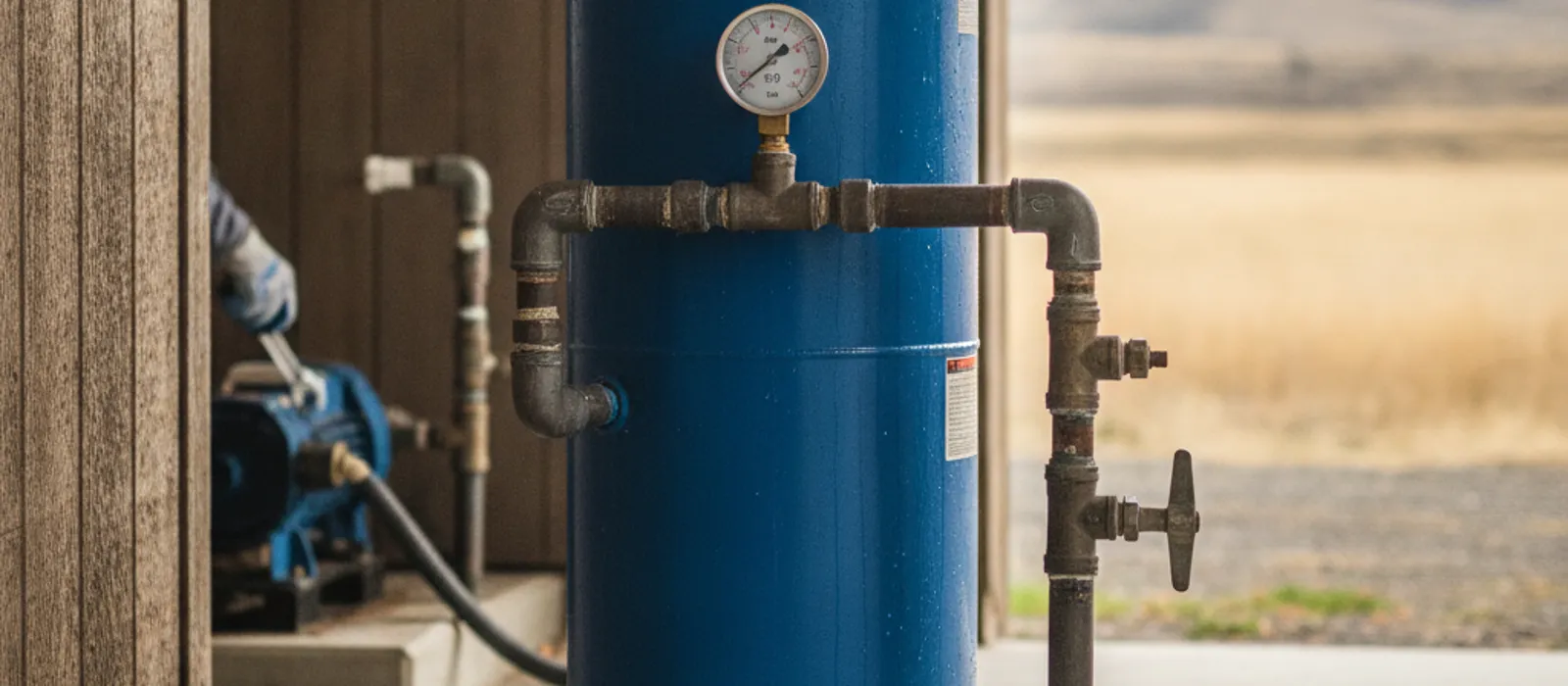
Your well pump is supposed to kick on a handful of times a day. If it’s clicking on every time you rinse a coffee mug, something’s wrong, and nine times out of ten the culprit is a waterlogged pressure tank.
It’s one of the most common problems we see across Wenatchee, East Wenatchee, and the whole Columbia River valley. It’s also one of the most expensive to ignore, because a waterlogged tank doesn’t just annoy you. It quietly grinds your well pump to death, turning a $400 tank problem into a $2,500 pump replacement.
The good news? Diagnosing a waterlogged pressure tank takes about ten minutes and a $10 tire gauge. In this guide we’ll cover the symptoms that give it away, what causes a tank to fill up with water, how to test yours, and exactly what the fixes cost in North Central Washington.
What a Waterlogged Pressure Tank Actually Means
Your pressure tank has one job: store water under pressure so your pump doesn’t have to run every single time you open a faucet. Think of it as a shock absorber for your whole water system.
Inside a modern tank is a rubber bladder or diaphragm. Water fills one side, compressed air sits on the other. When you open a tap, that air pushes water out into your pipes. The pump only starts once pressure drops to the cut-in setting, usually 30 or 40 PSI.
A waterlogged tank has lost that air cushion. Either the air charge leaked out over time, or the bladder tore and water flooded the whole tank. Either way, the tank is now mostly water with almost no compressed air doing the work.
Without the cushion, there’s no stored capacity. Open a tap and pressure crashes almost instantly, the pump slams on, pressure spikes, the pump shuts off, and the cycle repeats over and over. That rapid on-off pattern is called short cycling, and it’s brutal on pump motors, pressure switches, and check valves.
Here’s the part most homeowners don’t realize. Every pump start pulls a surge of electricity and creates a jolt of mechanical stress. A healthy system might see 30 to 50 starts a day. A waterlogged one can see 300 or more. Pumps are rated by lifetime starts, not years, so you’re burning through your pump’s life ten times faster.
If your pump is clicking on and off right now while you read this, don’t wait on it. Call Wenatchee Well Pros at (509) 300-5151 and we’ll get eyes on your tank, usually same day.
6 Symptoms of a Waterlogged Pressure Tank
You don’t need special tools to spot most of these. You just need to know what to look and listen for.
1. The pump clicks on and off constantly
This is the classic sign. Stand near your pressure switch and run a faucet. If you hear the switch click on, off, on, off every few seconds or every minute, your tank has lost its air cushion. We wrote a full breakdown of this in our guide to well pump short cycling, but a waterlogged tank is the number one cause.
2. Water pressure pulses at the tap
Strong, weak, strong, weak. If your shower surges in rhythm with the pump kicking on and off, that’s the missing air charge talking.
3. The tank feels heavy and cold top to bottom
A healthy bladder tank is water on the bottom, air on top. Rock it gently. If it won’t budge, or the whole tank sweats with condensation from top to bottom on a warm day, it’s likely full of water.
4. The pressure gauge bounces like a tachometer
Watch the gauge by your pressure switch while water runs. Healthy systems show a slow, steady climb and fall between cut-in and cut-out. A waterlogged system swings 20 PSI in seconds.
5. Air spitting from faucets
When a bladder ruptures, the trapped air charge mixes into your water. You’ll get sputtering, burping faucets for a day or two. If that’s your main symptom, our post on air in your water lines covers the other possible causes too.
6. Tapping the tank sounds dull everywhere
Knock on the upper third of the tank. It should ring hollow. If it thuds like you’re knocking on a full rain barrel, water has taken over the air space.
Gary in East Wenatchee heard that rapid clicking from his pump house for three weeks last summer and figured it was normal hot-weather behavior. By the time he called us, his 1.5 HP submersible had cooked its motor windings. The tank fix would’ve run him about $725 installed. Instead he paid $2,400 for a new pump and the tank. Three weeks of “I’ll deal with it later” cost him $1,700.
What Causes a Pressure Tank to Become Waterlogged
Tanks don’t waterlog for no reason. There are four usual suspects, and a couple of them hit harder here in Chelan, Douglas, and Grant counties than in milder climates.
A ruptured or torn bladder
The rubber bladder inside the tank flexes thousands of times a year. After 8 to 15 years it gets brittle and eventually tears. Once it does, water floods the air side and the tank waterlogs fast, often within days. There’s no patching a torn bladder. The tank gets replaced.
A slow air leak
Air can seep out through the Schrader valve on top of the tank, a hairline crack in a fitting, or right through the rubber itself over years. The bladder is intact, but the pre-charge bleeds down until there’s no cushion left. This one’s actually good news, because the fix can be as simple as adding air.
Sediment and hard water
Our wells in orchard country pull a lot of minerals. Hard water scale and fine sediment grind against the bladder every cycle and shorten its life. If your fixtures show white crust, your tank is aging faster than the brochure says. Iron and sediment in well water also clog the tank inlet, which makes symptoms worse.
An old-style galvanized tank
Plenty of older homes around Cashmere, Chelan, and Quincy still run pre-1980 galvanized tanks with no bladder at all. In those, the air and water touch directly, and the water slowly absorbs the air. Those tanks need their air charge restored every few months forever, or an upgrade to a modern bladder tank.
Marlene, on a place up Chumstick Highway outside Leavenworth, had the slow-leak version. Her 20-gallon tank had bled down from 38 PSI of pre-charge to 4 PSI over about six years. Her pump was starting roughly 200 times a day, and the pressure switch contacts were so pitted they’d started to stick. We recharged the tank, replaced the $90 switch, and her pump starts dropped back to about 40 a day. Total bill: $260. Her bladder was still good, so she dodged the big one.
How to Check Your Tank in 10 Minutes
You can confirm a waterlogged pressure tank yourself with a tire pressure gauge. Here’s the safe way to do it.
- Kill power to the pump at the breaker. This is the only electrical step you should do yourself, and it’s non-negotiable. Never work around a pressure switch with the power live.
- Drain the system. Open a faucet or the drain valve near the tank and let pressure fall to zero.
- Find the air valve on top of the tank. It looks just like a tire valve under a plastic cap.
- Check the pressure. Press your gauge on the valve. The reading should be 2 PSI below your pump’s cut-in pressure. On a 30/50 switch, that’s 28 PSI. On a 40/60 switch, 38 PSI.
- Watch for water. If water sprays out of the air valve instead of air, stop. The bladder is ruptured and the tank needs replacement. No amount of added air will fix it.
If the reading is just low and only air comes out, you can add air with a bicycle pump or small compressor up to the correct pre-charge, restore power, and watch the system for a week. If pressure holds, you just fixed it for free. If it bleeds down again, there’s a leak and it’s time to call.
One more number worth knowing: time the pump. From cut-in to cut-out, a properly sized tank should give you at least a minute of pump run time. If your pump runs 15 seconds and shuts off, the tank isn’t doing its job no matter what the gauge says.
Not comfortable poking around the pump house? That’s fair. Request a free estimate and we’ll test the tank, the switch, and your pump amp draw in one visit, anywhere from Moses Lake to Lake Chelan.
Fix Options and What They Cost Around Wenatchee
There are really only three fixes for a waterlogged tank, and the right one depends on what your 10-minute check found.
| Fix | When it applies | Typical cost (NCW) | How long it lasts |
|---|---|---|---|
| Recharge air to proper pre-charge | Bladder intact, slow air loss | Free DIY, or $150-$250 service call | Months to years if no leak |
| Replace pressure switch and recharge | Pitted or stuck switch from cycling | $200-$350 | 5-10 years |
| Replace tank (20-32 gal bladder) | Ruptured bladder, rusted tank | $600-$1,100 installed | 8-15 years |
| Replace tank (44-86 gal bladder) | Bigger homes, irrigation demand | $900-$1,800 installed | 8-15 years |
| Upgrade old galvanized to bladder tank | Pre-1980 systems | $800-$1,600 installed | 8-15 years |
A few notes on those numbers. Tank prices climbed in the last few years, so quotes from old forum posts will run low. Bigger is usually better here, because a larger tank means fewer pump starts and a longer pump life, and the price jump from a 32-gallon to a 44-gallon tank is often only $150 or so. We break the sizing math down in our full guide to well pressure tank cost.
Also factor in what the tank is protecting. A new submersible pump in our area runs $1,800 to $3,500 installed depending on depth and horsepower. Read up on the signs your well pump is failing, because if a waterlogged tank has been hammering your pump for months, it’s smart to have the pump’s amp draw tested before you sink money into just the tank.
Tom runs 15 acres of apples outside Quincy and learned the sizing lesson the hard way. His 20-gallon tank was undersized for his house plus frost-protection sprinklers, and it waterlogged twice in four years. We swapped him to an 86-gallon tank for $1,650. His pump starts dropped from about 180 a day during irrigation season to under 50, and his power bill dipped about $14 a month from fewer motor surges.
When the diagnosis points to replacement, our pressure tank replacement service in Wenatchee handles the whole job in a half day, including hauling off the old tank. And if the cycling has already taken your pump down with it, our well pump repair crew can usually get water flowing again the same day.
Why Tanks Fail Faster in North Central Washington
Our climate is hard on pressure tanks, and it helps to know why so you can get ahead of it.
Summers in the valley regularly top 95 degrees. A pump house or wellhead shed can hit 110 inside, and heat ages rubber bladders fast. Then winter swings the other way. A tank in an unheated pump house that freezes even once can crack fittings and stress the diaphragm. Decent insulation pays for itself, and it protects the rest of your system too.
Add our mineral-heavy groundwater, which scales up bladders and fittings, and the 8-to-15-year lifespan estimate often lands closer to 8 around here than 15.
The fix is simple: check your tank’s air charge every spring and fall. Put it on the calendar with your other well maintenance schedule items. The EPA recommends private well owners do an annual system checkup anyway, and their private well owner resources are worth bookmarking. The Washington State Department of Health also keeps good guidance for the roughly one in five Washington households on a private well.
One safety line we’ll draw clearly. Checking air pressure and adding air is safe homeowner work. Replacing a tank, rewiring a pressure switch, or anything involving the pump’s electrical supply beyond flipping the breaker is not. A 240-volt well circuit doesn’t give second chances. When in doubt, get a free estimate from our licensed techs instead of guessing.
Frequently Asked Questions
Can I fix a waterlogged pressure tank myself?
Sometimes. If the bladder is intact and the tank just lost its air charge, you can drain the system and add air to 2 PSI below cut-in with a bike pump or compressor. If water comes out of the air valve, the bladder is ruptured and the tank needs professional replacement. No air charge will hold in a torn bladder.
How long does a well pressure tank last?
Most bladder tanks last 8 to 15 years. In North Central Washington, hard water, hot pump houses, and freezing winters tend to push failures toward the earlier end of that range. Twice-a-year air checks and good pump house insulation buy you years.
What should my pressure tank’s air charge be?
Set the pre-charge 2 PSI below your pressure switch’s cut-in setting, measured with the pump off and the system drained to zero. That means 28 PSI for a 30/50 switch or 38 PSI for a 40/60 switch. Checking it with water pressure still in the tank gives a false high reading.
Will a waterlogged tank ruin my well pump?
Yes, given enough time. The short cycling it causes can multiply daily pump starts by ten, and pumps wear out by starts, not years. We routinely see pumps fail two to five years early behind a waterlogged tank, so treat constant clicking as urgent, not cosmetic.