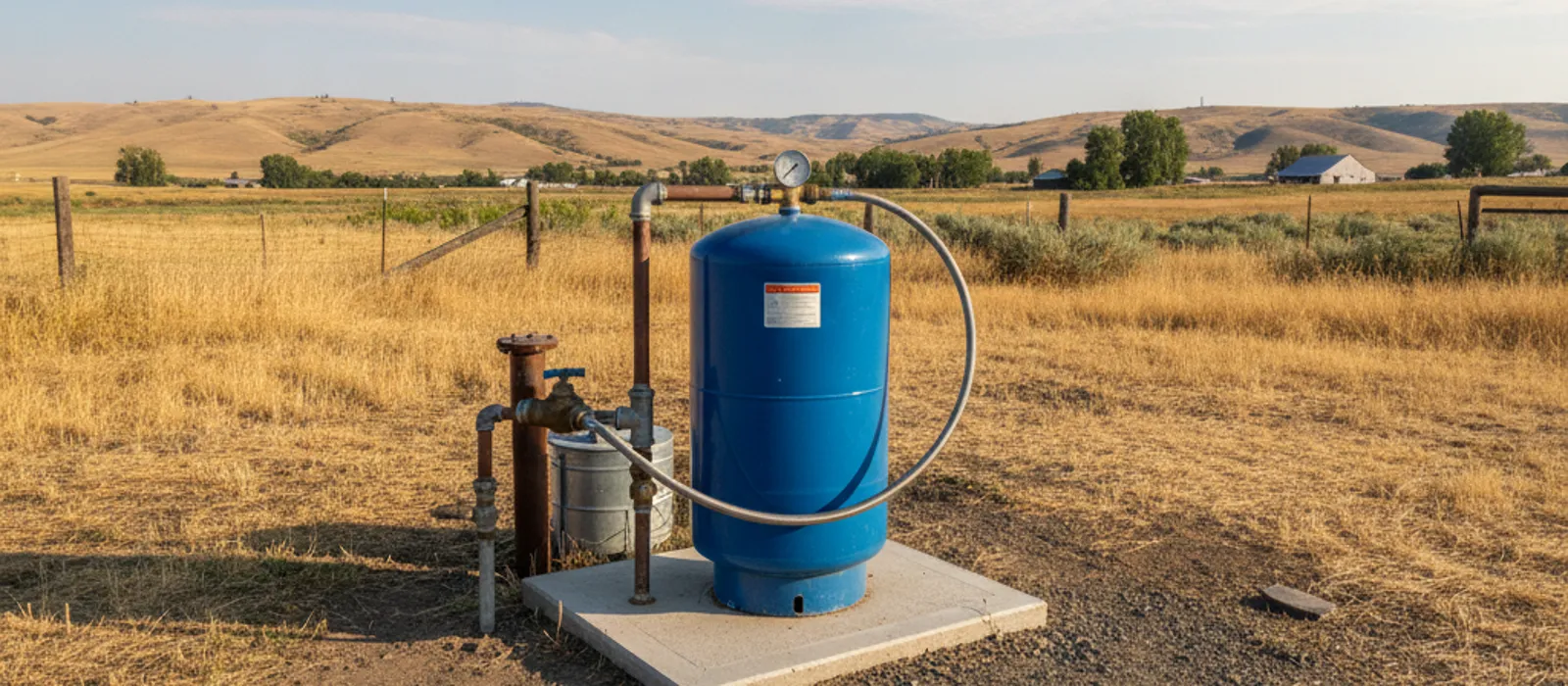
A healthy well pump kicks on maybe 30 to 40 times a day. A short cycling pump can rack up that many starts in a single hour, and every one of those starts hammers the motor harder than an hour of steady running.
If you’ve noticed your pump clicking on and off every few seconds, or the shower pressure pulsing strong-weak-strong while you rinse shampoo, you’re not imagining it. That’s well pump short cycling, and it’s one of the most common calls we get from Wenatchee to Moses Lake. The good news is that most of the causes are cheap to fix when you catch them early. The bad news is that ignoring it is the fastest way we know to turn a $200 repair into a $4,000 pump replacement.
In this guide we’ll walk through what short cycling actually is, the six causes behind almost every case we see in North Central Washington, what each fix costs, what you can safely check yourself, and when it’s time to put the wrenches down.
What Well Pump Short Cycling Actually Means
Your well system is built around a simple rhythm. The pump pushes water into a pressure tank, the tank stores it under air pressure, and a pressure switch turns the pump on and off at set points. Most systems around here run 40/60, meaning the pump kicks on at 40 psi and shuts off at 60 psi. Older systems often run 30/50.
In a healthy system, that cycle takes a while. You run a faucet, the tank drains down slowly, pressure drops to 40, the pump runs for a minute or two, pressure climbs back to 60, and the pump rests. One cycle might cover several toilet flushes and a sink full of dishes.
Short cycling means that rhythm has collapsed. The pump turns on, hits cutoff pressure within seconds, shuts off, and then immediately drops back to cut-in and starts again. On, off, on, off, sometimes every 10 to 30 seconds while water is running.
Here’s how to confirm it. Go to your pressure tank, usually in the pump house, garage, or basement, and run a faucet somewhere in the house. Watch the pressure gauge and listen for the click of the pressure switch. If the needle is swinging from 40 to 60 and back in under a minute, and the switch is clicking like a metronome, your pump is short cycling.
Why does it matter so much? Because starting is the hardest thing a pump motor does. A submersible pump pulls a big surge of current on every startup, and that surge heats the windings. Pumps are designed for a limited number of starts per day. The U.S. Environmental Protection Agency notes that more than 23 million households rely on private wells for drinking water (EPA private wells), and the single most expensive component in most of those systems is the pump sitting a few hundred feet down the casing. Around Wenatchee, where many wells run 200 to 400 feet deep, pulling and replacing that pump isn’t a small job.
If your pump is clicking on and off right now, don’t wait on it. Call us at (509) 300-5151 and we’ll usually have a tech out same day, often within a couple hours for no-water emergencies.
Why Your Well Pump Is Short Cycling: 6 Usual Suspects
Roughly nine out of ten short cycling calls we run in Chelan, Douglas, and Grant counties come down to one of these six causes. They’re listed in rough order of how often we see them.
1. A Waterlogged Pressure Tank
This is the big one. Your pressure tank has an air charge that acts like a spring, absorbing water and pushing it back out. In modern tanks, a rubber bladder or diaphragm keeps the air and water separated. When that bladder tears, or an old-style tank simply loses its air over time, the tank fills completely with water.
Water doesn’t compress. With no air cushion, even a small draw drops the pressure instantly, and the pump snaps on and off in seconds. We wrote a full breakdown on this in our guide to waterlogged pressure tanks, but the quick test is simple. Tap the side of the tank top to bottom. The top should sound hollow, the bottom dull. If it sounds dull and full all the way up, or the tank feels heavy and cold top to bottom, it’s waterlogged.
Rita in East Wenatchee heard her pump clicking from the garage for about three weeks last August. The showers pulsed, the sprinklers stuttered, but the water kept flowing, so she let it ride. By week four the pump motor had burned out from the constant starts. A $1,100 tank replacement turned into a $4,300 job once we had to pull and replace a submersible pump from 280 feet. She tells that story to her neighbors now so they don’t repeat it.
2. Wrong Air Precharge in the Tank
Sometimes the bladder is fine but the air charge behind it has drifted. The precharge should sit about 2 psi below your pump’s cut-in pressure. On a 40/60 system, that’s 38 psi. Too low and you lose your cushion. Tanks lose a little air every year, the same way a basketball goes soft in the garage. This is the cheapest fix on this list, sometimes just a service call and ten minutes with an air compressor.
3. A Failing Pressure Switch
The pressure switch is the little gray box, usually mounted on the pipe near the tank, that does the actual on-and-off work. The electrical contacts inside pit and burn over years of arcing. Debris or sediment can also clog the small tube that feeds pressure to the switch, making it read wrong and trigger erratically.
Marv up in Leavenworth had a pump cycling every 15 seconds last fall, right as the first freeze hit. His tank tested fine. The culprit was a 12-year-old pressure switch with contacts so pitted they chattered instead of closing clean. Total fix: $240 including the service call, and his system has run quiet since. If your gauge readings look normal but the switch is clicking fast or buzzing, start your reading with our post on pressure switch problems.
4. A Leak or Failed Check Valve
The check valve (or foot valve on jet pump systems) keeps water from draining back down the well when the pump shuts off. When it fails, pressure bleeds backward, the switch sees the drop, and the pump fires again even with every faucet closed.
The test is easy. Shut off all water in the house and watch the gauge. If pressure falls on its own, water is escaping somewhere, either back down the well through a bad check valve or out through a leak in a buried line. Out here in orchard country, we find plenty of leaks in old galvanized lines running from the wellhead to the house, especially on properties where the lines went in 40 years ago.
5. Clogged Filters, Sediment, or a Blocked Line
This one causes short cycling in the other direction. If a whole-house filter is plugged or a line is restricted, the pump builds pressure almost instantly against the blockage, hits cutoff, shuts down, and the trapped pressure bleeds through slowly until it cycles again. Wells in our area can move fine silt and sand, especially after a low water year, so a packed sediment filter is a frequent offender in Quincy and Moses Lake where irrigation wells work hard all summer.
6. An Oversized Pump or a Struggling Well
Less common, but real. A pump that’s too big for the well or the tank fills the system faster than the tank can buffer. And a well with a dropping water level can suck air, trip its low-water protection, and create cycling patterns that look similar. The Washington State Department of Ecology tracks well construction and groundwater levels statewide (Ecology well resources), and after a string of dry summers we’ve seen more marginal wells in the foothills around Cashmere and Chelan than we used to.
Not sure which of the six you’ve got? Request a free estimate and we’ll diagnose it on site. The inspection is part of the deal, and we’ll give you the real number before any work starts.
What It Costs to Fix, and What It Costs to Ignore
Here’s what these repairs typically run in the Wenatchee Valley as of 2026. Your number depends on access, well depth, and parts, but these ranges hold for most homes we service.
| Cause | Typical Fix | Typical Cost (Our Area) |
|---|---|---|
| Low air precharge | Recharge tank air, test bladder | $0 to $150 |
| Failed pressure switch | Replace switch, set pressures | $150 to $350 |
| Failed check valve | Replace valve | $300 to $700 |
| Waterlogged pressure tank | Replace tank | $600 to $1,500 |
| Leaking supply line | Locate and repair | $400 to $2,000+ |
| Burned-out submersible pump | Pull and replace pump | $2,500 to $5,500 |
Look at that bottom row. Every cause above it is a fraction of the price of the pump it’s destroying. A short cycling pump can log 500 or more starts a day. Motors rated for a 10 to 15 year life can cook themselves in weeks under that load. That’s the whole argument for acting fast, and it’s why we treat short cycling calls as urgent even when the water is still flowing. For context on what a normal pump lifespan looks like, see how long well pumps last.
How to Stop Well Pump Short Cycling: What You Can Safely Check
You can run a useful diagnosis yourself in about 20 minutes with a tire pressure gauge and your ears. Here’s the safe version.
Step 1: Confirm the Cycling
Run a faucet, watch the pressure gauge at the tank, and time the cycles. Under a minute from cut-in to cutoff and back means you’ve got a problem worth chasing.
Step 2: Check the Tank’s Air Charge
Turn off the breaker to the pump. Open a faucet and let the system drain to zero pressure. Find the air valve on top of the tank, it looks just like a tire valve, and check it with a tire gauge. You want about 38 psi on a 40/60 system, 28 psi on a 30/50. If water spits out of the air valve, stop. The bladder is torn and the tank needs replacement.
Step 3: Test for Leak-Back
Restore power, let the system pressurize, then shut off every fixture and watch the gauge for 15 to 30 minutes. Falling pressure with no water running points to a check valve or a leak.
Step 4: Check Your Filters
If you have a whole-house sediment filter, look at the cartridge. If it’s brown and packed, swap it and see if the cycling stops.
That’s where the do-it-yourself list ends, and we mean it. Don’t open the pressure switch cover while the power is on, and don’t work inside any electrical box at all. Pressure switches carry 240 volts, and a wet pump house floor makes a bad combination. Breaker on, breaker off, that’s your lane. Anything past that is ours.
Carla, who runs a small orchard property outside Quincy, did exactly this last June. She timed the cycles, checked the tank air, found it at 12 psi with no water at the valve, and called us. We recharged the tank, tested the bladder, and had her irrigation back to normal for a $140 service visit. Total downtime, one morning. That’s the version of this story we like telling.
When to Stop and Call a Well Pro
Call a professional right away if any of these apply:
- Water comes out of the tank’s air valve (torn bladder)
- The pressure switch is buzzing, sparking, or hot to the touch
- The breaker for the pump keeps tripping
- Cycling continues after you’ve corrected the air charge and swapped filters
- You’ve lost water entirely
Short cycling is a symptom, and the clock is running on your pump motor the whole time it continues. We handle pressure tank replacement in Wenatchee and the surrounding valley daily, and our well pump repair techs carry switches, tanks, and check valves on the truck, so most short cycling jobs are done in one visit. We’re licensed and insured in Washington, estimates are free, and we answer the phone at 2 a.m. because no-water emergencies don’t keep business hours.
Hearing that click-click-click from the pump house? Give us a ring at (509) 300-5151, day or night, and we’ll get your system back into a healthy rhythm before the motor pays the price.
Frequently Asked Questions
How many times a day should a well pump turn on?
A properly sized system usually cycles 30 to 50 times a day for a typical household, more during heavy irrigation. The better measure is cycle length. If your pump runs less than a minute between cut-in and cutoff, or restarts within seconds of shutting off, it’s short cycling and needs attention.
Can I still use my water while the pump is short cycling?
You can, but every hour of use stacks more starts on the motor and shortens its life. Treat it like driving with the oil light on. Use water sparingly, do the basic checks above, and get the underlying cause fixed within days, not weeks.
Will adding air to my pressure tank fix short cycling?
Sometimes, yes. If the bladder is intact and the precharge has simply drifted low, recharging to 2 psi below cut-in pressure solves it. If water comes out of the air valve or the tank waterlogs again within weeks, the bladder is torn and the tank needs to be replaced.
How much does it cost to fix a short cycling well pump?
In the Wenatchee area, most fixes land between $150 and $1,500 depending on the cause. A pressure switch runs $150 to $350, a new tank installed is usually $600 to $1,500. Wait too long and a burned-out submersible pump pushes the bill to $2,500 to $5,500, which is exactly why early diagnosis pays.