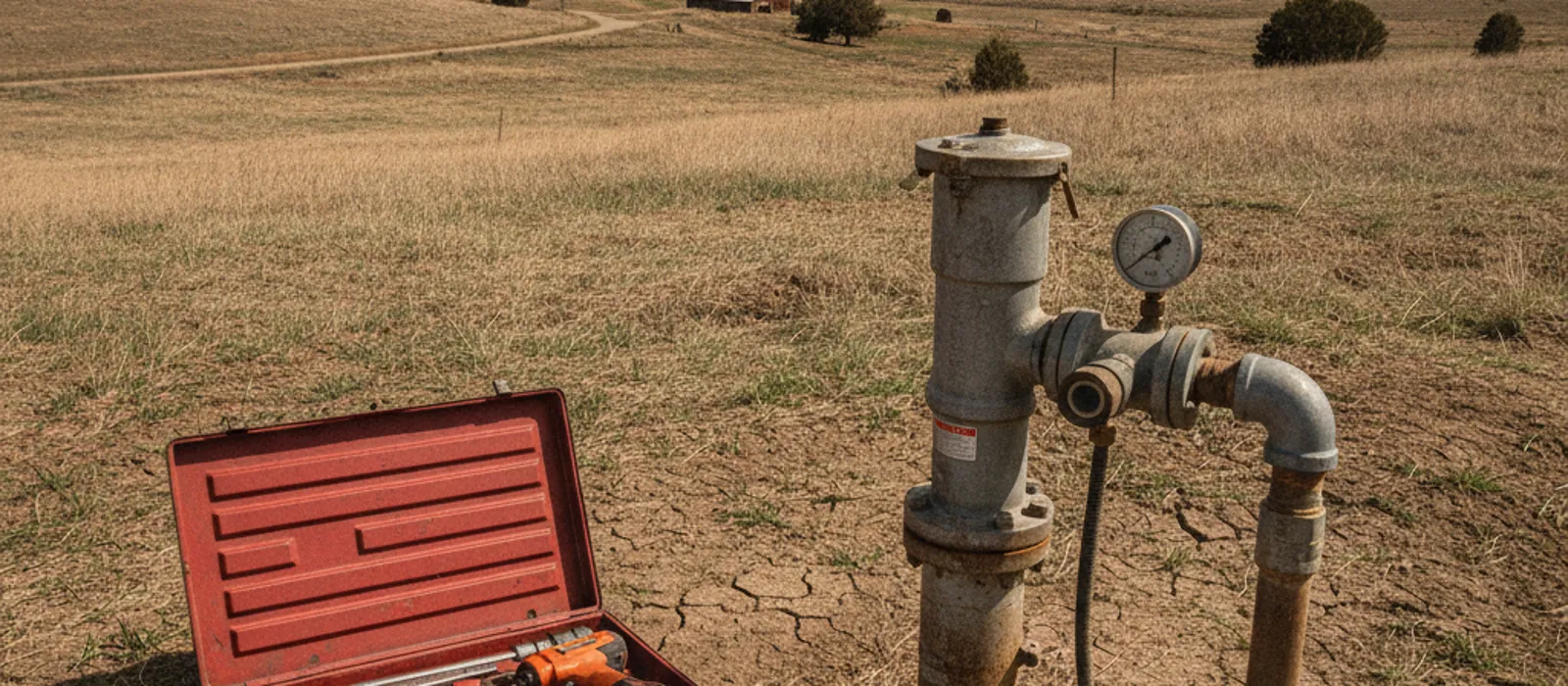
A well pump that never shuts off can destroy itself in a matter of days. And a new submersible pump installed in the Wenatchee Valley runs $1,800 to $4,500. So if the hum from the pump house never stops, your instincts are right. Something’s wrong, and waiting makes it more expensive.
Here’s the good news. When a well pump runs constantly, the cause is almost always one of six things, and several of them are cheap fixes. A stuck pressure switch might cost you $200. Ignore it for a month and you could be looking at a cooked motor and a full replacement.
In this guide we’ll walk through all six causes, what each one costs to fix here in North Central Washington, how to narrow down which one you’ve got, and what to do tonight to protect your pump.
Why a Well Pump Runs Constantly (and Why You Shouldn’t Wait)
A healthy well system works in cycles. The pump kicks on when pressure in your tank drops to the cut-in point, usually 30 or 40 psi. It runs for a minute or two, builds pressure back up to the cut-off point, usually 50 or 60 psi, and shuts down. Then it rests until you use enough water to drop the pressure again.
When the pump runs nonstop, one of two things is happening. Either the system can’t reach that cut-off pressure no matter how long the pump runs, or the pressure switch isn’t telling the pump to stop. That’s it. Every cause on this list falls into one of those two buckets.
Why does it matter so much? Three reasons:
- Motor burnout. Pump motors are built to cycle, not run 24/7. Continuous running overheats the motor windings and chews up bearings. A pump that had five good years left can fail in a week.
- Your power bill. A typical 1 HP submersible pulls around 1,000 to 1,500 watts. Run it around the clock and you’re adding $80 to $130 a month to your Chelan or Douglas County PUD bill.
- Dry running. If the pump is running because the well level dropped, it may be sucking air part of the time. Running dry is the fastest way to kill a submersible pump. Period.
If your pump has been running constantly for more than a day, don’t gamble with it. Call us at (509) 300-5151 and we’ll talk you through a quick check over the phone, free, before anything gets damaged.
The 6 Reasons a Well Pump Won’t Shut Off
These are listed from cheapest to most expensive, which is also roughly the order we check them in.
1. A stuck or failed pressure switch
The pressure switch is the brain of your system, and it’s a $30 part. Inside are electrical contacts that open and close as pressure changes. Those contacts can pit, burn, and weld themselves shut. When they stick closed, the pump gets a “run” signal forever, even with the tank at full pressure.
Sediment is the other culprit. Wenatchee Valley wells pull plenty of fine sand and mineral grit, and it loves to clog the little tube that feeds pressure to the switch. The switch never “sees” the pressure rise, so it never shuts the pump off.
Signs it’s the switch: the pressure gauge reads at or above the cut-off point but the pump keeps running. We cover the full diagnosis in our guide to pressure switch problems.
Important safety note: the switch has live 240-volt wiring inside. Flipping the breaker off is fine. Opening the switch cover and poking at contacts is not a homeowner job.
2. A waterlogged pressure tank
Your pressure tank holds a cushion of compressed air that pushes water into the house between pump cycles. When the air bladder fails or the air charge leaks out, the tank fills completely with water. No air cushion means pressure swings wildly, and the pump either short cycles or runs nonstop trying to satisfy a tank that can’t hold pressure.
Quick test: push the pin on the air valve at the top of the tank. If water comes out instead of air, the bladder’s shot and the tank needs replacing. A new tank installed typically runs $600 to $1,400 around here depending on size. You can read more about diagnosing a waterlogged pressure tank before you call.
Rita in East Wenatchee had this one. Her pump had been running almost constantly for three weeks, and she figured it was just irrigation season. Her electric bill jumped $74 before she called us. The bladder in her 20-year-old tank had ruptured, and the pump was straining nonstop against a tank full of water. We swapped in a new 32-gallon tank for $1,050 and her pump went back to running 90 seconds at a time. The pump survived, barely. The motor was already running hot to the touch.
3. A leak between the well and your house
If water is escaping somewhere, the system may never build enough pressure to hit cut-off. The pump just keeps chasing a target it can’t reach. The leak can be in the drop pipe inside the well, at the pitless adapter where the line exits the casing, or anywhere along the buried line to the house.
Out here, frost heave and rocky orchard ground are hard on buried lines. So are 40-year-old galvanized drop pipes that rust through at the threads. Look for a soggy patch in the yard that never dries out, unusually green grass in a strip between the wellhead and the house, or sand and air sputtering at your faucets.
Marv, on an orchard property outside Cashmere, heard his pump kick on at 6 a.m. one March morning and noticed it still running at noon. He also had a muddy soft spot in his gravel driveway that hadn’t been there a week earlier. The buried line had split at a 35-year-old fitting. The repair was $1,800 including excavation. If he’d let the pump grind away another few weeks, he’d likely have added a $3,500 pump replacement on top of it.
4. A bad check valve or foot valve
The check valve keeps water from draining back down the well when the pump shuts off. When it fails, pressure bleeds backward into the well, the system loses pressure constantly, and the pump runs and runs to compensate. On older jet pump systems, the foot valve at the bottom of the well does the same job and fails the same way.
The telltale sign: shut off all water in the house and watch the pressure gauge. If pressure steadily drops with nothing running and no wet spots in the yard, water is going back down the well. Replacement usually means pulling the pump, so cost depends on depth, but $400 to $900 covers most check valve jobs in our area.
5. A worn-out pump that’s lost its punch
Pumps wear out. Impellers erode, especially in wells that produce sand, and motors lose efficiency. A tired pump might still move water, just not enough to ever reach 60 psi. So it runs forever, delivering weak pressure the whole time.
This one shows up gradually. Pressure that’s been slowly getting worse for months, a pump that’s 15 to 20 years old, maybe some grinding or whining from the pump house. If that sounds familiar, check our rundown of the signs your well pump is failing. At this stage you’re usually weighing repair against replacement, and our well pump replacement service in Wenatchee can give you a straight answer on which makes sense. We’ll tell you if a $300 fix buys you five more years. Sometimes it does.
6. A dropping water table or low-yield well
Sometimes the pump is fine and the well itself is the problem. If the water level drops below the pump’s effective reach, or close to it, the pump can’t deliver enough flow to build pressure. It runs constantly, often pulling air, which makes everything worse.
This is a real issue in our region. Hot, dry summers plus heavy irrigation draw down aquifers across Chelan, Douglas, and Grant counties, and the Washington Department of Ecology tracks well levels for exactly this reason. Late July through September brings the most calls about it.
Carla, on five acres near Quincy, started losing pressure every August like clockwork. By the third summer her pump was running nearly 24/7 during irrigation season. Her static water level had dropped about 30 feet over a decade. We lowered her pump 40 feet deeper in the well for $850, and the problem disappeared. If your situation is worse, you may be looking at hydrofracking or deepening the well, which is a bigger conversation. Our article on what happens when a well runs dry walks through the options.
What Each Fix Costs in the Wenatchee Valley
Here’s what we actually see on invoices across Wenatchee, East Wenatchee, Cashmere, Leavenworth, Chelan, Quincy, and Moses Lake. Your number depends on well depth, access, and parts.
| Cause | Typical Repair | Local Cost Range |
|---|---|---|
| Stuck or failed pressure switch | Replace switch, clean sediment from nipple | $150 to $350 |
| Waterlogged pressure tank | Replace tank | $600 to $1,400 |
| Bad check valve or foot valve | Pull pump, replace valve | $400 to $900 |
| Leak in drop pipe or buried line | Repair pipe, excavation if buried | $500 to $2,500 |
| Worn-out pump | Replace submersible pump | $1,800 to $4,500 |
| Dropping water level | Lower pump deeper in well | $600 to $1,500 |
| Severely low-yield well | Hydrofrack or deepen well | $3,000 to $10,000+ |
Two takeaways from that table. First, the cheap problems become the expensive problems if you let the pump keep grinding. A $250 switch fix ignored for a month can turn into a $3,500 pump replacement. Second, you can’t price the job until you know the cause, so be skeptical of anyone quoting a firm number over the phone without asking questions.
Want a real diagnosis instead of a guess? Request a free estimate and we’ll put a gauge on the system and give you the actual number before any work starts.
How to Narrow It Down Before You Call
You don’t need to diagnose this yourself, but ten minutes of observation saves time and money. Here’s a safe homeowner checklist:
- Read the pressure gauge. If it reads at or above 55 to 60 psi while the pump runs, suspect the switch. If it’s stuck low and not climbing, the system can’t build pressure: think leak, tank, valve, pump, or water level.
- Shut off water to the house. Close the valve between the pressure tank and the house plumbing. If the pump finally catches up and shuts off, your problem is on the house side, maybe a running toilet or a leaking irrigation zone, not the well at all.
- Test the tank’s air valve. Press the pin briefly. Water spraying out means a waterlogged tank.
- Walk the line. Look for wet ground, lush grass strips, or sinkholes between the wellhead and the house.
- Listen and feel. A pump or motor that’s screeching, grinding, or too hot to touch is telling you it’s near the end. Kill the breaker.
That’s where homeowner diagnosis should stop. Anything involving the switch wiring, pulling the pump, or opening the well cap is licensed-contractor territory, both for safety and because Washington regulates work on wells. The EPA’s private well program is also a solid resource for understanding how your system fits together, since nobody is inspecting a private well for you.
What to Do Tonight if Your Well Pump Runs Constantly
If you can’t get a tech out until tomorrow, do this:
- If the gauge shows good pressure but the pump won’t stop, flip the pump’s breaker off. You’ve got a tank full of pressurized water that will cover toilet flushes and hand washing for a while. Flip it back on when you need to refill, then off again. This babysitting routine protects the motor.
- If the pump is running and you have little or no water, shut the breaker off and leave it off. The pump may be running dry, and every hour it runs could be the hour that kills it.
- If you hear grinding, smell hot electrical, or see a tripped breaker that won’t reset, leave everything off and don’t troubleshoot further.
A pump running constantly overnight isn’t a “wait until Monday” problem in July heat with livestock, orchard blocks, or a houseful of kids depending on that well. That’s why we run 24/7 emergency well service across the valley. No water at 2 a.m.? Call (509) 300-5151 and you’ll get a person, not a voicemail.
One more thing. The opposite problem, a pump that clicks on and off every few seconds, has its own set of causes and is just as hard on the motor. If that’s what you’re hearing, read our piece on well pump short cycling instead.
Frequently Asked Questions
How long can a well pump run continuously before it’s damaged?
Most submersible pumps can handle a few hours of continuous running if they’re fully submerged and moving water. The danger zone is multi-day continuous running, which overheats the motor, and any amount of dry running, which can destroy a pump in minutes. If your pump has run nonstop for more than 24 hours, shut it off at the breaker until it’s diagnosed.
Is it safe to just turn off the breaker to my well pump?
Yes. Flipping the dedicated breaker for the pump is a normal, safe homeowner step, and it’s exactly what we recommend while you wait for service. Your pressure tank will still supply some water afterward. What you shouldn’t do is open the pressure switch cover or touch any wiring, since the switch carries live 240-volt power.
How much does it cost to fix a well pump that runs constantly?
In the Wenatchee area, the most common fixes range from about $150 for a pressure switch up to $4,500 if the pump itself needs replacing. Most calls we run for this problem land between $200 and $1,400, because switches, tanks, and check valves cause the majority of cases. An honest diagnosis comes first, and estimates are free.
Why does my well pump run constantly only in summer?
Two usual suspects. Heavy summer irrigation can simply outpace what your pump or well can deliver, so the pump never catches up while sprinklers run. Or your well’s water level drops in late summer as the aquifer draws down, which is common in Chelan, Douglas, and Grant counties. A flow test will tell you which one you’re dealing with, and lowering the pump often solves the second.