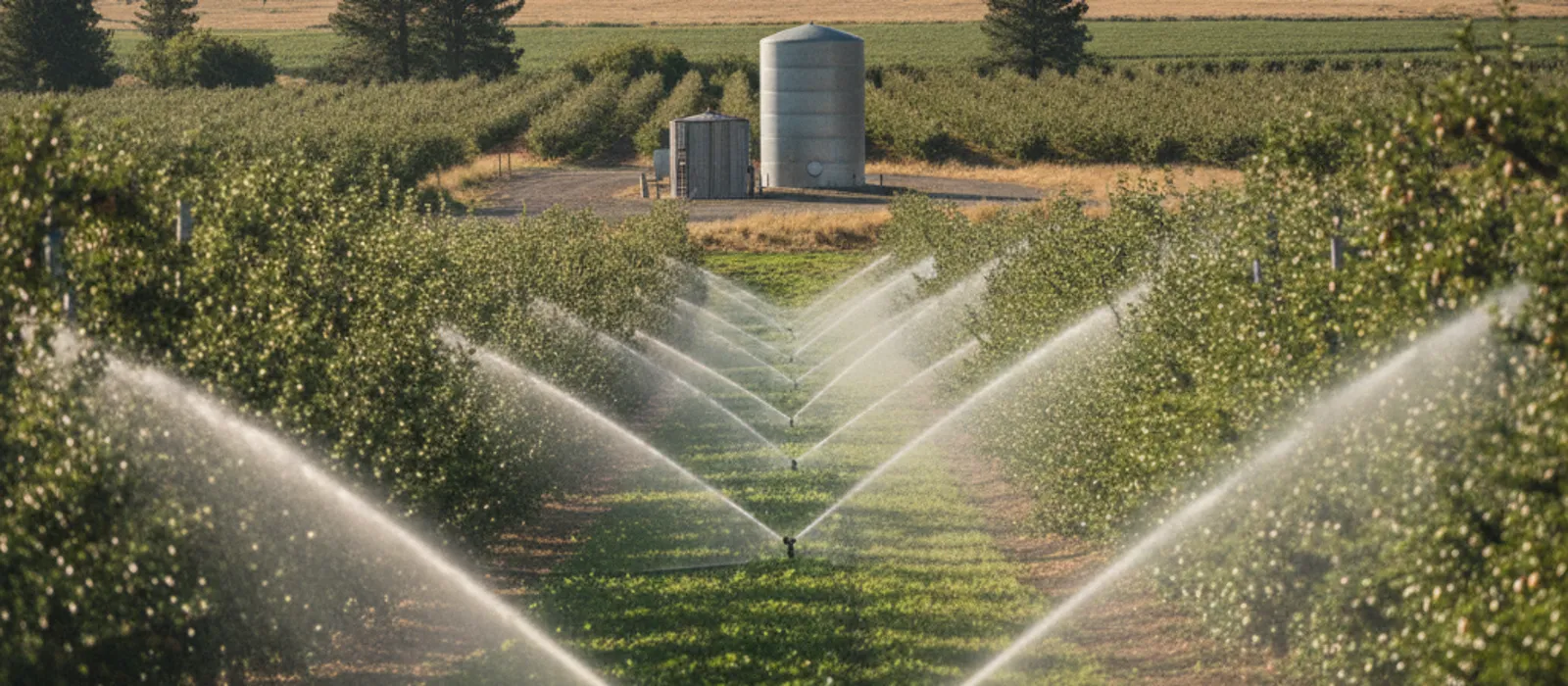
One mature acre of apples in the Wenatchee Valley can drink more than 8,000 gallons of water on a hot July day. Run ten acres and your well is moving more water before lunch than the average house uses in a month.
If you farm or keep acreage anywhere between Cashmere and Moses Lake, you already know this. Our summers are hot, dry, and long, and the difference between a good crop and a stressed one usually comes down to whether the water showed up on time. The right irrigation well pump makes that automatic. The wrong one makes every heat wave a gamble.
This guide covers what we’ve learned installing and repairing irrigation pumps across Chelan, Douglas, and Grant counties. We’ll walk through why a household pump can’t do this job, how to size a pump using real GPM numbers, what installations actually cost in 2026, the water rights rules you can’t ignore in Washington, and how to keep the whole system alive through our freeze-and-bake climate.
Why Your House Pump Can’t Water an Orchard
A typical domestic well pump in our area is a 1/2 to 1 HP submersible pushing 8 to 12 gallons per minute. That’s plenty for showers, laundry, and a garden hose. It is nowhere close to irrigation duty.
Here’s the math. During peak summer evapotranspiration, a mature orchard block in North Central Washington can use around 0.3 inches of water per day. One acre-inch is about 27,000 gallons, so that’s roughly 8,100 gallons per acre per day. If you irrigate in a 12 hour set, you need about 11 GPM per acre just to keep up. Five acres means 55 GPM or more. A house pump trying to deliver that will run flat out, overheat, and die young.
We see it every season. Somebody buys five acres outside East Wenatchee, plants trees, tees their drip system into the domestic well line, and by August the pump is short cycling and the house has no pressure. Irrigation needs its own properly sized pump, and often its own well.
Not sure what your current setup can actually handle? Give us a call at (509) 300-5151 and we’ll talk through your acreage, your well, and your options before you spend a dime. Estimates are always free.
Sizing an Irrigation Well Pump: GPM, Head, and Horsepower
Irrigation pump sizing comes down to three numbers. Get these right and the pump runs efficiently for 15 years. Get them wrong and you’ll replace it in five.
Flow rate (GPM)
Start with your crop and your irrigation method. Rough planning numbers for our area:
- Drip or micro-sprinkler orchard: 7 to 12 GPM per acre during peak season
- Solid set or wheel line sprinklers: 10 to 15 GPM per acre
- Pasture with big gun or hand lines: 12 to 18 GPM per acre
Then check what your well can actually produce. A pump that pulls 60 GPM from a well that recovers at 35 GPM will suck the water level down, run dry, and burn up. A proper well yield test tells you the safe number before you buy anything. In parts of the Quincy basin and up the Wenatchee River drainages, yield varies a lot from one parcel to the next, so don’t assume your neighbor’s numbers apply to you.
Total dynamic head (TDH)
This is the total pressure the pump has to generate: the depth to the pumping water level, plus the elevation rise from wellhead to your highest emitter, plus pipe friction losses, plus the operating pressure your system needs. Drip systems usually want 25 to 45 PSI at the manifold. Impact sprinklers want 50 to 60 PSI. Every 1 PSI equals 2.31 feet of head, so a sprinkler system alone adds 115 to 140 feet of head before you’ve lifted a drop out of the ground.
On benches above the Columbia, elevation is the silent killer. We’ve sized pumps near Chelan where the orchard sat 180 feet above the wellhead. That elevation alone demanded more head than the entire rest of the system.
Horsepower
Horsepower falls out of the first two numbers. Typical irrigation well pumps around here run 3 to 30 HP, compared to the 1/2 to 1 HP in a domestic well. Bigger isn’t better. An oversized pump wastes power, hammers your pipes, and cycles itself to death. Our full well pump sizing guide goes deeper on the calculations.
Teresa, who runs 14 acres of cherries near Chelan, learned this the expensive way. Her previous installer put in a 15 HP pump against a well that tested at 45 GPM. The pump outran the well every afternoon, tripped on dry-run protection, and her trees went thirsty during the 2024 heat wave. We swapped it for a properly matched 7.5 HP unit with a flow restrictor. Her power bill dropped about $90 a month and the well has never run dry since.
What an Irrigation Well Pump Costs in North Central Washington
Real numbers from jobs we’ve done across the valley in the past two years. Your price depends on well depth, horsepower, wire run, and how much of the old system is salvageable.
| Setup | Typical pump | Installed cost range |
|---|---|---|
| Hobby acreage, 1-3 acres drip | 2-3 HP submersible | $4,500 - $8,000 |
| Small orchard, 4-10 acres | 5-7.5 HP submersible | $8,000 - $15,000 |
| Mid-size orchard, 10-30 acres | 10-20 HP submersible or turbine | $15,000 - $30,000 |
| Large block, 30-60 acres | 25-40 HP turbine | $30,000 - $55,000 |
| VFD / constant pressure add-on | Drive + controls | $2,500 - $7,000 |
| New irrigation well (drilled) | Varies by depth | $40 - $70 per foot |
A few notes on those numbers. Three-phase power, where available, cuts operating costs on bigger pumps. A variable frequency drive (VFD) is worth serious consideration above 5 HP because it soft-starts the motor, holds steady pressure across different zone sizes, and can stretch pump life by years. And the cheap hydropower from our local PUDs means a 10 HP pump running 12 hours a day often costs less to operate here than a 5 HP pump does in other states.
If your current pump is limping but not dead, a repair often buys you a season or two. Our well pump repair team in Wenatchee can usually tell you within an hour whether a fix makes sense or you’re throwing money at a pump that’s done. When it is done, here’s what a full replacement involves.
Want a number for your specific property instead of a range? Request a free estimate and we’ll come walk the site.
Water Rights Rules for Irrigation Wells in Washington
This part trips up more new landowners than anything mechanical. In Washington, the water under your land isn’t automatically yours to use however you want.
A permit-exempt well lets you irrigate a lawn or noncommercial garden of one half acre or less, water livestock, and use up to 5,000 gallons per day for domestic purposes. That’s it. Irrigating a commercial orchard, hay field, or anything beyond that half acre requires a water right, even if the well is on your own property and even if it’s been there for decades.
The Washington Department of Ecology enforces this, and in fully appropriated basins like parts of the Wenatchee watershed, new irrigation rights are hard to get. Before you plant trees or buy a pump, confirm what your parcel actually has. Ecology’s water rights page is the place to start: https://ecology.wa.gov/water-shorelines/water-supply/water-rights. Many orchard parcels in our area carry old certificates or irrigation district shares, and a title search or a call to Ecology’s Central Regional Office in Union Gap can confirm what transferred with your sale.
We’re pump installers, not water lawyers, but we’ve seen people spend $20,000 on a well and pump for ground they couldn’t legally irrigate. Check the paper first. The USGS also publishes groundwater level data for our basins if you want to see what the aquifer is doing long term: https://www.usgs.gov/mission-areas/water-resources.
Submersible, Turbine, or Centrifugal: Picking the Right Pump Type
Three pump styles cover almost every irrigation well in Central Washington.
Submersible pumps
The workhorse. The motor and pump sit down in the well, pushing water up. They’re quiet, they can’t lose prime, and they handle our deep static water levels without complaint. For most orchards and acreage up to about 20 HP, a submersible is the right call. If you’re weighing this against an above-ground jet pump for a shallower well, our submersible vs jet pump comparison breaks down where each one wins.
Vertical turbine pumps
For high-volume wells and bigger horsepower, a lineshaft turbine puts the motor above ground at the wellhead with bowl assemblies down the column. They’re serviceable without pulling a motor from 300 feet down, and they dominate on blocks above 30 acres. Higher upfront cost, easier long-term maintenance.
Centrifugal booster pumps
If you’re pulling from a surface source, a pond, or a storage tank that your well fills overnight, an above-ground centrifugal does the pressurizing. Pairing a modest well pump with a 10,000 to 20,000 gallon storage tank and a booster is a smart fix for low-yield wells. The well refills the tank 24 hours a day, and the booster delivers big GPM during your irrigation window.
That tank-and-booster setup saved Rick’s pears in Cashmere. His well only made 18 GPM, nowhere near the 70 GPM his nine acres needed at peak. Instead of gambling $35,000 on drilling a new well, we set a 15,000 gallon tank and a 5 HP booster for about $19,000 total. His well now runs gently around the clock, the tank buffers the demand, and he hasn’t stressed a tree since.
Keeping Your Irrigation Pump Alive Year After Year
Central Washington is hard on equipment. Hundred-degree Augusts, sub-zero Januaries, and irrigation water that often carries fine sand. A few habits prevent most of the failures we get called out for.
Winterize every fall, no exceptions. Drain above-ground piping, blow out the lines, and protect the pump house before the first hard freeze, which can hit by early November up the Leavenworth and Lake Wenatchee drainages. A cracked pump volute or split manifold is a spring surprise nobody wants. Our winterization walkthrough covers the full checklist.
Watch your amps. A clamp meter reading once a month tells you more than anything else. Climbing amperage means wear, sand, or a failing motor, and catching it in June beats a dead pump on a 104 degree day in July.
Screen out the sand. Fine sediment is common in wells across the Quincy and Moses Lake basins. A sand separator at the wellhead costs $800 to $2,500 and can double the life of a pump’s impellers.
Mind the dry years. Static water levels in some local aquifers drop during drought cycles. If your pump starts sucking air late in the season, the fix may be lowering the pump setting, not replacing it.
Dale, who runs a small hobby orchard outside Quincy, skipped the fall blowout in 2024 because the forecast looked mild. A 9 degree night in late November split his manifold and froze the check valve. The April repair bill was $3,400. The blowout he skipped would have cost $250. He’s on our fall schedule now, every year, automatically.
Mid-season breakdowns don’t wait for business hours, and neither do we. If your pump quits with fruit on the trees, call (509) 300-5151 day or night. We run 24/7 emergency service across Chelan, Douglas, and Grant counties.
Frequently Asked Questions
How many GPM do I need to irrigate one acre of orchard?
Plan on 7 to 12 GPM per acre for drip or micro-sprinkler systems during peak summer demand, and 10 to 15 GPM per acre for overhead sprinklers. The exact number depends on your soil, crop, and how many hours per day you can run. Always verify your well can sustain that flow with a yield test before sizing the pump.
Can I use my domestic well pump for irrigation?
You can legally irrigate up to a half acre of lawn or noncommercial garden from a permit-exempt domestic well in Washington. Mechanically, though, a 1/2 or 1 HP house pump isn’t built for hours of high-flow duty and will wear out fast. Anything beyond a large garden deserves a dedicated, properly sized irrigation pump, and commercial irrigation requires a water right.
How long does an irrigation well pump last?
A correctly sized submersible irrigation pump typically runs 10 to 15 years in our area, and vertical turbines often go 15 to 20 with periodic bowl rebuilds. Sandy water, chronic short cycling, and running the well dry are the three things that cut that lifespan in half. Annual checkups and a sand separator are cheap insurance.
What does it cost to replace an irrigation well pump near Wenatchee?
Most replacements on existing wells run $4,500 to $15,000 for hobby acreage and small orchards, and $15,000 to $55,000 for larger commercial blocks, depending on horsepower, well depth, and controls. Adding a VFD typically runs $2,500 to $7,000 more. We give free on-site estimates anywhere in Chelan, Douglas, and Grant counties, so you’ll have a firm number before any work starts.