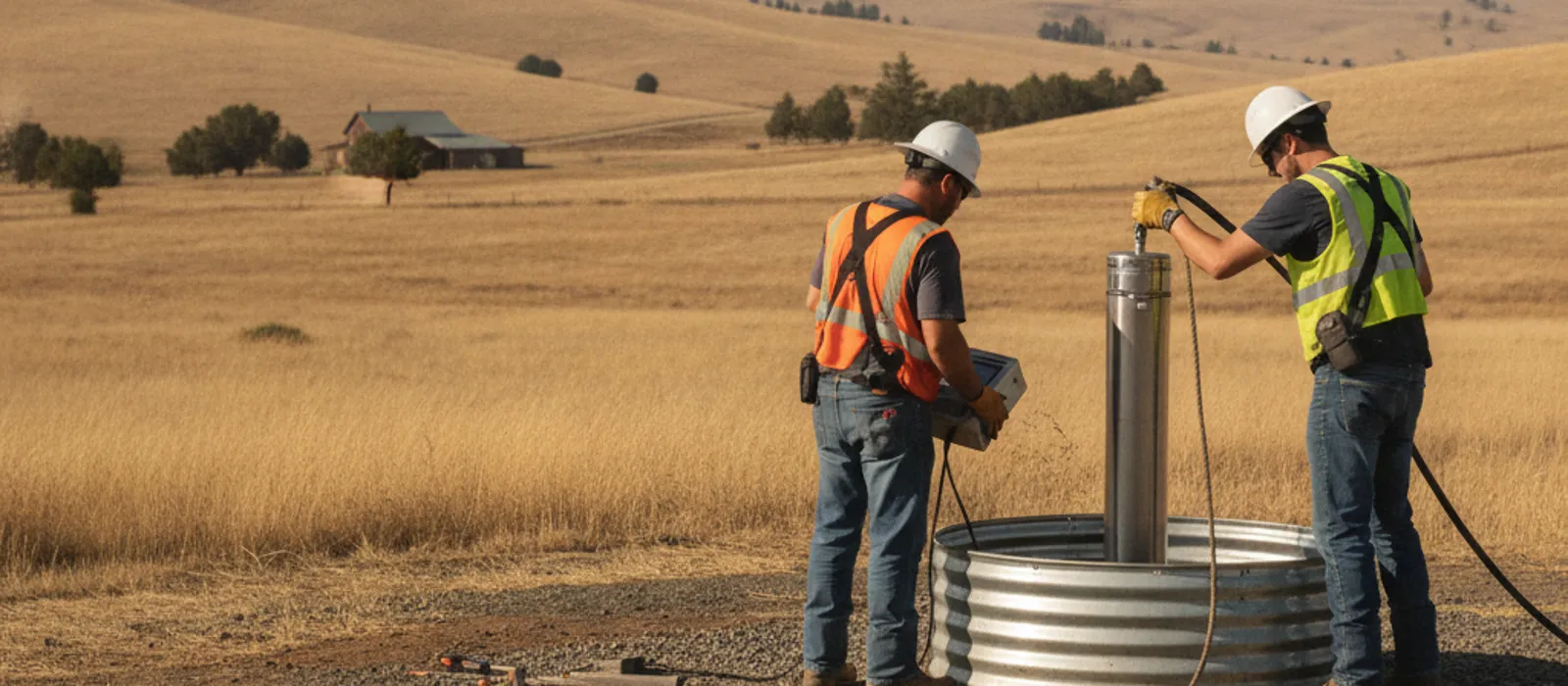
About nine out of ten pumps we pull in the Wenatchee Valley are submersibles. So why does every supply house in town still stock jet pumps? Because for the right well, a jet pump costs half as much up front and does the job just fine.
If you’ve been researching the submersible vs jet pump question, you’ve probably noticed the advice online contradicts itself. One site says jet pumps are obsolete. Another says they’re the budget hero. Here’s the honest version from a crew that works on both every week, from orchard wells in Cashmere to lake homes above Chelan. By the end of this article you’ll know how each pump works, where the hard depth limits sit, what each one really costs installed, and which one makes sense for a North Central Washington well. In most cases, your well’s depth makes the decision for you.
If you’d rather skip the homework and just get an answer for your specific well, call us at (509) 300-5151 and we’ll talk it through. Free estimates, no pressure.
How Each Pump Actually Works, in Plain English
The core difference is simple. A submersible pushes water up from inside the well. A jet pump sits above ground and pulls water up by suction. Pushing is easy. Pulling is hard. Almost everything else flows from that one fact.
Submersible pumps: the pusher
A submersible is a long, skinny cylinder, usually about 4 inches around and 2 to 4 feet long, that hangs on a pipe deep inside your well casing, fully underwater. The motor is sealed inside it. When your pressure tank calls for water, the pump spins up and pushes water straight up the drop pipe to your house.
Because it pushes from below, depth barely matters. A good submersible will lift water 400 feet or more without complaint. It’s also silent from the surface, it never needs priming, and the water around it keeps the motor cool. The tradeoff: when it fails, someone has to pull it out of the well, and that’s not a Saturday afternoon job on a 300-foot well.
Jet pumps: the puller
A jet pump looks like a motor bolted to a snail shell, and it sits above ground, usually in a pump house, well pit, or basement. It uses suction plus a clever venturi nozzle to draw water up out of the well.
Here’s the catch, and it’s physics, not marketing. Suction at our elevation can only lift water about 25 feet, period. No pump on Earth beats that number because it’s set by atmospheric pressure. A shallow well jet pump is honest about this and tops out around 25 feet. A deep well jet pump cheats by sending part of its own output back down the well through a second pipe to help push, which stretches the range to roughly 90 feet, but efficiency falls off a cliff the deeper you go.
If you want a deeper dive into the mechanics, the USGS has a solid plain-language explainer on how wells and groundwater work.
Submersible vs Jet Pump: Depth Decides Most of It
Before you compare price tags, find out your static water level, meaning how far down the water sits in your casing. Not the well depth, the water depth. Those are different numbers, and the water level is the one that matters.
Here’s the cheat sheet:
- Water within 25 feet of the surface: either pump works. A shallow well jet pump is the budget option.
- Water 25 to 90 feet down: a deep well jet pump can work, but a submersible will outperform it on pressure and power use almost every time.
- Water deeper than 90 feet: submersible. There’s no real debate.
Now the local reality. Most drilled wells around Wenatchee, East Wenatchee, and Quincy hit water somewhere between 100 and 400 feet down. Up the Icicle and Chumstick near Leavenworth, plenty of wells run deeper than that. We wrote up the typical numbers by area in our guide to how deep wells run in the Wenatchee area. The short version: if you have a modern drilled well in Chelan, Douglas, or Grant County, you’re almost certainly in submersible territory.
So where do jet pumps still earn their keep here? Shallow dug wells and sand points near the Wenatchee and Columbia rivers, older homesteads in the valley bottoms in Cashmere and Monitor, and some irrigation setups pulling from shallow water. If your pump is bolted to the wall of a pump house and you can hear it run, you’ve got a jet pump.
Marv, who has a place near the river in Cashmere, found this out the right way. His 1960s dug well holds water at 14 feet. When his old jet pump died last spring, another outfit quoted him $4,800 to convert to a submersible setup. We replaced his shallow well jet pump for $1,350, and it’ll serve that well fine for the next 10 to 15 years. A submersible would’ve worked too. It just would’ve been $3,400 of overkill.
Jet Pump vs Submersible Cost: What You’ll Pay Installed
Sticker price is only part of the story. Here’s what we actually see on invoices in Chelan, Douglas, and Grant counties, including labor:
| Shallow well jet pump | Deep well jet pump | Submersible pump | |
|---|---|---|---|
| Pump unit cost | $300 to $800 | $500 to $1,200 | $700 to $2,500 |
| Typical installed cost | $900 to $1,800 | $1,400 to $2,800 | $2,200 to $5,500 |
| Effective depth | To 25 ft | To about 90 ft | 400+ ft |
| Typical lifespan | 8 to 15 years | 8 to 15 years | 12 to 25 years |
| Noise | Audible above ground | Audible above ground | Silent |
| Priming needed | Yes | Yes | Never |
| Freeze risk | High if housed poorly | High if housed poorly | Very low |
| Efficiency | Fair | Poor at depth | Best |
A few notes on those numbers. Submersible install costs swing with depth, because pulling and setting 300 feet of drop pipe takes more time, more wire, and usually a pump hoist. Horsepower matters too. A 1/2 hp submersible for a modest house is a different invoice than a 1.5 hp unit feeding a home plus orchard irrigation. We break down the full range in our well pump replacement cost guide, and our well pump cost page has current local pricing.
Don’t ignore the power bill, either. A deep well jet pump working at 80 feet can burn 30 to 40 percent more electricity than a submersible moving the same water, because it’s recycling part of its own output just to keep pulling. Over a 12-year life, that gap can quietly eat the entire up-front savings.
If you want real numbers for your well instead of internet ranges, request a free estimate and we’ll quote it after looking at your actual setup.
Reliability, Noise, and What Winter Does to Each
On paper the lifespans look close. In practice, around here, submersibles win on reliability, and winter is a big reason why.
The freeze factor
Our valley winters drop below zero most years, and a jet pump full of water sits above ground waiting for it. Teresa, outside Leavenworth off the Chumstick, learned that one in January. Her pump house heat lamp bulb burned out during a cold snap that bottomed at minus 4. Three days later the jet pump housing cracked, and she was hauling water for her horses until we got there. Total damage: $2,100 for a new pump, fittings, and pipe repair, plus a properly insulated pump house this time.
A submersible spends its whole life 100-plus feet down where the ground stays around 52 degrees year round. The pump itself essentially cannot freeze. Your pipes and pressure tank still can, so the pump house still matters, but you’ve removed the most expensive component from the danger zone. Insulate the pump house either way, because frozen pipes don’t care what kind of pump you own.
Priming, noise, and wear
Jet pumps must stay primed, meaning full of water. Lose prime from a leaky foot valve or a dropping water table and the pump runs dry, overheats, and chews itself up. Submersibles never need priming. They can still be damaged by a well running dry, but they don’t lose prime from a 50-cent check valve failing.
Noise is the quality-of-life difference people don’t think about until they live with it. A jet pump cycling on and off is loud enough to hear in the house if it’s in the basement or near a bedroom wall. A submersible is dead silent. The only thing you’ll hear is the pressure switch clicking.
One more local wrinkle: sand and grit. Some wells around Quincy and Moses Lake produce fine sand, which wears jet pump impellers and venturis fast. The fix is proper pump selection and sometimes screening, not just swapping like for like every five years.
Which Pump Makes Sense for Your North Central Washington Well
Here’s how we’d call it, scenario by scenario:
- Drilled well, water below 90 feet (most of you): submersible. It’s not a preference, it’s the only tool that works well at that depth.
- Drilled well, water at 30 to 80 feet: submersible, in almost every case. The deep well jet pump exists for this range, but the submersible gives you stronger pressure, lower power bills, and a longer life for $800 to $1,500 more installed.
- Shallow dug well or sand point, water within 25 feet: shallow well jet pump, unless noise or freeze exposure is a dealbreaker. It’s the cheapest path to reliable water and parts are easy.
- Cabin or seasonal place near Chelan: lean submersible. Seasonal properties are exactly where jet pumps freeze, lose prime, and fail while nobody’s watching.
- Irrigation from a shallow source: jet pumps and above-ground centrifugals still earn their keep here, sized to the job.
One pattern we see a lot: a home with a tired deep well jet pump straining at 70 or 80 feet. Gary in East Wenatchee had exactly that, a 1990s deep well jet pulling from 75 feet, with 30 psi on a good day and a power bill he blamed on his shop heater. We converted him to a 3/4 hp submersible for $3,600. His pressure now holds at 55 psi, his pump is silent, and his summer power bill dropped about $22 a month. The conversion pays for itself slowly, but the showers got better immediately.
Whatever you install, make sure it’s sized and set up legally. Washington has real rules on well construction and pump installation, and the Department of Ecology’s well program is the authority on what’s required. A licensed installer handles that paperwork and the electrical, which is not a place to improvise. Wiring a 230-volt pump circuit wrong can kill the pump, or you.
And if your current pump is limping, get it looked at before it strands you. Our well pump repair team in Wenatchee can often save a pump that’s caught early, and when it’s truly done, well pump replacement usually happens same day or next day. No water right now? Don’t wait on a blog post. Call (509) 300-5151, we answer 24/7.
The Bottom Line
For most wells in Chelan, Douglas, and Grant counties, the submersible vs jet pump debate ends at the tape measure. Water below 25 feet pushes you toward a submersible, and water below 90 feet demands one. Jet pumps still make honest sense on shallow dug wells and sand points near the rivers, where they’re the cheaper, simpler tool.
Spend your money on depth-appropriate equipment, correct sizing, and a freeze-proof setup. Skip the upsell when a $1,400 jet pump fits, and skip the false economy when it doesn’t. Either way, the right pump installed right should give you 10 to 20 quiet years of water. If yours is making noise, short cycling, or just plain old, it’s worth knowing how long well pumps usually last so the failure doesn’t pick the timing for you.
Frequently Asked Questions
Is a submersible pump better than a jet pump?
For wells with water deeper than 25 feet, yes, almost always. A submersible delivers stronger pressure, uses less electricity, runs silently, and typically lasts 12 to 25 years versus 8 to 15 for a jet pump. Jet pumps only win on up-front cost, and only on shallow wells where suction can actually reach the water.
Can I replace my jet pump with a submersible?
Usually, if your well casing is at least 4 inches in diameter and in decent shape. The conversion involves removing the old suction piping, setting a submersible on a drop pipe, running new wiring down the well, and often updating the pressure tank and switch. Around the Wenatchee area the conversion typically runs $2,500 to $5,000 depending on depth.
How deep can a jet pump pull water?
A shallow well jet pump maxes out around 25 feet, which is a hard physical limit set by atmospheric pressure. A deep well jet pump uses a two-pipe ejector down the well to reach roughly 90 feet, but it loses efficiency badly past 50 feet. Beyond 90 feet, a submersible is the only practical choice.
How do I know which type of pump my well has?
Look and listen. If there’s a motor you can see and hear above ground in a pump house, pit, or basement, it’s a jet pump. If your well cap just has wires and a pipe disappearing down the casing and you never hear the pump run, it’s a submersible. Your pressure tank looks the same either way, so the tank won’t tell you anything.