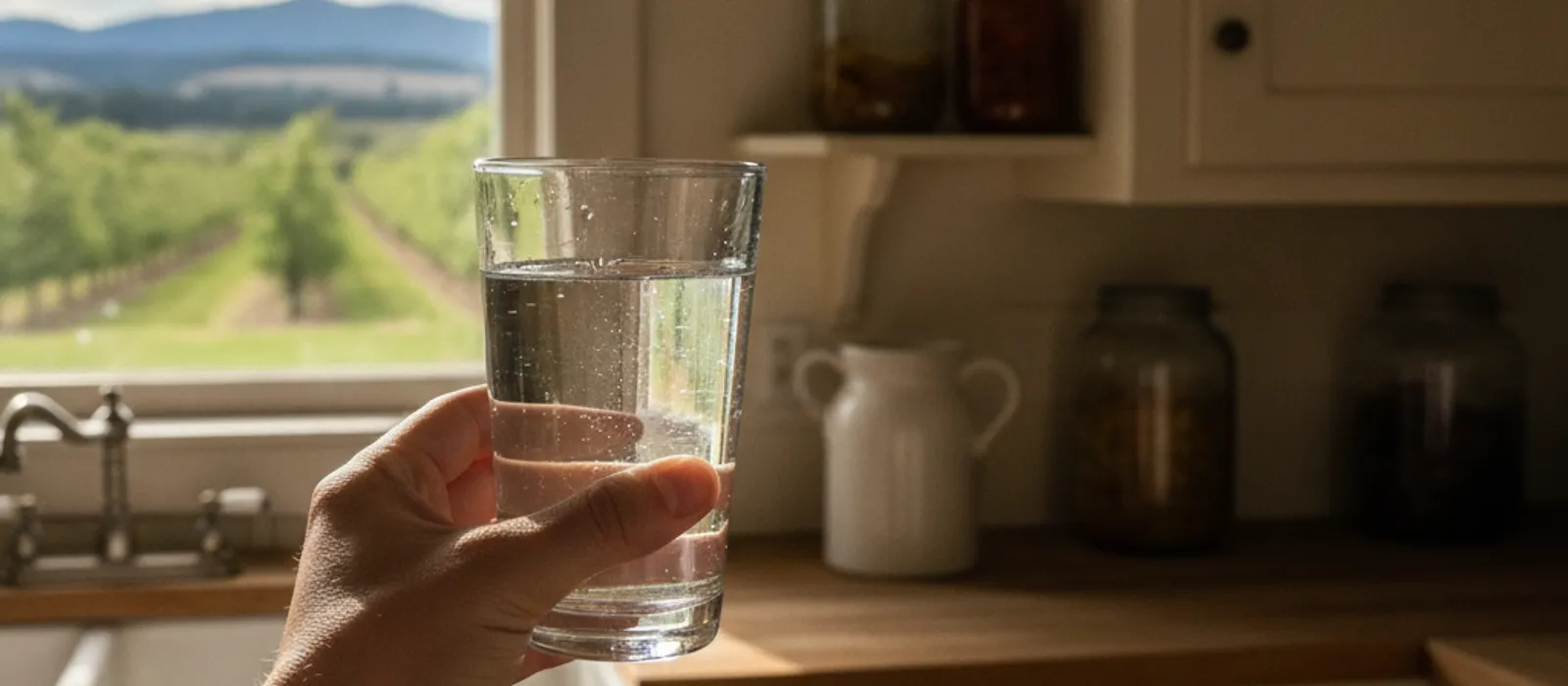
Your well water can look crystal clear, smell like nothing, and taste perfectly fine, and still carry enough nitrate to put an infant in the hospital. There’s no warning at the tap. None.
That’s what makes nitrates in well water different from the contaminants people usually worry about. Iron stains your sink. Sulfur smells like rotten eggs. Nitrates give you nothing to notice, and around here, in orchard and farm country from Cashmere to Moses Lake, they’re one of the most common problems we see on private well tests.
The good news is this problem is completely manageable. A test costs less than a tank of gas, and proven treatment options exist at every budget. In this article we’ll cover where nitrates come from, what the numbers on a test report actually mean, who’s most at risk, and exactly how to fix it if your well comes back high.
Why Nitrates in Well Water Are a Bigger Deal Here Than Most Places
Nitrate is a form of nitrogen, and nitrogen is what makes things grow. That’s the whole problem. North Central Washington has been growing apples, pears, and cherries commercially for over a century, and the Columbia Basin around Quincy and Moses Lake is some of the most intensively farmed ground in the state.
Decades of fertilizer, both synthetic and manure, have left nitrogen in the soil. Irrigation water carries it down through that soil and into the aquifer. Once it’s in the groundwater, it moves with the water, sometimes for miles, sometimes for decades.
Add in rural septic systems and livestock operations, and you’ve got three steady nitrate sources sitting on top of the same aquifers that feed our wells. Grant County sits inside the Columbia Basin Groundwater Management Area, which was created specifically because of nitrate contamination. This isn’t a theoretical risk. The Washington Department of Health tracks nitrate as one of the most common contaminants in the state’s groundwater, and you can read their guidance at doh.wa.gov.
Shallow wells get hit hardest. If your well is less than 100 feet deep, sits downhill from orchard ground, or is within a few hundred feet of a septic drainfield or corral, your odds of elevated nitrate go up fast.
Not sure how vulnerable your well is? We’ll give you a straight answer. Call us at (509) 300-5151 and we’ll talk through your well’s depth, location, and history at no charge.
What Nitrates Do to Your Health, and Who’s Most at Risk
For most healthy adults, moderate nitrate exposure isn’t an emergency. The real danger is concentrated in a few groups, and for them it’s serious.
Infants under six months
This is the big one. Babies’ digestive systems convert nitrate to nitrite, which binds to the hemoglobin in their blood and blocks it from carrying oxygen. The condition is called methemoglobinemia, or blue baby syndrome, because the baby’s skin can literally take on a bluish tint. It can be fatal, and it can develop fast.
Formula mixed with high-nitrate well water is the classic exposure route. If there’s a baby in your house, or one on the way, testing your well isn’t optional. Do it before the baby comes home.
Pregnant women
Pregnancy changes how the body handles nitrate, and some studies link high nitrate exposure during pregnancy to birth defects and other complications. Most doctors tell pregnant patients on private wells to test and, if nitrate is elevated, switch drinking water immediately.
Everyone else, over time
Long-term consumption of high-nitrate water has been studied for links to thyroid problems and certain cancers. The science is still developing, but the EPA didn’t set its limit casually. The federal maximum contaminant level for nitrate is 10 milligrams per liter (measured as nitrate-nitrogen), and you can see the full standard in the EPA’s National Primary Drinking Water Regulations.
One thing nitrates won’t do is hurt you in the shower. Nitrate is a drinking and cooking water problem. You don’t absorb meaningful amounts through your skin, which matters when we get to treatment, because it means you usually don’t need to treat every drop in the house.
Two Local Wells, Two Wake-Up Calls
Marta in Quincy had her first baby last spring. Her midwife asked one question at a checkup: are you on a well? She was, and she’d been mixing formula with tap water for three weeks. Her test came back at 13 mg/L, three points over the federal limit. She switched to bottled water that afternoon, and within a week had an under-sink reverse osmosis unit installed for about $850. Follow-up testing on the RO tap reads under 1 mg/L. The baby’s fine. Marta still talks about those three weeks.
Gary runs 40 acres of pears outside Cashmere on a well his dad drilled in 1978. His nitrate tested at 6.2 mg/L back in 2019. Under the limit, so he shrugged it off. When he finally retested in 2023, it had climbed to 8.9. Same well, same water source, just a steady upward creep. That trend line convinced him to act before he crossed 10. He now retests every spring and put in a nitrate treatment system last year. The lesson: a passing test isn’t a permanent pass. The number moves.
How to Test Your Well Water for Nitrates
You can’t shortcut this with your senses. Testing is the only way to know, and it’s cheap and fast.
A basic nitrate test at a state-certified lab runs $20 to $40. Most labs in our area turn results around in two to five business days. You can collect the sample yourself with the lab’s bottle and instructions, or have a pro pull it so there’s no question about technique.
Here’s our standing advice for wells in Chelan, Douglas, and Grant counties:
- Test nitrate and bacteria every year. Spring is the best time, after snowmelt and the start of irrigation season, when nitrate levels tend to peak.
- Test immediately if you’re pregnant, bringing home a baby, buying a home with a well, or if a neighbor’s well tested high.
- Keep every result. A single number tells you where you are. Five years of numbers tell you where you’re headed, like Gary’s well did.
While you’re at it, add arsenic to the panel once every few years. It’s the other invisible contaminant common in Washington groundwater, and we covered it in our guide to arsenic in Washington well water. For the full rundown on what to test and when, see our well water testing guide for the Wenatchee area.
If you’d rather have us handle sampling, lab coordination, and a plain-English walkthrough of the results, request a free estimate here. We’ll tell you honestly if your numbers need action or just an annual recheck.
Reading Your Results: What the Numbers Mean
Nitrate results are usually reported as nitrate-nitrogen (NO3-N) in milligrams per liter, which is the same as parts per million. Here’s how to read yours:
- Under 2 mg/L: Normal background. Retest annually.
- 2 to 5 mg/L: Above natural background, which means human activity is reaching your aquifer. Not dangerous, but watch the trend.
- 5 to 10 mg/L: Elevated. Retest in six months, and start pricing treatment if the trend is upward. Some health agencies advise caution for infants even in this range.
- Over 10 mg/L: Exceeds the federal limit. Stop using the water for infant formula, drinking, and cooking right now. Use bottled water until treatment is in place.
One critical warning: do not boil the water. Boiling kills bacteria, but it does the opposite for nitrates. As water boils off as steam, the nitrate stays behind and gets more concentrated. Boiled high-nitrate water is worse than what came out of the tap.
How to Remove Nitrates From Well Water
Here’s where homeowners waste the most money, because the two most common water treatment devices in American homes do nothing for nitrate. A carbon filter, including the pitcher and fridge filters everyone owns, won’t touch it. Neither will a standard water softener. Plenty of folks have both and assume they’re covered. They’re not.
These are the options that actually work, with real installed prices from our service area:
| Treatment Option | Removes Nitrates? | Typical Installed Cost | Best For |
|---|---|---|---|
| Under-sink reverse osmosis | Yes, typically 83 to 92% | $400 to $1,500 | Drinking and cooking water at one tap |
| Nitrate-selective anion exchange | Yes | $1,800 to $3,500 | Treating the whole house |
| Whole-house reverse osmosis | Yes | $4,500 to $12,000 | Very high nitrate plus other contaminants |
| Countertop distiller | Yes | $300 to $1,200 | Small volumes, backup option |
| Carbon filter | No | $50 to $500 | Taste and odor only |
| Standard water softener | No | $1,500 to $3,000 | Hardness only |
For most families, the under-sink RO is the right call. Since nitrate only matters in the water you swallow, treating the kitchen tap covers 95% of the actual risk for a fraction of whole-house cost. Plan on $100 to $200 a year in replacement filters and membranes.
Anion exchange makes sense for higher flows, or when you want every tap covered. It works like a softener but with resin that grabs nitrate instead of hardness minerals. One caution: it needs proper sizing and maintenance, because an exhausted resin bed can dump nitrate back into the water in a concentrated slug.
Ron and Patty bought a five-acre place outside Moses Lake in 2024. Their lender required a flow test but not a water quality test, and the home inspector didn’t sample either. Eight months later a routine test came back at 11.4 mg/L. They put in a nitrate-selective anion exchange system for $2,800 and now test twice a year. If they’d caught it during the purchase, they could have negotiated that cost into the deal. That’s exactly why we push water testing in our well inspection guide for home buyers.
Whatever system you choose, treatment isn’t fire-and-forget. Test the treated water once or twice a year to confirm the equipment is still doing its job. We service wells and treatment questions across the basin, including well service in Quincy and well service in Moses Lake, where nitrate questions come up more than anywhere else we work.
Protecting Your Well Going Forward
Treatment fixes the water. Prevention protects the well. A few practical moves:
Check your well cap and casing. A cracked cap or corroded casing lets surface water carry contaminants straight down the borehole, bypassing the soil filtration that normally protects the aquifer. If your wellhead looks rough, get it looked at.
Mind your setbacks. Washington code calls for at least 100 feet between a well and a septic drainfield. Keep fertilizer, manure piles, and chemical storage well away from the wellhead too.
Go easy on lawn fertilizer near the well. Your own yard can be a nitrate source. Whatever the grass doesn’t use heads down toward your water.
Consider deepening or sealing if numbers keep climbing. Nitrate usually rides in the upper part of an aquifer. Sometimes a deeper well, or a deeper seal on the existing one, pulls from cleaner water below. That’s a bigger conversation, and well construction details like depth matter a lot around here. Our post on how deep wells run in the Wenatchee area explains why.
And if you’re seeing other water quality issues alongside nitrate, sediment, staining, or smells, a properly designed setup can knock out several problems at once. Our overview of well water filtration systems walks through how the pieces fit together.
Got a test result you don’t know what to do with, or a baby on the way and an untested well? Don’t sit on it. Call (509) 300-5151 and we’ll help you sort out next steps, usually in one phone call. Estimates are always free, and we’re licensed and insured in Washington.
Frequently Asked Questions
What is a safe level of nitrates in well water?
The federal drinking water standard is 10 mg/L measured as nitrate-nitrogen. Below 2 mg/L is normal background for groundwater. Anything between 2 and 10 means human sources are reaching your aquifer, so retest regularly and watch the trend. Over 10, stop drinking the water until treatment is installed, especially if infants or pregnant women are in the home.
Can I boil well water to remove nitrates?
No, and boiling actually makes it worse. As water evaporates, the nitrate stays behind and becomes more concentrated in what’s left. The only proven home treatments are reverse osmosis, nitrate-selective anion exchange, and distillation. Carbon filters and standard water softeners do not remove nitrate at all.
How often should I test my well for nitrates?
Once a year at minimum, ideally in spring when levels around here tend to peak after snowmelt and the start of irrigation season. Test immediately if you’re pregnant, bringing home an infant, buying a property with a well, or if a nearby well has tested high. Keep every result so you can spot a rising trend before it crosses the limit.
Do orchards really cause nitrates in well water?
Fertilized agriculture is the largest nitrate source in groundwater across farm country, and that includes orchards, row crops, and livestock operations. Septic systems add to it in rural neighborhoods. That said, today’s orchardists fertilize far more precisely than past generations did, and much of the nitrate in our aquifers reflects decades of accumulation. The source matters less than your number, so test and treat based on results.