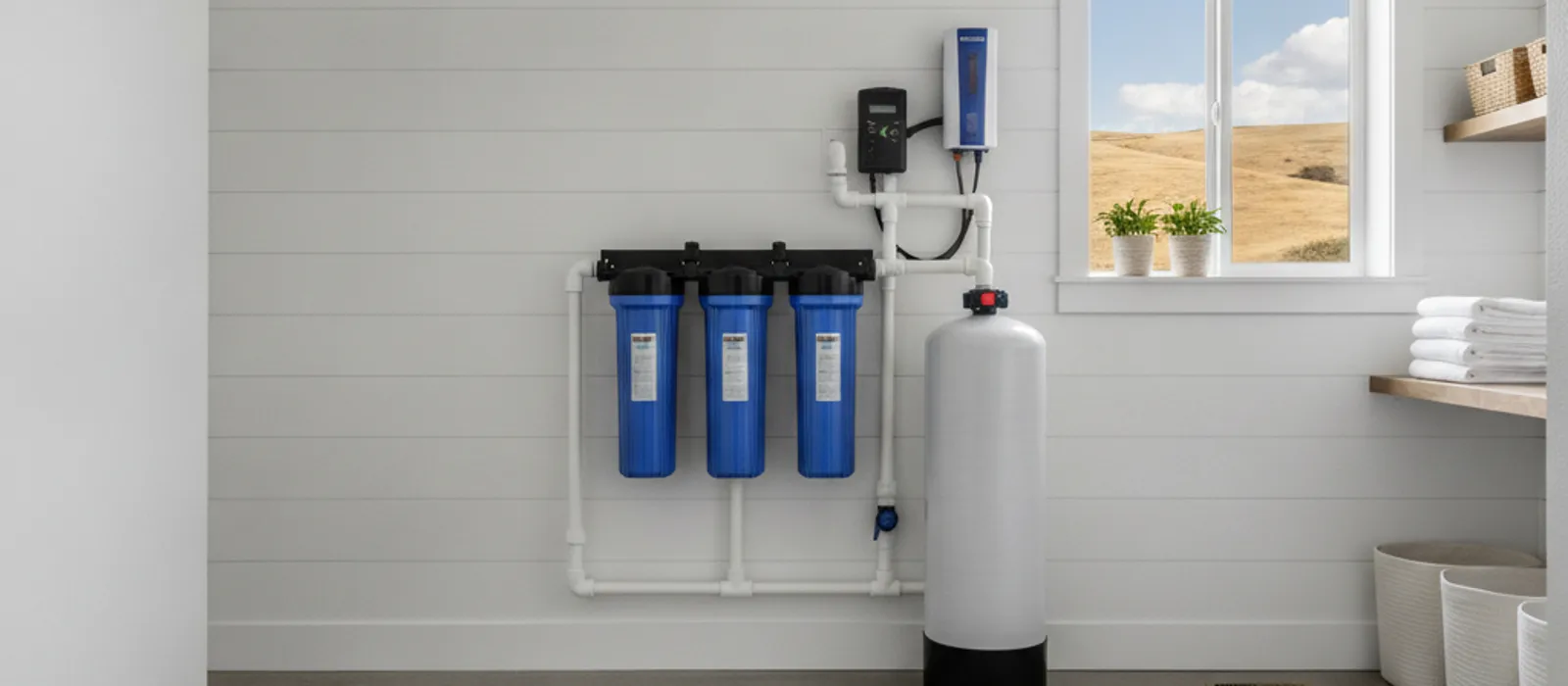
Here’s an uncomfortable number. About half the water treatment equipment we see installed on wells around Wenatchee is treating a problem the water never had. Somebody paid $3,000 for a softener when the real issue was iron. Or bought a fancy carbon system for water that just needed a $40 sediment cartridge.
You’re on a well, so clean water is your job, not the city’s. Fair enough. The good news is that a well water filtration system doesn’t have to be complicated or expensive once you know what’s actually in your water. Most homes in Chelan, Douglas, and Grant counties need one or two pieces of equipment, not the five-stage monster some salesman wants to bolt to your wall.
This guide walks through what works, what it costs, and what’s a waste of money. We’ll cover the common water problems in North Central Washington, the right fix for each one, and the order to do things in. By the end you’ll know exactly what your house needs and what it doesn’t.
Test First, Buy Second
Never buy filtration before you test. That rule alone will save you more money than anything else in this article.
A standard lab test for a private well runs $150 to $350 depending on what panel you order. Around here the smart panel covers bacteria, nitrates, hardness, iron, manganese, pH, and arsenic. That’s the short list of what actually shows up in Columbia River valley wells. We covered the details in our guide to well water testing in Wenatchee, including which local labs to use.
The Washington Department of Health recommends private well owners test for bacteria every year and nitrates every one to two years. Most people never test at all. Then they buy equipment based on taste, a stain, or a salesman’s free in-home “test” that mysteriously always finds something expensive.
Get the lab numbers first. If you want help reading the results or pulling a clean sample, give us a call at (509) 300-5151 and we’ll walk you through it. Takes ten minutes.
What free in-home water tests really are
That free test from the treatment company? It’s a sales appointment. The little vials that turn colors are real chemistry, but the person running them gets paid when you buy a system. They’ll test hardness and iron because those almost always show something in this valley. They usually won’t test for bacteria, nitrates, or arsenic, the things that can actually hurt you, because there’s no $5,000 system to sell off those results without a lab report anyway.
Use an accredited lab. Period.
Common Well Water Problems in North Central Washington
Our water here comes off granite, basalt, and glacial deposits, then filters through orchard country before it hits your pump. That combination produces a predictable set of problems.
Hardness. Most wells from Cashmere to Moses Lake pull moderately hard to very hard water, often 10 to 25 grains per gallon. You see it as white scale on faucets and a water heater that dies young. More on that in our piece on hard water from a well.
Iron and manganese. Orange or brown staining in toilets and tubs, black slime in the tank, metallic taste. Extremely common in Douglas County wells. We wrote a full breakdown on iron in well water.
Sediment and sand. Older wells, shallow wells, and wells with worn pumps push grit into the house. It chews up fixtures and appliance valves.
Bacteria. Coliform hits happen after flooding, after well cap damage, or in older wells with shallow casings. It’s a fix-the-source problem first, a treatment problem second.
Nitrates. This is farm country. Fertilizer and septic systems push nitrates into shallow groundwater, especially in the Quincy basin and parts of Grant County. The EPA limit is 10 mg/L, and it matters most for infants and pregnant women.
Arsenic. Naturally occurring in some Washington aquifers. You can’t taste it, smell it, or see it. Only a lab test finds it.
Sulfur smell. That rotten egg odor is usually hydrogen sulfide gas or a reaction inside your water heater. See our article on well water that smells like rotten eggs before you buy anything, because the cheap fix is often inside the water heater.
The Well Water Filtration Systems That Actually Work
Match the equipment to the lab result. Here’s the honest rundown.
Sediment filters: the workhorse
A spin-down filter or cartridge filter at the pressure tank catches sand and grit before it reaches your house. Installed cost runs $150 to $600. If your water carries visible particles, this is step one, and sometimes the only step you need.
One caution. Heavy sand can mean your pump is sitting too low or your well screen is failing. A filter that clogs every week isn’t a filtration problem, it’s a well problem.
Water softeners: for hardness, nothing else
A properly sized ion-exchange softener fixes scale, soap scum, and the early death of your water heater. Installed, expect $1,500 to $3,500. Softeners also remove small amounts of dissolved iron, under about 2 to 3 ppm, which is why salesmen push them as iron fixes. Above that level the resin fouls and you’ve bought the wrong machine.
Iron and manganese filters: air injection wins here
For real iron problems, an air injection oxidizing filter (often sold as AIO or Katalox systems) is the local standard. It oxidizes the iron, traps it in the media bed, and backwashes it out. Installed cost is $1,800 to $3,200, and a good one handles iron levels that would destroy a softener.
Dale up in Cashmere is a good example. He’d replaced two softeners in six years trying to kill the orange staining in his bathrooms. His iron tested at 6 ppm, double what any softener can survive. One air injection filter, $2,400 installed, and three years later his toilets are still white. He spent $5,000 on the wrong equipment before spending $2,400 on the right one.
UV systems: the bacteria insurance policy
An ultraviolet disinfection system kills bacteria and viruses as water passes a UV lamp. Installed cost runs $800 to $1,500, plus a $100 to $150 lamp every year. UV needs clear water to work, so it usually sits downstream of a sediment filter.
Rita near Leavenworth got a coliform-positive test when she sold her cabin in 2024. The buyer’s lender wouldn’t close without clean water. We shocked the well, fixed a cracked well cap that was letting surface water in, and installed a UV unit for $1,100. Retest came back clean nine days later and the sale closed on schedule. The UV system now protects the new owners every time spring runoff gets aggressive.
Reverse osmosis: for the stuff you drink
An under-sink RO unit strips nitrates, arsenic, lead, and most dissolved contaminants from your drinking and cooking water. Installed cost is $400 to $900, with $100 a year in filters. Whole-house RO exists but it’s overkill for almost everyone, wasting water and money to purify what you flush down the toilet.
Marie outside Quincy tested her well after her daughter got pregnant. Nitrates came back at 12 mg/L, over the EPA limit. A whole-house nitrate system would’ve run her north of $6,000. Instead she put a $550 RO unit under the kitchen sink for drinking and cooking water, then retested to confirm output at under 1 mg/L. Right-sized fix, one-tenth the price.
Carbon filters: taste and smell
Whole-house carbon systems ($1,200 to $2,500 installed) remove chlorine taste after shock chlorination, some odors, and certain organic compounds. They do not remove bacteria, nitrates, hardness, or arsenic, no matter what the box implies.
What a Well Water Filtration System Costs Around Wenatchee
Here’s the local pricing picture in one table, based on what we see installed in Chelan, Douglas, and Grant counties.
| System | Fixes | Installed Cost | Annual Upkeep |
|---|---|---|---|
| Sediment filter | Sand, grit, cloudiness | $150 to $600 | $40 to $100 |
| Water softener | Hardness, scale, minor iron | $1,500 to $3,500 | $100 to $200 (salt) |
| Air injection iron filter | Iron, manganese, some sulfur | $1,800 to $3,200 | $50 to $150 |
| UV disinfection | Bacteria, viruses | $800 to $1,500 | $100 to $150 (lamp) |
| Under-sink RO | Nitrates, arsenic, lead, taste | $400 to $900 | $75 to $150 |
| Whole-house carbon | Chlorine, odor, organics | $1,200 to $2,500 | $100 to $300 |
A typical full setup for a valley home with hard, iron-heavy water is a sediment filter, an iron filter, and a softener, roughly $4,000 to $6,500 installed. Plenty of homes need half that. Almost nobody needs the $12,000 package deals that get pitched at home shows.
Want a straight answer on what your water actually needs? Request a free estimate and we’ll quote off your lab results, not off a sales script.
What to Skip
Some products live entirely on marketing.
Magnetic and electronic descalers. Clip-on gadgets that claim to soften water with magnets or radio waves. Independent testing keeps failing to show meaningful results on well water at our hardness levels. Skip them.
Whole-house RO for a normal home. Unless you’ve got severe contamination across the board, you’re paying thousands to treat irrigation and toilet water.
Oversized everything. A softener sized for a family of eight in a two-person house wastes salt and water and channels the resin. Bigger is not better. Sizing matters.
Any system sold before a lab test. If the installer didn’t ask for your water chemistry, they’re guessing with your money.
The EPA’s private well resources are a solid free reference if you want to go deeper on any contaminant. You own the well, so a little reading pays off.
Filtration Won’t Fix a Failing Well System
One thing we see constantly. A homeowner blames the water when the real problem is the equipment pulling it.
Cloudy water that clears when it sits is usually air, not contamination. Sudden sand can mean a dropping water table or a worn pump, which is a well pump repair call, not a filter purchase. Rusty water that shows up only first thing in the morning often points to a corroding pressure tank or old galvanized pipe, and a pressure tank replacement solves what no filter can.
Filtration also depends on steady pressure. Backwashing filters like iron systems need 5 to 7 gallons per minute to clean themselves. If your well or pump can’t deliver that, the media bed fouls and the system fails early. We check flow before we ever quote a backwashing filter, because installing one on a weak well just sets money on fire.
So before you spend on treatment, make sure the well, pump, and tank are healthy. If your water changed suddenly, that’s usually mechanical. Strange noises, pressure swings, or short bursts of air mean the system needs eyes on it. Call (509) 300-5151 and we’ll figure out whether you’ve got a water problem or an equipment problem, usually in one visit.
The Right Order to Do This
If you take nothing else from this article, take the sequence.
- Test at an accredited lab. Bacteria, nitrates, hardness, iron, manganese, pH, arsenic.
- Fix the well first. Bad caps, cracked casings, and failing pumps make any treatment system pointless.
- Treat health risks. Bacteria gets UV plus source repair. Nitrates and arsenic get RO at the tap.
- Treat nuisance problems. Iron filter, then softener, then carbon if taste still bothers you.
- Retest. Confirm the equipment is doing its job, then retest bacteria yearly.
That order protects your health first and your wallet second. It also means you might stop after step one, because plenty of wells in this valley test clean enough that a single sediment cartridge is the whole answer.
Frequently Asked Questions
What’s the best well water filtration system for this area?
There’s no single best system because wells a mile apart can have completely different chemistry. The most common setup around Wenatchee is a sediment filter plus an air injection iron filter plus a softener, but plenty of homes only need one of the three. Test first, then buy only what the numbers call for.
Do I really need a filtration system if my well water tastes fine?
Maybe not, but taste tells you nothing about bacteria, nitrates, or arsenic, which are all invisible and tasteless. The Washington Department of Health recommends annual bacteria testing and nitrate testing every one to two years for private wells. Test clean and you can skip the equipment with a clear conscience.
How much does a whole-house well water filtration system cost?
For most homes in Chelan, Douglas, and Grant counties, a complete setup runs $2,000 to $6,500 installed depending on what the water needs. A single-problem fix like a sediment filter or UV unit can be under $1,000. Be skeptical of anything quoted above $10,000 for a normal house.
Will a water softener remove iron from my well water?
Only a little. Softeners handle dissolved iron up to about 2 to 3 ppm, and higher levels foul the resin and ruin the unit. If you’ve got visible orange staining, get the iron tested, because you likely need a dedicated air injection iron filter instead of, or in addition to, a softener.