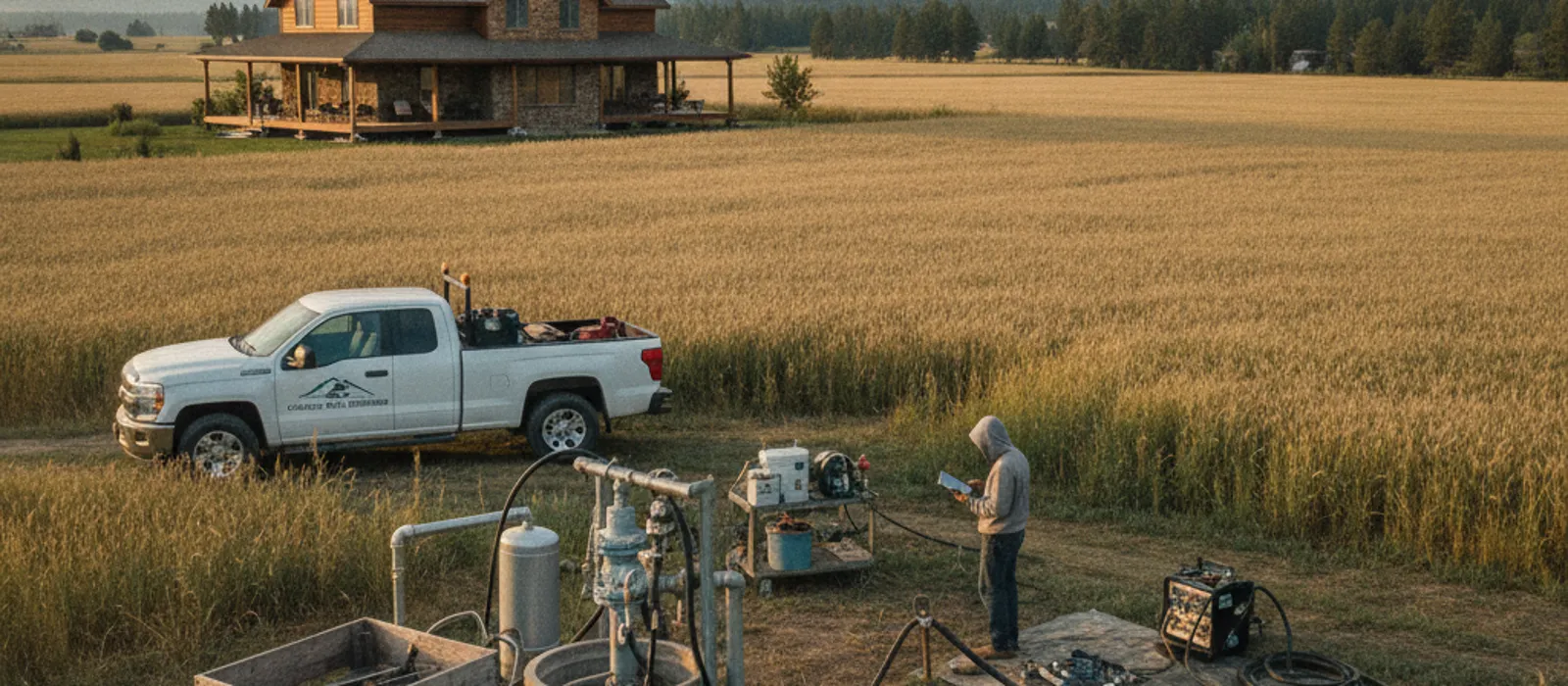
A standard home inspection spends about five minutes on the well. Five minutes, on the one system that decides whether your new house has water at all.
If you’re shopping for a home in Wenatchee, Cashmere, Leavenworth, or anywhere else in North Central Washington’s orchard country, there’s a good chance the property runs on a private well. And here’s the part most buyers don’t realize until it’s too late: a well inspection when buying a house is a separate service from the home inspection, and almost nobody orders it unless they know to ask.
This guide fixes that. We’ll walk through exactly what a real well inspection covers, what the water tests should include, what it all costs, and the red flags that should send you back to the negotiating table. By the end, you’ll know more about well due diligence than most agents in the valley.
Why a Well Inspection When Buying a House Is Non-Negotiable
When you buy a house on city water, the utility owns the problems. When you buy a house on a well, you own everything: the pump, the pressure tank, the casing, the wiring, the water quality, all of it. The day you close, every one of those components becomes your bill.
And the numbers aren’t small. A failed submersible pump in a 300-foot well runs $2,500 to $5,500 to replace. A well that’s losing yield might need deepening or, worst case, a new well, and drilling in Chelan and Douglas counties commonly runs $40 to $75 per foot before the pump system goes in. That’s a $25,000 to $50,000 surprise hiding behind a kitchen faucet that ran fine during your 20-minute showing.
Here’s the thing about wells: they almost always look fine during a showing. The seller runs the tap, water comes out, everyone nods. A showing tells you the well worked for 90 seconds. An inspection tells you whether it’ll work for the next 15 years.
Ask Marcus and Jenna, who bought a 1970s farmhouse outside Cashmere in 2024. The home inspector ran the faucets, checked the box, moved on. Six weeks after closing, the pump started short cycling, and a well company found a waterlogged pressure tank, a corroded pressure switch, and a pump drawing nearly double its rated amps. Total repair: $4,800. A $700 well inspection would have caught every bit of it, and they could’ve negotiated the price down or asked the seller to fix it before closing.
If you’ve got an offer in on a well property anywhere in the Wenatchee Valley, schedule a pre-purchase well inspection with us before your inspection contingency expires. We do them all the time, and we’ll give you a straight report, not a sales pitch.
What a Proper Well Inspection Covers
A real well inspection takes two to three hours, not five minutes. Here’s what should be on the checklist.
The Flow and Yield Test
This is the heart of the inspection. The inspector runs water at a measured rate, usually for one to two hours minimum, while watching the well’s recovery. The question being answered: can this well actually keep up with a household?
For a typical family home, you want to see a sustained yield of at least 5 gallons per minute. Some lenders require documentation of 3 to 5 GPM minimum for financing. A short tap test can’t reveal a low-yield well because the pressure tank and the water sitting in the well casing can mask a weak aquifer for the first 20 or 30 minutes. That’s exactly why sellers’ quick demonstrations mean nothing.
In our area, this matters more than most places. Hot, dry summers push irrigation demand way up, and static water levels in parts of the Columbia River valley drop noticeably by August. A well that tests fine in April can struggle in a dry September. A good inspector will factor seasonal levels into the report. For the full picture on how this testing works, see our guide to well yield testing.
The Pump and Pressure System
The inspector should check:
- Pump age and type. Submersible pumps typically last 10 to 15 years. If the pump is 12 years old, you’re buying a replacement in the near future, and that should be priced into your offer. Our article on how long well pumps last breaks down lifespan by pump type and water conditions.
- Amp draw. A pump pulling high amps is a pump on its way out. This is a five-minute check with a clamp meter that predicts failures months in advance.
- Pressure tank condition. Tap test for waterlogging, check the air precharge, look for rust at the base. A failed tank kills pumps fast.
- Pressure switch and controls. Burned contacts, erratic cut-in and cut-out pressures, and rapid cycling all show up here.
- Cycle behavior. The system should hold pressure with no fixtures running. If the pump kicks on with everything off, there’s a leak or a failing check valve somewhere.
The Wellhead, Casing, and Site
Above ground, the inspector looks at the well cap (it should be tight, vermin-proof, and 6 to 12 inches above grade), the casing condition, and the seal. They’ll also check setbacks: Washington requires wells to be at least 100 feet from septic drainfields and 50 feet from septic tanks. On older rural properties around Quincy and Moses Lake, we find violations of those setbacks more often than you’d think, and a contaminated well next to an old drainfield is a problem money doesn’t easily fix.
The Paper Trail
Every well drilled in Washington since the early 1970s should have a well log on file. You can look it up yourself for free through the Washington Department of Ecology’s well report database. The log tells you the well’s depth, casing size, original yield, and static water level at drilling. Compare the original yield to today’s test and you’ll know whether the well is holding steady or declining.
If the property shares a well with a neighbor, stop and read the shared well agreement before you sign anything. Who pays for the next pump? Who owns the easement? What happens when one party sells? Unwritten handshake arrangements between long-gone neighbors cause real legal headaches. We cover the details in our post on shared wells in Washington.
Water Quality Testing Before You Buy
Flow tells you if you’ll have water. Testing tells you if you’ll want to drink it.
The EPA doesn’t regulate private wells, so nobody is checking this water but you. The EPA’s private well guidance recommends testing at least annually, and a purchase is the one moment you have leverage to make problems the seller’s problem.
At minimum, test for:
- Total coliform and E. coli bacteria. The basic safety screen, and the one most lenders require.
- Nitrates. A big one in orchard and farm country. Decades of fertilizer use in Chelan, Douglas, and Grant counties means elevated nitrates show up regularly, and they’re a genuine health risk for infants and pregnant women.
- Arsenic. Naturally occurring in parts of Washington’s geology. You can’t taste it, smell it, or see it.
- Hardness, iron, and manganese. Not health threats, but they tell you whether you’re also buying a water softener and filtration system, which can add $1,500 to $4,000.
Take Dale, who bought five acres near Quincy in 2023 without a nitrate test. The well water looked and tasted fine. A routine test a year later came back at 12 mg/L, above the 10 mg/L safety standard, and he spent $2,300 on a reverse osmosis system he could have negotiated into the purchase. One $250 lab panel during his contingency period would have shifted that entire cost to the seller.
Use a state-certified lab, and make sure the sample is drawn correctly. We walk through the whole process in our guide to well water testing in the Wenatchee area.
What a Well Inspection Costs When Buying a House
Here’s the honest math. The inspection is cheap insurance against five-figure problems.
| Item | Typical Cost | What It Protects You From |
|---|---|---|
| Basic well inspection (pump, tank, wellhead, controls) | $300 - $500 | $2,500 - $5,500 pump replacement surprises |
| Flow/yield test (1-2 hour drawdown) | $250 - $500 | $25,000+ low-yield or dry well disasters |
| Standard water quality panel (bacteria, nitrates) | $150 - $300 | Health risks, treatment system costs |
| Expanded panel (arsenic, metals, hardness) | $250 - $500 | $1,500 - $4,000 in filtration equipment |
| Full pre-purchase package | $700 - $1,200 | All of the above |
On a $500,000 rural property, a $900 inspection package is 0.18% of the purchase price. It’s the cheapest line item in the entire transaction, and it’s the only one that tells you whether the house actually has reliable water.
Compare that to what we replace after the fact. A complete pump system replacement is detailed in our well pump replacement service page, and the numbers there make the inspection fee look like pocket change.
Want a firm quote for your specific property? Call us at (509) 300-5151 with the address and we’ll pull the well log before we even schedule.
Red Flags That Should Change Your Offer
Not every finding is a deal killer. Most are negotiating points. Here’s how we’d read them.
Negotiate repairs or credits for these:
- Pump over 10 years old with elevated amp draw
- Waterlogged or rusted pressure tank
- Pressure switch cycling outside its rated range
- Sediment in the water, which often signals a failing screen or dropping water level
- Hard water or iron staining that needs treatment equipment
Slow down and dig deeper on these:
- Sustained yield under 5 GPM, especially if tested in spring when levels are highest
- Big gap between the original well log yield and today’s test
- Well casing less than 6 inches above grade, or a cracked or loose cap
- Septic setback violations
- No well log on file at Ecology, which usually means a very old or undocumented well
Think hard before proceeding on these:
- Positive E. coli test that doesn’t clear after shock chlorination
- Nitrates or arsenic well above standards with no treatment in place
- Evidence the well has run dry in past summers (ask the neighbors, they’ll tell you)
- A shared well with no written agreement and an uncooperative co-user
Last spring, a buyer named Teresa called us about a place above Leavenworth. The inspection found 4 GPM in May and a static level 30 feet below the original well log reading. She didn’t walk away. She used the report to negotiate $18,000 off the price, enough to cover a storage tank and low-yield pump system, and she closed knowing exactly what she was getting. That’s what an inspection is for. It doesn’t kill deals. It prices them correctly.
If the well system needs work before or right after closing, we handle everything from pressure tank replacement to full pump swaps, and we’ll coordinate with your closing timeline.
How to Get It Done Without Blowing Your Contingency Window
Most Washington purchase contracts give you a 10-day inspection contingency. That’s tight, but workable if you move on day one.
- Day 1-2: Pull the well log from Ecology’s database yourself. It’s free and takes ten minutes. Order the well inspection and flow test immediately, because good well companies book out.
- Day 2-4: Inspection and flow test happen on site. Water samples go to the lab the same day.
- Day 5-8: Bacteria results come back in 24 to 48 hours. Nitrates and metals take a few days longer. Rush processing is worth the small upcharge.
- Day 8-10: Review the report, then negotiate. Repairs, credits, a price reduction, or a clean walk-away while your earnest money is still protected.
One more tip: don’t let the seller’s well company do the inspection. Get an independent contractor whose only client in the deal is you.
We’ve done pre-purchase inspections from Lake Chelan down to Moses Lake, and we know what the lenders and the local water tables both demand. Request your free estimate here and we’ll work inside your contingency clock.
Frequently Asked Questions
Is a well inspection required when buying a house in Washington?
Not by state law for a standard purchase, but many lenders require water testing and proof of adequate yield, and FHA, VA, and USDA loans have specific well requirements including septic setbacks and bacteria tests. Even when nobody requires it, skipping it means accepting the well’s condition sight unseen. For rural properties, treat it as mandatory.
How long does a well flow test take?
Plan on one to two hours of sustained pumping, plus setup and recovery monitoring. Shorter tests can’t see past the water stored in the casing and pressure tank, so a 15-minute test is close to worthless. The full inspection visit, including the pump and tank evaluation, usually runs two to three hours.
Who pays for the well inspection, buyer or seller?
The buyer typically pays, just like a home inspection, because the report needs to serve your interests, not the seller’s. Costs run $700 to $1,200 for a full package with water testing. If the inspection finds problems, you can often negotiate repair credits that pay for the inspection many times over.
What if the well fails the inspection?
A failed component like an old pump or a waterlogged tank is a negotiation item, not a deal breaker, and sellers fix or credit these all the time. Low yield or serious contamination is more significant, but even then you can price in storage tanks, treatment systems, or in rare cases a new well. The inspection’s job is to make sure you decide with real numbers instead of finding out after closing.