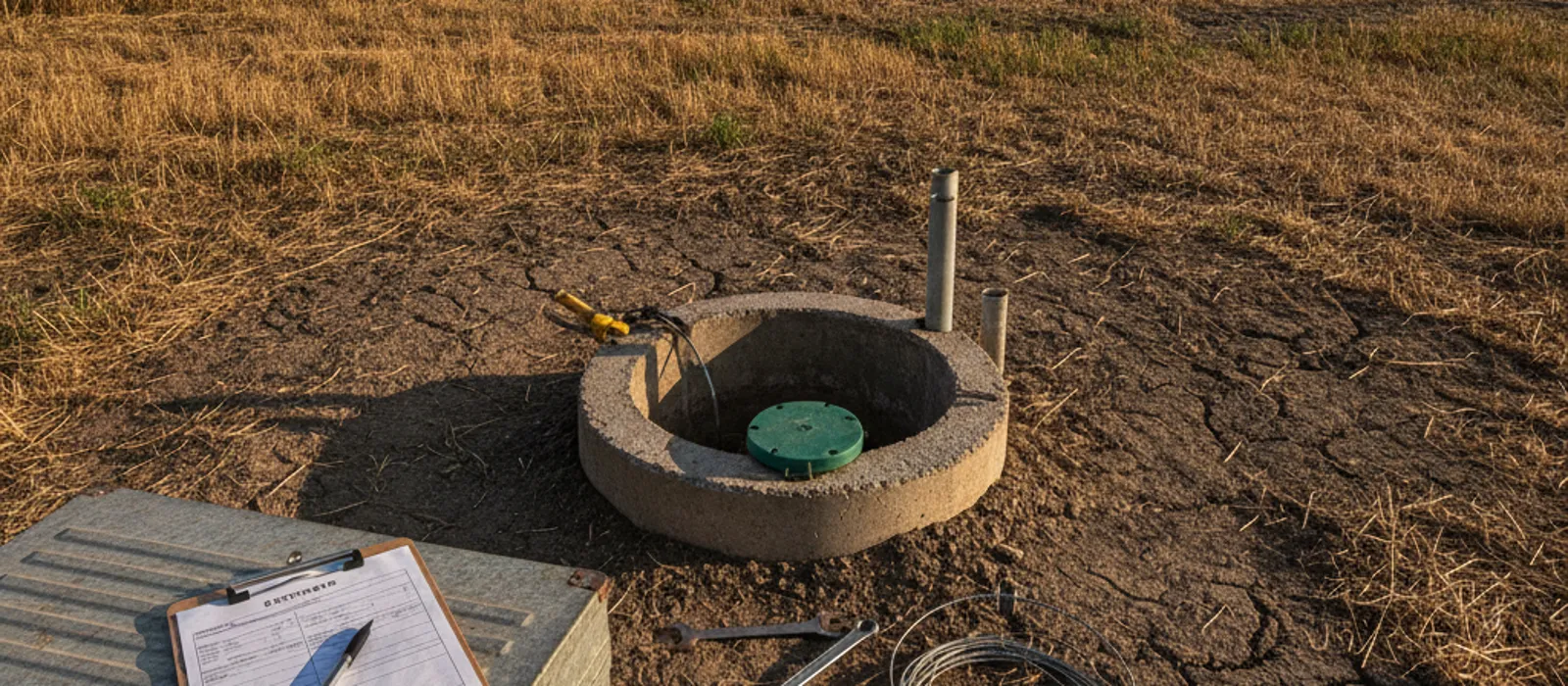
That rusty pipe sticking out of the ground behind the old orchard rows? If it’s an unused well, Washington law says it’s your problem until it’s properly sealed. And no, dumping a few wheelbarrows of gravel down it doesn’t count.
If you own rural property around Wenatchee, Cashmere, or Quincy, there’s a decent chance you’ve got an old well somewhere on the parcel. Maybe it ran dry. Maybe you drilled a new one and forgot about the first. Either way, well decommissioning in Washington isn’t optional, and it isn’t something you can do with a tractor and a Saturday afternoon.
The good news is that the process is straightforward once you know the rules. In this guide we’ll cover what Washington actually requires, what decommissioning costs in 2026 (real numbers, not ranges so wide they’re useless), how the work gets done, and when it makes sense to save an old well instead of sealing it.
If you already know you’ve got an abandoned well that needs to go, call us at (509) 300-5151 and we’ll walk the site with you. Estimates are free, and we handle the state paperwork.
Why Washington Takes Abandoned Wells So Seriously
An unused well isn’t just a hole. It’s a direct, unfiltered pipeline from the surface straight into the aquifer your neighbors drink from.
Here in North Central Washington, most rural homes pull from the same groundwater. A single open or poorly sealed well can let surface runoff, fertilizer, orchard spray residue, septic leakage, or a drowned rodent flow right down into that shared water supply. The casing that once protected the water becomes the contamination shortcut. The EPA’s private well program flags abandoned wells as one of the most common preventable threats to rural groundwater.
There’s also the physical hazard. Old dug wells in particular, the wide ones from the 1940s and 50s, are big enough for a kid, a dog, or a deer to fall into. We’ve seen them hiding under a sheet of plywood with thirty years of pine needles on top.
And then there’s liability. In Washington, the well stays the property owner’s responsibility forever, even if it was drilled three owners ago. If your abandoned well contaminates a neighbor’s water or someone gets hurt, that lands on you. Sellers around the Wenatchee Valley are also finding that lenders and buyers increasingly demand proof of proper decommissioning before closing. We cover that more in our guide to well inspections when buying a home.
Washington Well Decommissioning Rules: What the Law Requires
Washington regulates wells under chapter 18.104 RCW and chapter 173-160 WAC, administered by the Washington Department of Ecology. The rules are specific, and they exist because “filled with whatever was handy” wells kept poisoning aquifers.
Here’s what the state requires when a well is permanently taken out of service:
A licensed driller has to do the work. Decommissioning must be performed by a Washington licensed water well contractor, the same license required to drill a well. There’s a narrow exemption for owners working on their own property, but you’d still have to follow every technical standard, file the same paperwork, and somehow place grout properly at depth without a grout pump and tremie pipe. In practice, this is licensed-driller work.
A Notice of Intent gets filed first. Ecology must be notified before work begins, at least 72 hours ahead. Your contractor files this. It’s routine paperwork, but skipping it can void the whole job in the state’s eyes.
The well gets sealed bottom to top with approved materials. Not dirt. Not gravel. Not old concrete chunks. The rules require sealing material like bentonite or neat cement grout, placed from the bottom of the well upward so there are no gaps or bridges. Pumps, piping, wiring, and debris come out first.
The casing gets handled correctly. Depending on the well’s construction, the casing may be perforated so grout can squeeze into the space around it, cut off below ground surface, or pulled entirely. The goal is restoring the natural barrier between water-bearing zones that the well punched through.
A decommissioning report gets filed afterward. Within 30 days of finishing, the contractor files a report with Ecology documenting how the well was sealed. That report is your proof, and it matters at sale time. Keep a copy with your property records.
One more wrinkle that surprises people: most residential wells in our area are permit-exempt wells, meaning they never needed a water right to drill. That exemption covers use, not abandonment. The decommissioning rules apply to every well, exempt or not. If you’re fuzzy on how exempt wells work, our post on permit-exempt wells in Washington breaks it down.
What Well Decommissioning Costs in Washington
Now the question everyone actually wants answered. For most residential wells in Chelan, Douglas, and Grant counties, proper decommissioning runs $1,200 to $4,000. The biggest cost drivers are depth, diameter, access, and what’s still stuck down the hole.
Here’s how it typically breaks out in our service area in 2026:
| Well type | Typical depth | Typical cost |
|---|---|---|
| Shallow dug or jet well | 25 to 60 ft | $900 to $1,800 |
| Standard drilled well (6 in casing) | 100 to 200 ft | $1,500 to $3,200 |
| Deep drilled well | 250 to 400+ ft | $2,800 to $6,000 |
| Pump and pipe removal (if equipment remains) | any | add $300 to $800 |
| Fishing out stuck or dropped equipment | any | add $500 to $2,000+ |
| Poor access (steep lot, no truck path) | any | add $300 to $1,000 |
Why the spread? Sealing material is the main variable. A 300 foot well holds a lot more grout than a 60 foot one, and bentonite isn’t cheap by the ton. Wide old dug wells can swallow surprising amounts of fill and engineered seal. And if a previous owner dropped a pump down the hole in 1987, somebody has to fish it out before grouting can start.
For perspective, decommissioning usually costs about a tenth of what drilling a replacement well does. If you’re weighing both ends of that equation, see our breakdown of well drilling costs in Washington.
A real example. Rita in East Wenatchee bought a 1962 orchard property last spring with two wells on it, the active house well and an old irrigation well nobody had touched since the orchard came out. Her lender flagged the abandoned well during underwriting. The well was 140 feet with a seized pump still hanging on rotten poly pipe. Pulling the equipment took half a day, sealing took another. Total bill: $2,650, and she had the Ecology report in hand nine days before closing. Compare that to the $11,000 escrow holdback the lender wanted if it stayed unsealed.
Not sure what’s down your old well or how deep it goes? Request a free estimate and we’ll scope it with a camera before quoting, so the number you get is the number you pay.
The Decommissioning Process, Step by Step
Most residential decommissioning jobs take one to two days on site. Here’s what actually happens.
1. Site assessment and records check
We pull the original well log from Ecology’s database if one exists, which tells us depth, casing size, and construction. No log? We measure and camera the well ourselves. This is where we find the surprises, like the Hendersons’ place near Chelan, where the “60 foot well” on a faded 1971 log turned out to be 240 feet with a liner inside the original casing. Better to know before the bid than after.
2. Notice of Intent filed with Ecology
We file the NOI and wait out the notice period. You don’t touch this paperwork, it’s on us.
3. Equipment removal
The pump, drop pipe, wiring, and pitless adapter all come out. Anything dropped or stuck gets fished. The hole has to be clear top to bottom, because grout poured on top of a stuck pump leaves an unsealed void below it. That void is exactly the contamination pathway the law is trying to close.
4. Sealing from the bottom up
Bentonite chips or grout, or neat cement, goes in through a tremie pipe lowered to the bottom of the well. We fill upward in measured lifts, verifying the level as we go. On cased wells we may perforate the casing at set intervals so the seal pushes into the annular space outside the pipe.
5. Surface finish and reporting
The casing gets cut off below grade, the last few feet are sealed, and the surface is restored so you can mow, plant, or pave over it. Within 30 days, the decommissioning report goes to Ecology and a copy goes in your file.
One honest warning. We sometimes get called to “finish” a well someone already half filled with rock and concrete chunks. Clearing a botched DIY fill costs more than decommissioning an untouched well, sometimes double, because drilling out debris is slow work. If you’ve got an open well, leave it capped and call a licensed contractor first.
Should You Decommission, or Is the Old Well Worth Saving?
Here’s something a lot of contractors won’t tell you: not every old well should be sealed. Around here, water is valuable. Before you spend money closing a well forever, it’s worth an hour figuring out what you’ve got.
Decommissioning is the right call when the well is dry, collapsed, contaminated beyond treatment, in the way of construction, or so badly built that repair costs more than replacement. It’s also usually required when a well sits within the footprint of a new septic system or building pad.
But plenty of “dead” wells aren’t dead. Gary out in Quincy nearly sealed a 180 foot well that hadn’t produced water in a decade. Everyone assumed it was dry. Our camera found the real story: a corroded casing split at 90 feet had let silt bury the pump. A casing liner and a new submersible brought it back at 18 gallons per minute, and now it irrigates his pasture for about $6,400, far less than the $25,000 a new irrigation well would’ve run. If the structure is sound, problems like a failed pump are fixable, and our well pump replacement service in Wenatchee handles that end of it.
A salvageable old well can become an irrigation source, livestock supply, or backup. A flow test and camera inspection typically runs a few hundred dollars, cheap insurance before a permanent decision. And if your current well has died suddenly and you’re deciding between fixing it and starting over, that’s exactly the kind of call our well pump repair team in Wenatchee makes every week.
Either way, don’t let an open well sit. Cap it securely today, decide its future this month. If you want a straight answer on seal-it versus save-it, give us a call at (509) 300-5151. We’ll tell you honestly which one your well deserves, even when the answer makes us less money.
Frequently Asked Questions
Can I decommission my own well in Washington?
Technically there’s a limited owner exemption, but you’d still have to meet every standard in chapter 173-160 WAC, file the Notice of Intent and decommissioning report, and place grout from the bottom up through a tremie pipe. Almost no homeowner has the equipment to do that correctly. A bad seal can contaminate the aquifer and leaves you liable, so this is one job that belongs with a licensed well contractor.
How much does it cost to decommission a well in Washington?
Most residential wells in the Wenatchee area run $1,200 to $4,000 depending on depth, diameter, and access. Shallow wells under 60 feet often come in under $1,800, while deep wells past 250 feet can reach $6,000. Stuck pumps, dropped debris, or a previous DIY fill attempt add cost because the hole has to be cleared before sealing.
Do I have to decommission an old well before selling my property?
State law requires unused wells to be properly decommissioned regardless of a sale, but a sale is usually when it gets enforced. Lenders, inspectors, and buyers’ agents flag abandoned wells, and many lenders won’t close until you produce Ecology’s decommissioning report. Handling it before listing is cheaper and faster than doing it under deadline during escrow.
How long does well decommissioning take?
Most residential jobs take one to two days on site, plus the 72 hour notice period before work starts. Wells with stuck equipment, collapsed sections, or difficult access can stretch to several days. Start to finish, including paperwork, plan on one to two weeks, so don’t wait until the week before closing to schedule it.