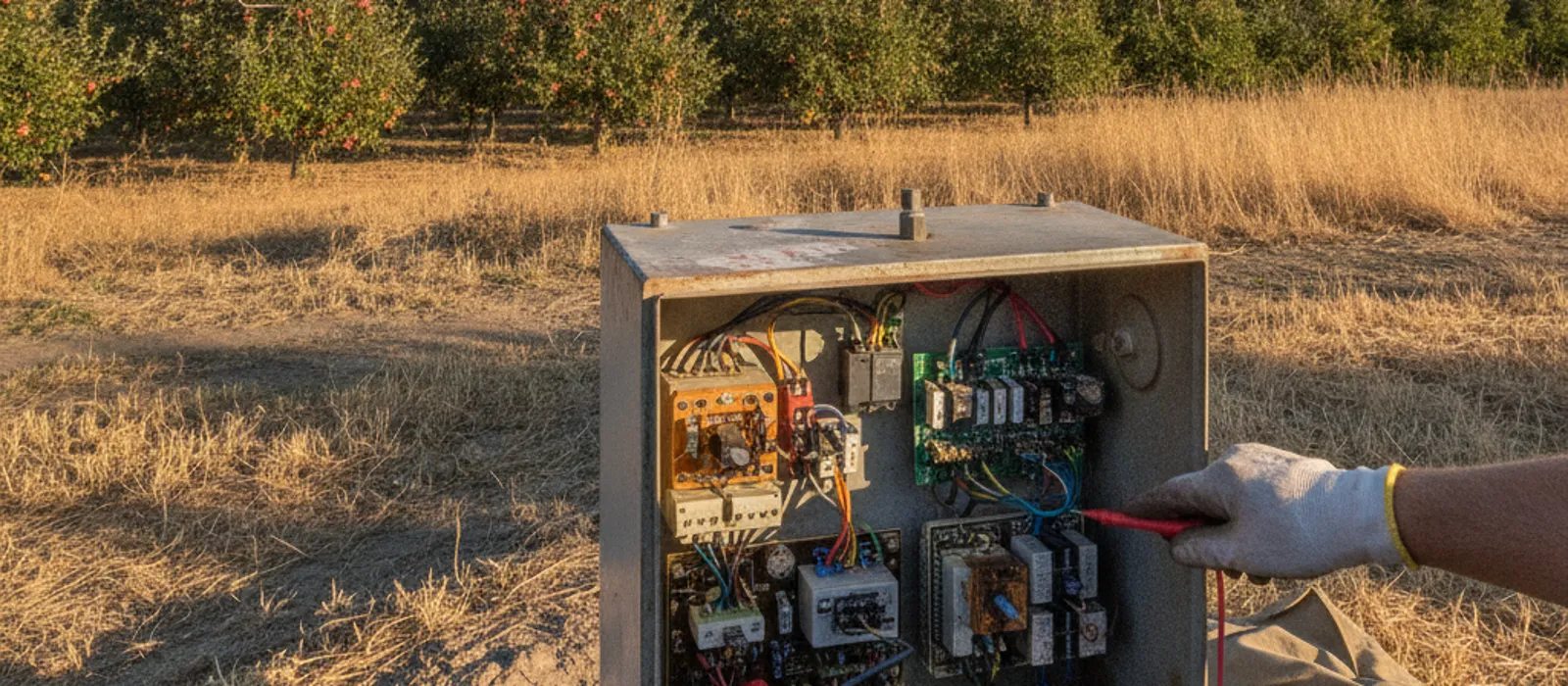
Your pump hums for a second, maybe kicks the breaker, then goes dead silent. Before you assume the pump itself is shot and start pricing a $3,000 replacement, there’s a smaller, cheaper box worth checking first. On a 3-wire submersible system, the well pump control box is often the actual culprit, and swapping it runs a fraction of what a new pump costs.
We see this mix-up constantly across the Wenatchee Valley. A homeowner hears a hum or a click, assumes the worst, and calls asking about pump replacement. Half the time the pump down the hole is fine. It’s the little metal box mounted near the pressure tank, usually gray or green, about the size of a large lunchbox, that’s given out. If you want the short version now, call us at (509) 300-5151 and we’ll walk you through it over the phone before you spend a dime.
What a Well Pump Control Box Does
A submersible well pump needs one of two wiring setups. A 2-wire pump has all the starting components built into the motor itself, down in the well, and it wires straight to the pressure switch. A 3-wire pump keeps the start components up top, in a separate control box mounted in the pump house or basement, with three wires running down the well to the motor instead of two.
That separation matters. On a 2-wire pump, if the start components fail, you’re pulling the whole pump to fix it, which means pulling pipe out of a well that might be 200 to 400 feet deep. On a 3-wire system, the same failure is a box sitting at eye level next to your pressure tank. You unscrew four screws, not a few hundred feet of drop pipe.
The control box’s job is simple to describe and important to get right. It gives the motor a jolt of extra torque to get it spinning, then switches over to steady running power once the motor is up to speed. It also protects the motor from overload, and on some models it senses if the pump is running dry. Every one of those jobs depends on small components that wear out on a schedule, whether you notice them or not.
Inside the Box: Capacitors, Relays, and the Parts That Fail
Pop the cover off a 3-wire control box (with the power off, always) and you’ll find a handful of parts doing all the work.
- Start capacitor. This stores a jolt of energy and releases it to help the motor overcome resistance the instant it starts. It’s usually a small cylindrical or oval component, and it’s the single most common failure point in any control box.
- Run capacitor, on some models. Keeps current smooth once the motor is running. Less common to fail than the start capacitor, but it happens.
- Relay (or starting switch). This is the component that decides when to disconnect the start capacitor once the motor spins up. Contacts inside it pit and weld shut over time, the same way a pressure switch’s contacts do.
- Overload protector. A safety component that trips if the motor draws too much current, protecting the motor from cooking itself. If this trips repeatedly, something downstream, often the pump motor or wiring, is the real problem.
These parts run hot inside a sealed box, and in orchard country pump houses that swing from freezing in January to over 100 degrees in August, that heat cycling shortens their life. A control box lasts 5 to 15 years depending on the brand, how hard the pump cycles, and how well ventilated the pump house is. Cheap or off-brand boxes tend toward the short end of that range.
If your system is due for a checkup anyway, our well pump repair team in Wenatchee tests the box, the switch, and the pump motor together, so you’re not guessing which one failed.
Common Well Pump Control Box Problems and What They Sound Like
Here’s what we run into most often on service calls, roughly in order of frequency.
The pump hums but doesn’t start
A single low hum, then nothing, almost always points to a failed start capacitor. The motor gets power but never gets the torque boost it needs to actually spin. Left alone, this can overheat the motor windings in minutes, so don’t keep flipping the breaker hoping it’ll catch. Turn it off and get it looked at.
The pump starts, runs a few seconds, then shuts off
This is a relay or overload protector doing its job, tripping because something isn’t right. Sometimes it’s a bad relay itself. Sometimes it’s a genuinely struggling motor drawing too much current, which the box is correctly flagging. We covered the breaker side of this pattern in our post on a well pump tripping the breaker, which is worth a read if your panel breaker is the one going, not just the box.
Burning smell or visible scorch marks
Capacitors that fail hard sometimes bulge, leak, or scorch the inside of the box. A burning smell near the control box means power off immediately, no exceptions. This isn’t a tap-it-and-see-if-it-works situation. A shorted capacitor can arc, and the box carries 230 volts.
Buzzing or clicking with no pump response
A relay with pitted or welded contacts buzzes or chatters without actually engaging the motor. It sounds similar to a bad pressure switch, which is exactly why so many homeowners misdiagnose this one. More on telling the two apart below.
Pump runs, but weak or intermittent
If the run capacitor is degrading rather than fully dead, the motor may run rough, cycle oddly, or lose power under load. This one’s sneakier because the system half-works, so people put off calling until it fails completely, usually at the worst time.
Kyle out in Cashmere had this exact pattern for about three weeks. The pump would hum, catch on the second or third try, then run fine. He figured it was just an old system being an old system. When it finally quit for good on a Sunday, our tech found a start capacitor that had been slowly cooking itself for months. A $220 same-day capacitor swap fixed it. Had he called at week one instead of week three, it would’ve been a scheduled weekday visit instead of a weekend emergency call.
Control Box vs. Pressure Switch: How to Tell Which One Failed
This is the mix-up we untangle more than almost anything else. Both parts sit near the pressure tank. Both can click, buzz, or go silent. Both failures look identical from the kitchen faucet: no water.
Here’s the practical difference. The pressure switch tells the system when to call for water, based on tank pressure. The control box is what actually starts and runs a 3-wire motor once that call comes in. If your system uses a 2-wire pump, there’s no separate control box at all, and the pressure switch is your only suspect.
A quick way to narrow it down without opening anything: listen at the pressure switch first. If you hear a clean click when pressure drops and the pump still doesn’t run, the switch is doing its job and the problem is downstream, likely the control box or the pump itself. If you never hear a click at all, start with the switch. We wrote a full breakdown of switch symptoms in our guide to well pressure switch problems, and it’s worth ten minutes if you’re not sure yet which box you’re dealing with.
One more clue: a 3-wire control box will have three or four wires running down toward the well plus wires to the pressure switch and power. A 2-wire setup has a much simpler wiring picture. If you’re not confident identifying which system you have, that’s a fair reason to call rather than guess. Request a free estimate and we’ll identify the system and the failure point in one visit.
Troubleshooting a Well Pump Control Box Safely
There’s a real limit to what’s safe to check yourself here, more so than with a pressure switch. Control boxes carry higher voltage and the capacitor inside can hold a charge even after power is cut. Here’s what’s reasonable to do on your own, and where to stop.
Safe to check yourself:
- Confirm the breaker isn’t tripped, and if it trips again immediately after resetting, stop and call a pro rather than resetting it repeatedly.
- Look (don’t touch) for obvious scorch marks, melted plastic, or a burning smell with the cover on.
- Note the exact symptom pattern (hum only, runs then trips, clicks with no motor response) so whoever you call can bring the right parts.
Not a DIY job:
- Opening the box and testing components with a multimeter. Capacitors store a charge and can shock you even with the breaker off, unless properly discharged first.
- Replacing the capacitor, relay, or the box itself. Matching the wrong capacitor rating to your motor’s horsepower can damage the motor.
- Anything involving the wiring going down into the well itself.
The EPA’s guidance for private well owners is blunt about leaving well system electrical work to licensed professionals, and that’s exactly the line we’d draw with our own families. A control box replacement takes a trained tech under an hour. A DIY mistake with a live capacitor can put you in the ER.
Diane in Chelan smelled something faintly hot near her pump house after a thunderstorm rolled through and correctly killed the breaker before touching anything. A power surge from a nearby lightning strike had fried her control box. Because she didn’t poke around inside it, our tech swapped the box safely the next morning for $410, and nobody got hurt in the meantime. That’s the outcome we want for every call like this.
What Well Pump Control Box Repair Costs in the Wenatchee Valley
Here’s what these jobs typically run across Chelan, Douglas, and Grant counties.
| Repair | Parts | Typical Total (Installed) | Time |
|---|---|---|---|
| Start capacitor replacement | $30 to $80 | $150 to $300 | Under 1 hour |
| Relay replacement | $40 to $90 | $175 to $350 | Under 1 hour |
| Full control box replacement | $80 to $200 | $250 to $450 | About 1 hour |
| Control box failure that damaged the pump motor | varies | $1,800 to $4,500 | Same day to a few days |
| Emergency after-hours call | varies | add $150 to $300 | Same day |
A few notes on those numbers. Replacing just the failed component, say a capacitor, is usually cheaper than swapping the whole box, but if the box is more than 10 years old, we’ll often recommend replacing the whole unit anyway, since the other components are living on borrowed time too. It’s a similar logic to what we lay out in our well pump replacement cost guide, where fixing one part of an aging system sometimes just delays the next failure by a few months.
If a bad control box let the motor run in a damaged state for too long, and the motor itself burned out, you’re now looking at pump replacement territory. That’s the scenario worth avoiding by catching the humming-and-tripping pattern early rather than resetting the breaker over and over. Our well pump replacement service in Wenatchee handles it when that’s genuinely the fix needed, but a $250 box swap beating a $3,000 pump job is the outcome we’re always rooting for.
Keeping Your Control Box Alive
A few habits stretch the life of this part in our climate:
- Keep the pump house ventilated. Heat is the enemy of capacitors. A box baking in a sealed, uninsulated shed in August fails faster than one with airflow.
- Don’t reset a tripped breaker more than twice. If it trips a third time, you’re not fixing anything by resetting it again, you’re risking more damage.
- Listen for the pattern, not just the silence. A hum-then-nothing or a run-then-trip pattern is diagnostic information. Note it before you call.
- Have it inspected around year 8 to 10. Most boxes are still fine at that age, but it’s a reasonable point to have a tech check capacitor condition during a routine visit.
- Protect against power surges. Rural power around Quincy and Moses Lake sees its share of storm-related surges. A whole-house or dedicated surge protector is cheap insurance for a box that isn’t.
If your pump hums and quits right now, don’t keep flipping the breaker. Schedule a free estimate or call (509) 300-5151 any hour, and we’ll figure out whether you’re looking at a $200 capacitor or something bigger before any work starts.
Frequently Asked Questions
How do I know if my well pump control box is bad, not the pump itself?
The clearest sign is a motor that hums for a second or two and then stops, without ever fully spinning up. That points to a failed start capacitor inside the box rather than a dead pump motor. A pump that runs fine but shuts off after a few seconds, or a box with visible scorch marks or a burning smell, also points to the box rather than the pump downhole.
Can I replace a well pump control box myself?
We don’t recommend it. The box carries 230 volts and the capacitor inside can hold a dangerous charge even after the breaker is off. Matching the wrong capacitor or relay to your motor’s specs can also damage the pump. At $250 to $450 installed, professional replacement is affordable enough that the risk isn’t worth taking on yourself.
What’s the difference between a control box and a pressure switch?
The pressure switch tells the system when water is needed, based on tank pressure. The control box, found only on 3-wire pump setups, is what actually starts and runs the motor once that call comes in. Both sit near the pressure tank and can click or buzz when failing, which is why they get confused, but they’re separate parts with separate failure points.
How long does a well pump control box last?
Most last 5 to 15 years, with heat, cheap components, and frequent power surges shortening that range. A box in a hot, poorly ventilated pump house tends to fail earlier than one with good airflow. If yours is past the 10-year mark and showing any symptoms, replacing the whole box rather than just one component is usually the better value.