A coliform test at the lab costs about $30. The week your family spends fighting a stomach bug from contaminated well water costs a whole lot more. And here’s the part that surprises most well owners around Wenatchee: bacteria has no taste, no smell, and no color. Your water can look perfect coming out of the tap and still fail a test.
If you’ve had a positive bacteria test, or you’re tired of shock chlorinating your well every spring, you’re in the right place. A UV water treatment well system kills bacteria, viruses, and parasites using nothing but light. No chlorine taste. No chemicals to store. No guesswork.
In this guide, we’ll walk through how UV systems actually work, what they kill and what they don’t, real installed costs for our area, and the one mistake that makes half of these systems useless. By the end, you’ll know whether UV makes sense for your well.
Why Well Owners Around Wenatchee Keep Failing Bacteria Tests
Private wells in Chelan, Douglas, and Grant counties deal with a specific set of problems. Spring snowmelt pushes surface water down through fractured rock. Orchard irrigation keeps soil saturated for months. Older wells, and we have plenty of them, often have cracked caps or shallow casings that let runoff seep in.
The result is predictable. A well that tests clean in February can test positive for total coliform in May. The Washington State Department of Health recommends testing private wells for bacteria at least once a year, and after any flooding or work on the well. Most folks don’t.
Marcy in Cashmere learned this the hard way. She bought a 1970s orchard house in 2024 and the well tested positive for total coliform that first spring. She shock chlorinated it herself, about $40 in supplies and a full weekend of work. The retest came back clean. Then the August test came back positive again. After the second shock treatment failed to hold through fall, she had us install a UV system for $1,450. Every test since has been clean.
That’s the pattern we see constantly. Shock chlorination kills what’s in the well today. It does nothing about what seeps in next week. UV treats every gallon, every day.
If your well has already tested positive and you’re not sure what to do next, call us at (509) 300-5151. We’ll talk you through your options for free, no pressure.
How UV Water Treatment for Well Systems Actually Works
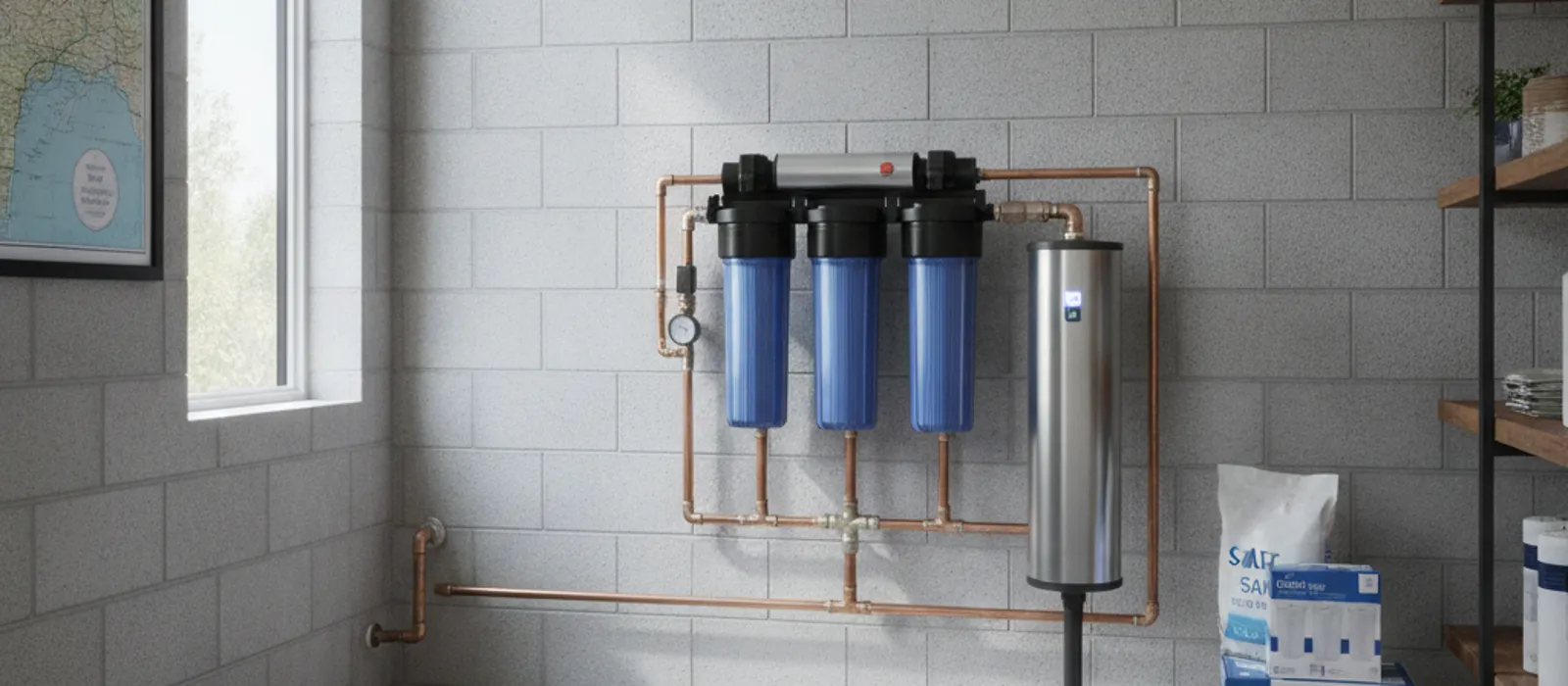
The science is simple and it’s been used in city water plants for decades. Water from your pressure tank flows through a stainless steel chamber. Inside that chamber sits a UV lamp protected by a clear quartz sleeve. As water passes the lamp, ultraviolet light at a wavelength of 254 nanometers scrambles the DNA of any microorganism in the water.
The organism isn’t filtered out. It’s still in the water. But its DNA is so damaged it can’t reproduce, which means it can’t infect you.
A few things make UV a great fit for wells in our area:
- It treats everything, all the time. Every gallon that enters your house passes the lamp. There’s no dosing to manage and no chemical to run out of.
- It adds nothing to the water. No chlorine taste, no byproducts, no change in pH. Your water tastes exactly the same.
- It’s fast. Water is treated in the second it takes to flow through the chamber. No contact tank needed.
- It’s cheap to run. A typical residential unit draws 40 to 60 watts, about the same as an old light bulb. Figure $30 to $60 a year in electricity.
The system installs on the main line after your pressure tank, usually in the pump house or where the line enters the home. A correctly sized residential unit handles 10 to 15 gallons per minute, which covers most households even with two showers and a load of laundry running.
One thing UV won’t fix is delivery problems. If your pressure is weak or the pump is cycling oddly, that’s a separate issue, and it’s worth reading up on low water pressure from a well before assuming treatment equipment is the culprit.
What UV Kills, and What It Won’t Touch
This is where people get into trouble, so let’s be direct about it.
UV kills or deactivates:
- E. coli and total coliform bacteria
- Giardia and Cryptosporidium, which chlorine struggles with
- Viruses like norovirus and hepatitis A
- Most other waterborne pathogens, typically at a 99.99 percent rate in a properly sized unit
UV does nothing about:
- Iron, manganese, or hardness minerals
- Nitrates from fertilizer or septic systems
- Arsenic, lead, or other metals
- Sediment, sand, or tannins
- Bad tastes and odors
That second list matters in orchard country. A lot of wells around Quincy and Moses Lake have nitrate issues from decades of agriculture, and UV won’t help with that at all. The EPA’s private well guidance is clear that you should test for what’s actually in your water before buying any treatment equipment, and we agree completely.
So the honest framing is this: UV is a disinfection tool, not a filtration tool. It solves the bacteria problem better than anything else on the market. For everything else, you pair it with the right filter. Our breakdown of well water filtration systems covers how the pieces fit together.
What a UV Water Treatment Well System Costs
Here are real numbers for our service area in 2026, installed by a licensed pro. DIY equipment costs run 30 to 40 percent less, but read the pretreatment section below before you order anything online.
| Item | Typical Installed Cost |
|---|---|
| Basic UV unit, 10 GPM, point of entry | $700 - $1,200 |
| UV with 5-micron sediment prefilter | $1,200 - $2,000 |
| UV plus iron or heavy sediment pretreatment | $2,500 - $4,500 |
| Annual replacement lamp | $80 - $150 |
| Quartz sleeve, every 2 to 3 years | $40 - $90 |
| Yearly electricity | $30 - $60 |
A few notes on those numbers. The lamp is not optional maintenance. UV lamps lose intensity over time, and after about 9,000 hours, roughly one year of continuous use, the output drops below the level needed to reliably kill pathogens, even though the lamp still glows blue. Mark a calendar date and change it annually, period.
Better units include a lamp countdown timer and an audible alarm. The best ones add a UV intensity sensor and a solenoid valve that physically shuts off water flow if the dose drops too low. For a family that’s had E. coli in the well before, we usually recommend spending the extra $300 to $500 for that failsafe.
Compare that to the alternatives. Shock chlorination runs $200 to $400 per professional treatment and often needs repeating. A chemical injection chlorinator costs $1,500 to $3,000 installed, requires monthly chemical handling, and changes the taste of your water. Spread over ten years, UV is usually the cheapest option that actually works continuously. Want a number for your specific setup? Request a free estimate and we’ll spec it out.
Pretreatment: The Step That Makes or Breaks Your System
Here’s the dirty secret of UV treatment. The light has to actually reach the organisms. If your water carries sediment, iron staining, or cloudiness, particles shadow the bacteria and the UV passes right by them. The industry calls this UV transmittance, and it’s the single biggest reason UV systems fail in the field.
The Hendersons in Quincy found this out four months after installing a UV unit themselves. They skipped the sediment prefilter to save $200. Fine silt from their well coated the quartz sleeve in a gray film, and the lamp behind it might as well have been off. Their follow-up bacteria test came back positive even though the system showed green lights across the board. We pulled the sleeve, cleaned it, added a 5-micron prefilter ahead of the unit, and the next test was clean. Total fix: $180 service call plus $260 for the filter setup.
The rule of thumb for water entering a UV chamber:
- Less than 0.3 ppm iron
- Less than 0.05 ppm manganese
- Hardness under 7 grains per gallon, or the sleeve scales up
- Turbidity under 1 NTU, which basically means visually clear water
Plenty of wells around here blow past those numbers, especially on iron. If yours does, you’ll need an iron filter or softener ahead of the UV unit. That’s the $2,500 to $4,500 scenario in the table above. It costs more, but a UV system on dirty water is just an expensive blue night light.
Sediment can point to bigger issues too. If you’re seeing grit in aerators or cloudy water after the pump kicks on, look into sediment in well water causes before spending money on treatment. Sometimes the real problem is a failing pump or a casing issue, and our well pump repair team can usually tell you which it is in one visit.
UV vs Shock Chlorination: Which One Does Your Well Need?
These two get confused constantly, so here’s the clean breakdown.
Shock chlorination is a one-time event. You flood the well and plumbing with a strong chlorine solution, let it sit, then flush it out. It’s the right move after well repairs, after a flood, or after a single positive test on a well with no history of problems. Our guide to shock chlorinating a well walks through the whole process.
UV is continuous protection. It’s the right move when contamination keeps coming back, when the source of bacteria can’t be fixed, or when you simply want every gallon disinfected without thinking about it.
A quick story that shows the difference. Gary has a cabin near Leavenworth on a shallow 60-foot well, maybe 200 yards from a seasonal creek. Every June, snowmelt raised the water table and his well tested positive like clockwork. He shocked it three years running, about $250 a year paying someone to do it, and it never held past mid-summer. The geology was the problem, and you can’t chlorinate geology. A $1,600 UV system with prefilter ended the cycle. Three clean Junes since.
The decision tree is honestly pretty simple:
- One positive test, no history? Shock the well, fix any obvious cap or casing issues, retest in two weeks.
- Repeat positives, shallow well, or surface water influence? Install UV. Stop fighting a battle you can’t win with chlorine.
- Positive for E. coli specifically? Stop drinking the water now, use bottled, and treat it as urgent. E. coli means sewage or animal waste is reaching your well.
That third one isn’t a wait-a-week situation. If you’ve got E. coli or you’ve suddenly lost water entirely, our emergency well service line runs 24/7. Call (509) 300-5151 and we’ll get someone out fast.
Living With a UV System: The Maintenance Reality
Good news first. UV is about the lowest-maintenance treatment equipment you can own. There’s no salt to haul, no media to replace, no chemicals to mix. The full annual routine takes most people under an hour.
Here’s the yearly checklist we give customers:
- Replace the lamp every 12 months. Even if it still lights up. Write the date on the unit with a marker.
- Clean the quartz sleeve when you change the lamp. A soft cloth and a little vinegar removes mineral film. Handle it with gloves, skin oils etch into hot quartz.
- Replace the sleeve every 2 to 3 years, or sooner if it’s scratched or permanently clouded.
- Change the sediment prefilter cartridge every 6 to 12 months depending on your water.
- Test your water annually even with the system running. A $30 coliform test is your proof the whole setup is working. Our post on well water testing in the Wenatchee area covers where to send samples and what to ask for.
Two warnings worth repeating. First, UV systems need constant power. If your pump house loses electricity, the lamp goes dark while water can still flow on tank pressure, untreated. After any outage longer than a few minutes, run taps for a couple minutes before drinking. Second, winter matters here. A UV chamber full of water will crack if it freezes, and pump houses in Leavenworth and Chelan see plenty of nights below zero. Insulate the unit like you’d insulate the rest of the system.
One safety note since these units are hardwired or plugged in near water: lamp and sleeve swaps are fine for a homeowner with the power off. Anything involving the wiring, the solenoid valve, or plumbing modifications belongs to a pro. The repair bill for a flooded pump house wipes out years of DIY savings.
If you’re weighing UV against other options, or your bacteria problem might really be a well construction problem, we’re happy to look at your test results and shoot straight with you. Set up a free consult, or just call. We’ve installed these systems from Cashmere to Moses Lake and we know what works in this valley’s water.
Frequently Asked Questions
How often do I need to replace the UV lamp in a well system?
Every 12 months, no exceptions. UV lamps lose germicidal intensity long before they burn out, so a lamp that still glows blue at 14 months may not be killing anything. Most quality units have a countdown timer or alarm to remind you. Budget $80 to $150 per year for the replacement.
Does UV treatment change the taste or smell of well water?
No. UV adds nothing to the water and removes nothing from it, so taste, odor, and chemistry stay exactly the same. That’s the main reason people choose it over chlorine injection. If your water already tastes or smells off, that’s a separate issue that needs filtration, not disinfection.
Can I install a UV water treatment system on my well myself?
A handy homeowner can manage a basic plug-in unit on accessible plumbing, and lamp changes are definitely DIY-friendly. That said, sizing the unit to your flow rate, adding the right pretreatment, and wiring a solenoid shutoff are where DIY installs usually go wrong. A botched install gives you false confidence, which is worse than no system at all. When in doubt, get a quote first.
Will UV work if my well water is cloudy or has iron?
Not reliably. Particles and iron staining block UV light from reaching microorganisms, and mineral film coats the quartz sleeve within months. Water entering the UV chamber should be clear, with iron under 0.3 ppm. If your water doesn’t meet that, install sediment or iron filtration ahead of the UV unit, or the system won’t protect you.