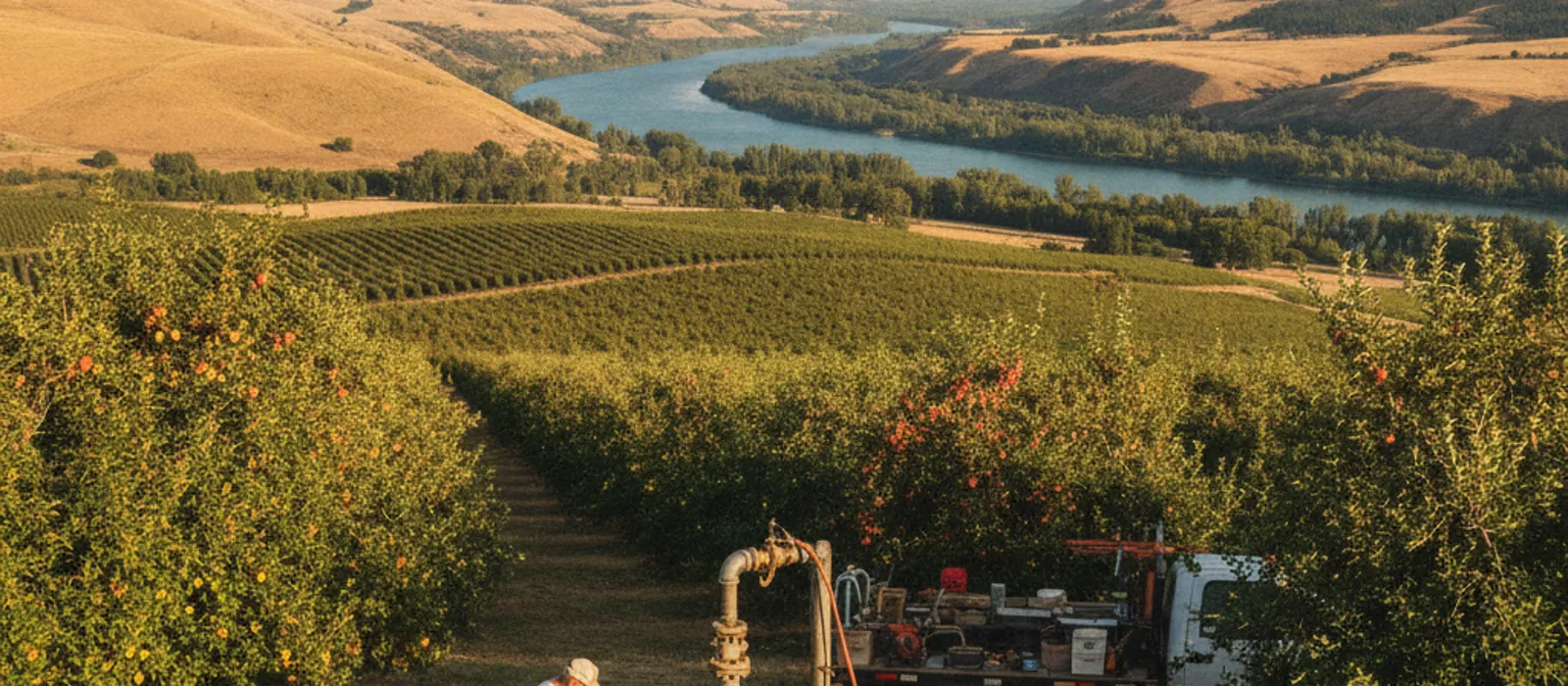
A five-acre block of Honeycrisp can pull close to 40,000 gallons out of the ground on a single 95 degree July afternoon. That number surprises a lot of new orchard owners around Wenatchee, right up until they watch their pressure crash mid-irrigation in the middle of harvest season.
Orchard irrigation well water demand is not something most people calculate before they plant. They size a well, buy some trees, and figure the water will work itself out. It usually doesn’t, at least not without a plan. Trees don’t care what your well was built for. They need a specific amount of water on a specific schedule, and if the well and pump can’t hit that number, the trees show it first.
This guide walks through the real numbers. We’ll cover gallons per acre for apples, cherries, and pears, how to turn that into a GPM figure your well and pump actually have to hit, when demand peaks hardest during our growing season, and how to check whether your well can support the acreage you have or want to plant. For the hardware side of this problem, our guide to irrigation well pumps covers sizing and cost. This one is about the math that comes before you buy anything.
Why Orchard Irrigation Well Water Demand Doesn’t Match What Your Well Was Built For
Most wells around Chelan, Douglas, and Grant counties were originally drilled for a house. A domestic well and a 1/2 to 1 HP pump handle showers, laundry, and a garden hose without much strain. That setup was never designed with orchard irrigation well water demand in mind, and the gap between the two is bigger than most people expect.
A household of four uses somewhere around 300 gallons a day, spread out unevenly over 24 hours. One acre of mature fruit trees at peak summer demand can use 25 times that much, concentrated into a single irrigation set of a few hours. That’s not a difference of degree. It’s a different category of water use entirely, and it calls for different math from day one.
If you’re not sure your current well and pump were ever sized for what you’re asking them to do now, that’s worth sorting out before the trees tell you the hard way. Request a free estimate and we’ll walk your property with you, or call (509) 300-5151 if you’re already seeing pressure drop during irrigation sets.
Gallons Per Acre: Apples, Cherries, and Pears Compared
Orchard water demand comes down to evapotranspiration, or ET, which is the combined water loss from soil evaporation and the tree pulling moisture through its leaves. ET is measured in inches of water per day, and one acre-inch works out to about 27,000 gallons. From there, gallons per acre per day is simple multiplication.
Here’s what peak-season ET looks like for the three fruits that dominate orchards in our valley:
| Crop | Peak ET (inches/day) | Peak Gallons Per Acre Per Day | Notes |
|---|---|---|---|
| Apples | 0.28 - 0.32 | 7,500 - 8,600 | Highest sustained demand through July and August |
| Cherries | 0.22 - 0.28 | 5,900 - 7,500 | Lower canopy demand, but very water-sensitive right before harvest |
| Pears | 0.27 - 0.31 | 7,300 - 8,400 | Tracks close to apples, slightly less peak demand |
These are averages for a mature, full-canopy block on the valley floor during a hot stretch. Young orchards use less because the canopy is smaller. Benches and canyon sites can run hotter or cooler depending on elevation and wind exposure, which shifts the numbers a bit in either direction.
Angela runs six acres of Bing and Rainier cherries outside Chelan, and for three seasons she irrigated on the same schedule she’d used since planting, without ever recalculating for the mature canopy. By her fifth leaf, the trees needed nearly twice the water they had as saplings, but the schedule never changed. Fruit started splitting on the vine right before her 2025 harvest, and she lost close to $14,000 in marketable cherries. A revised irrigation schedule, based on the numbers above instead of the original planting-year schedule, fixed it the following season at no equipment cost at all. Sometimes the fix is the math, not the pump.
Turning Gallons Per Acre Into GPM Your Well Has to Deliver
Gallons per acre per day tells you the demand. It doesn’t tell you what your well and pump have to produce, because you’re not running water for 24 hours straight. You’re running it for however long your irrigation set lasts, and that’s where GPM comes in.
The formula is straightforward. Take your gallons per acre per day, divide by the hours in your irrigation set, divide by 60, and multiply by your number of acres.
For a five-acre apple block at 8,100 gallons per acre per day, irrigated over a 12-hour set:
8,100 ÷ 12 ÷ 60 = 11.25 GPM per acre
Five acres at 11.25 GPM per acre means your well and pump need to sustain roughly 56 GPM for the full 12 hours, every day, through the peak of summer. Shorten the set to 8 hours and that jumps to nearly 85 GPM. Stretch it to 16 hours and it drops to about 42 GPM. The length of your irrigation window has a direct, large effect on the flow rate you need, which is often the easiest lever to pull if your well is short on yield.
Drip and micro-sprinkler systems apply water efficiently, so the numbers above are close to what actually needs to leave the wellhead. Overhead sprinklers lose more to evaporation and wind drift, so plan for 15 to 20 percent more raw gallons to deliver the same amount to the root zone.
Miguel planted four acres of Gala and Fuji apples near Cashmere in 2023 and had his well tested at 30 GPM sustained, which sounded like plenty. Once the trees matured, his actual demand at a 10-hour set came out to roughly 46 GPM, well past what the well could sustain, and the pump was cycling on low water cutoff three or four afternoons a week. We split his irrigation into two 5-hour sets instead of one 10-hour set, which cut his instantaneous GPM need to around 23, well inside his well’s real capacity. No new well, no new pump, just a different schedule.
If your own well’s true sustained flow is a question mark rather than a known number, that’s the place to start. Our guide to well yield testing covers exactly how that gets measured and what a normal number looks like for wells around here.
Seasonal Peaks: When Demand Hits Hardest
Orchard irrigation well water demand isn’t flat across the growing season. It ramps up, peaks hard, and tapers off, and knowing the shape of that curve helps you plan instead of react.
- April to early May: Bud break and early leaf-out. Demand is low, often under 0.10 inches per day, and many orchards aren’t irrigating heavily yet.
- Late May to June: Canopy fills in fast. Demand climbs steadily as temperatures rise and days lengthen.
- July and August: Peak season. This is where the numbers in the table above apply, and where a string of 95-plus degree days can push demand even higher than the averages for a week or two at a time.
- September: Demand tapers as days shorten and temperatures cool, though a late heat spell can still spike it.
- October onward: Minimal irrigation, mostly winding down for the season ahead of the first hard freeze.
The trap most people fall into is sizing their pump and well for an average summer day instead of the worst week of the summer. A heat wave doesn’t just add a little demand. It can push ET 25 to 40 percent above a normal peak day, right when cherries are close to harvest or apples are sizing up fruit, which is exactly when you can least afford a shortfall.
Ready to see how your specific acreage stacks up before the next heat wave hits? Get a free estimate and we’ll run the numbers for your property, crop mix, and current well.
Matching Well Yield to Orchard Size
Once you know your GPM requirement, the next question is simple: does your well actually make that much water, sustained, all day, without drawing down toward the pump intake?
Here’s a rough guide for drip-irrigated orchards at a 12-hour set, using the peak apple and pear numbers from earlier:
| Sustained Well Yield | Acreage It Can Support (Drip, 12-Hour Set) |
|---|---|
| 10 GPM | Under 1 acre |
| 25 GPM | About 2 acres |
| 50 GPM | About 4 to 5 acres |
| 100 GPM | About 8 to 9 acres |
| 200 GPM | About 17 to 18 acres |
These numbers assume the well can sustain that flow for the full irrigation window without excessive drawdown, which is not something you should assume without testing. A well that flashes 60 GPM for the first ten minutes and then fades to 20 doesn’t help you at hour three of a set.
The Nguyen family planted nine acres of Bartlett and D’Anjou pears near Quincy in 2022, working off a driller’s initial estimate that the well “should do fine.” Nobody ran a real sustained test before the trees went in the ground. By year three, the well was drawing down hard after 90 minutes of pumping and the family was losing pressure right when the afternoon heat hit hardest. A proper yield test showed a sustained capacity of just 38 GPM, well under the roughly 70 GPM their block needed at peak. Rather than drill a second well at an estimated $45,000, we installed a 20,000-gallon storage tank with a booster pump for about $22,000. The well now fills the tank around the clock, and the booster handles the peak demand the well alone never could. For more on how storage and booster setups work alongside a well that’s short on yield, our irrigation well pump guide goes deeper on the equipment side, and our well pump sizing guide walks through matching horsepower to your real numbers instead of a guess.
What To Do When Your Well Can’t Meet Orchard Irrigation Well Water Demand
If the math above doesn’t add up for your property, you have real options before you assume a new well is the only answer.
Split your irrigation into shorter, more frequent sets. As shown with Miguel’s apples, stretching or splitting your window can cut your instantaneous GPM need significantly without touching the well or pump at all.
Add storage. A tank and booster system lets a modest well fill around the clock and release strong flow during your irrigation window, which is often far cheaper than a new well or a bigger pump alone.
Get a real yield test before you plant or expand. Driller estimates and neighbor comparisons are not a substitute for a sustained flow test on your actual well. Our well yield test guide explains what a proper test involves and what the results actually mean for your acreage.
Check your water rights before you irrigate more than a half acre. In Washington, a permit-exempt well covers a limited amount of non-commercial irrigation. Anything beyond that, including most commercial orchard blocks, requires a water right through the Washington Department of Ecology. Confirm what your parcel holds before you invest in trees or equipment, at ecology.wa.gov/water-shorelines/water-supply/water-rights.
Know when to call a professional. Anything involving the wellhead, casing, downhole equipment, or electrical connections at the pump is not a weekend project. A miscalculated pump swap or a rushed wellhead repair can turn a water shortage into a well that’s out of service entirely during peak season. Our well pump replacement team handles the sizing and installation side once you know your real numbers, and if you just need a straight answer on what a fix or upgrade will run you, our well pump cost guide breaks down current pricing. For background on regional groundwater trends that can affect long-term well planning, the USGS Water Science School has a solid overview of irrigation water use nationally at usgs.gov.
Whatever the number comes out to, it beats finding out the hard way in the middle of August. Call (509) 300-5151 or request a free estimate and we’ll help you run the numbers for your orchard before the next peak season arrives.
Frequently Asked Questions
How many gallons per acre does an orchard need per day?
At peak summer demand, apples and pears typically need 7,300 to 8,600 gallons per acre per day, while cherries run a bit lower at 5,900 to 7,500 gallons per acre per day. These are peak-season numbers for mature, full-canopy trees on the valley floor. Early season and young orchard demand is significantly lower.
How do I convert orchard water demand into a well pump size?
Take your gallons per acre per day, divide by the hours in your planned irrigation set, divide by 60, and multiply by your total acres to get the GPM your well and pump need to sustain. Compare that number against a real sustained yield test of your well, not just a quick flow check, before sizing a pump. Our well pump sizing guide walks through the rest of the calculation once you have your GPM target.
Do cherries need more or less water than apples?
Cherries generally need somewhat less water than apples at peak season, roughly 5,900 to 7,500 gallons per acre per day compared to 7,500 to 8,600 for apples. The catch is timing. Cherries are highly sensitive to irrigation changes right before harvest, and both overwatering and underwatering close to picking can cause fruit splitting or sizing problems.
What if my well can’t produce enough water for my orchard?
You have several options short of drilling a new well, including splitting irrigation into shorter or more frequent sets, adding a storage tank with a booster pump, or lowering the pump setting if static water levels allow it. Start with an honest sustained yield test so you know your real number, then match your irrigation schedule and equipment to what the well can actually deliver. We handle both the testing and the equipment side, and free estimates are always available before you commit to any option.