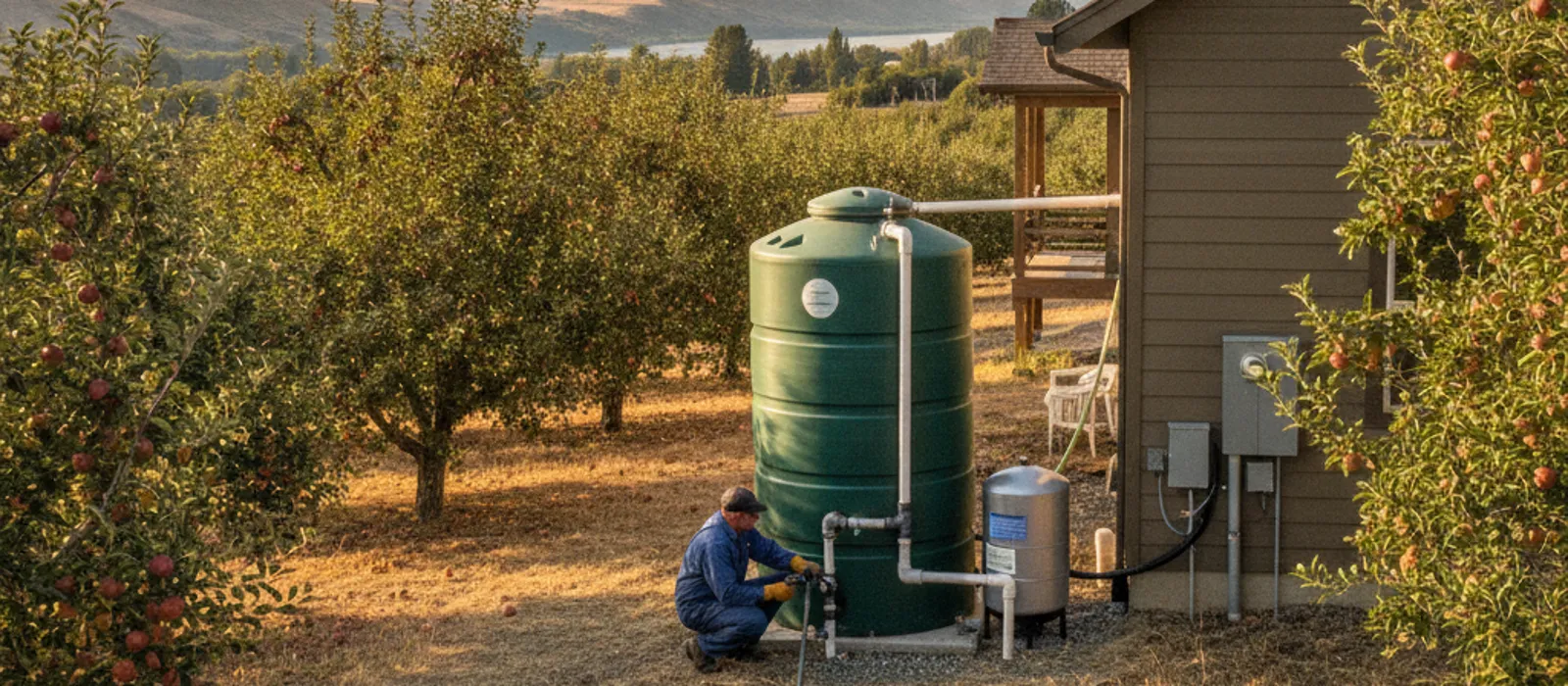
Your well makes 1.5 gallons a minute. Your family still wants two showers, a load of laundry, and the sprinklers running before 8 a.m. On paper that looks impossible. In practice, thousands of homes across Chelan, Douglas, and Grant counties run just fine on wells that weak, and the reason is almost always a cistern water storage system sitting quietly between the well and the house.
A cistern doesn’t make your well produce more water. It banks the water your well already makes, a little at a time, around the clock, so a booster pump can hand it to the house in a strong, steady stream whenever you need it. It’s often the cheapest real fix for a low-yield well, cheaper than deepening, cheaper than hydrofracturing, and far cheaper than drilling new.
This guide covers how these systems actually work, how to size one correctly, what installation runs in North Central Washington, and how booster pumps turn a trickle into real pressure. If your well tested low or your water pressure fades every afternoon, request a free estimate or call us at (509) 300-5151 and we’ll walk your property before you spend a dollar.
When Storage Beats Drilling: The Case for Cistern Water Storage
Do the math on a “weak” well and it stops looking so weak. A well producing just 1 GPM still delivers 1,440 gallons in a 24-hour day. A typical family of four uses 200 to 400 gallons daily. The well isn’t short on water. It’s short on speed, because nobody drinks water evenly across 24 hours. Everyone wants their gallons between 6 and 8 a.m. and 5 and 8 p.m.
Cistern water storage solves the mismatch. The well fills a tank slowly and continuously, all day and all night. The tank holds a reserve. A booster pump pulls from that reserve on demand and pushes it to the house at normal residential pressure, 40 to 60 PSI, the same as any city-supplied home.
This approach makes sense in a few specific situations:
- Confirmed low yield. A well yield test shows sustained flow under 3 GPM, especially in the 1 to 3 GPM range common in fractured granite and basalt wells around Cashmere, Leavenworth, and the Chelan benches.
- Seasonal decline. Your well performs fine in spring but fades every August as the aquifer draws down during irrigation season.
- New demand outpacing supply. You’re adding an ADU, a shop bathroom, or livestock, and the well was never sized for the extra draw.
- Deepening or drilling isn’t practical. Rock formation, casing condition, or budget rules out the bigger fixes.
Storage isn’t the answer for every low-yield well. If your well is barely producing anything, if you’re seeing signs your well is running dry rather than just slow, or if water quality is also failing, those need their own diagnosis first. That’s why we always start with a flow test rather than guessing at a tank size.
How a Cistern Water Storage System Works
A cistern water storage setup has four parts working together, and understanding each one helps you see why the system is reliable rather than fussy.
The well and pump. Your existing submersible or jet pump keeps running, but instead of feeding the house pressure tank directly, it feeds the cistern. Because the pump only has to fill a tank rather than answer sudden demand, it can run on a simple float switch and take its time. This is actually easier on the pump than the on-off cycling of a typical pressure-tank setup.
The storage tank (the cistern itself). Tanks are usually poly or fiberglass, sized anywhere from 1,000 to 5,000 gallons for a residential property. They get buried, set in a basement or crawlspace, or placed in an insulated outbuilding, depending on your site and our winters. A float valve or level control tells the well pump when to run and when to stop, the same idea as a toilet tank, just much bigger.
The booster pump. This is the pump that actually pressurizes your house. It pulls from the cistern and delivers water on demand, sized to match your home’s peak flow rather than the well’s slow trickle. Most residential booster setups use a constant-pressure pump, which holds steady pressure whether one faucet or four are running. Our guide to constant-pressure well systems covers how that technology works in more detail.
Controls and protection. A quality installation includes low-level shutoff so the booster pump never runs the cistern dry, plus dry-run protection on the well pump itself. These two safeguards are what separate a system that runs trouble-free for fifteen years from one that burns out a pump in its first summer.
Teresa, who owns a small hobby farm outside Chelan, called us in the spring of 2025 after her well tested at 1.8 GPM, barely enough for her house let alone her chickens and a vegetable garden. We installed a 2,000-gallon buried cistern with a constant-pressure booster for $6,400. Her well now fills the tank continuously in the background, and she waters the garden every evening without a second thought about running dry.
Sizing a Cistern for Your Well and Household
Getting the size right matters more than most homeowners expect. Too small, and you’re back to running out during a busy evening. Too big, and you’re paying for capacity and burial costs you’ll never use.
The starting point is your well’s yield, not your household usage. A well producing 1 GPM adds 60 gallons an hour, 1,440 gallons a day, whether anyone is home or not. Your cistern needs to bridge the gap between that steady trickle and your peak-hour demand.
A rough rule we use in the field: size the cistern to cover 1 to 2 days of household use, plus a buffer for the lowest-yield week of late summer. For most families that lands between 1,500 and 3,000 gallons. Larger properties with irrigation, livestock, or guest capacity often go to 3,000 to 5,000 gallons.
| Well Yield | Household Type | Recommended Cistern Size |
|---|---|---|
| Under 1 GPM | Small household, careful use | 2,000 - 3,000 gallons |
| 1 to 2 GPM | Typical family of 3-5 | 1,500 - 2,500 gallons |
| 2 to 3 GPM | Family with some irrigation | 1,000 - 2,000 gallons |
| Any yield + livestock or orchard | Farm or orchard property | 3,000 - 5,000 gallons |
| Any yield + guest house or ADU | Multi-household property | 3,000 - 5,000 gallons |
A few sizing details worth knowing before you buy a tank. Washington’s climate means any cistern set outside needs to sit below the frost line or get buried and insulated. Our winters get cold enough in the valley and worse up in Leavenworth and Plain that an above-ground uninsulated tank is asking for a cracked shell by January. If space or budget calls for a smaller cistern, pairing it with better water-use habits, like running laundry and irrigation on separate schedules, stretches the same tank noticeably further.
Cistern and Booster Pump Costs in North Central Washington
Costs vary with tank size, burial depth, and how far the cistern sits from both the well and the house. Here’s what we typically see installed across Chelan, Douglas, and Grant counties.
| System Component | Typical Cost | Notes |
|---|---|---|
| 1,000 - 1,500 gallon cistern, buried | $2,800 - $4,500 | Smaller properties, tighter budgets |
| 2,000 - 3,000 gallon cistern, buried | $4,500 - $7,500 | Most common residential setup |
| 4,000 - 5,000 gallon cistern, buried | $7,000 - $12,000 | Orchard, livestock, or multi-home sites |
| Constant-pressure booster pump | $1,200 - $2,500 | Installed and integrated with controls |
| Dry-run and low-level protection | $300 - $600 | Strongly recommended, cheap insurance |
| Trenching and piping (well to cistern to house) | $500 - $2,500 | Depends on distance and terrain |
A full turnkey system, tank, booster, controls, and installation, usually lands between $3,500 and $9,000 for most homes, with larger farm-scale setups running higher. Compare that to hydrofracturing at $5,000 to $10,000 with variable results, or a new well that commonly runs $25,000 to $50,000 or more in our region. For a well that’s simply slow rather than dead, storage is usually the better dollar-for-dollar fix.
Hank runs a small orchard block near Quincy and was quoted $34,000 for a new well after his old one tested at 2 GPM during peak irrigation season. Instead, we installed a 4,000-gallon cistern with a booster pump and separate irrigation feed for $10,800. Two seasons in, his orchard rows and his kitchen faucet have never competed for water again.
If your well tested low and you want real numbers for your property instead of a national average, get a free written estimate. We’ll look at your yield, your usage, and your site before recommending a size.
Booster Pumps: Turning Trickle Flow Into Real House Pressure
The cistern solves supply. The booster pump solves pressure, and it’s the part homeowners underestimate most. Without it, you’d just have a bigger, slower well.
A booster pump sits between the cistern and your house plumbing, usually alongside a small pressure tank of its own or built as a constant-pressure unit with a variable-speed motor. It’s sized to your home’s peak simultaneous demand, not your well’s yield, which is the opposite of how a direct-well pump gets sized. A house that might need 12 to 15 GPM during a busy morning gets a booster rated for that, even though the well feeding the cistern only makes 1.5 GPM.
Most residential booster setups fall into the same price range as a standard well pump repair, with the pump itself running $1,200 to $2,500 installed. Ongoing service is similar to any pressure system: common part repairs run $150 to $450, and if something fails outright, our well pump repair team in Wenatchee treats a booster pump the same as a well pump for diagnosis and parts.
The Reyes family in Cashmere had lived with a weak, sputtering shower for three summers before calling us. Their well tested at 2.2 GPM, workable but not enough for their household’s morning routine. We added a 1,800-gallon cistern and a constant-pressure booster for $5,900. Their water pressure now reads steady at 55 PSI whether it’s one tap running or three, something their old direct-well setup never managed even in April.
One thing to plan for: booster pumps are electrical equipment, same as your well pump, and they need a dedicated circuit and correct wiring. Never wire one yourself. If you’re not confident around electrical panels or well controls, that’s exactly the kind of work to leave to a licensed pro, and it’s a place where a mistake can be dangerous, not just expensive.
Living With a Cistern: Maintenance and Common Issues
A cistern water storage system is low-maintenance once it’s set up right, but it isn’t zero-maintenance. A little attention keeps it trouble-free for decades.
- Check the float switch and level controls yearly. A stuck float either overflows the tank or lets the well pump run dry against an empty cistern, and dry-running is what kills submersible pumps fastest.
- Inspect the tank interior every few years. Sediment settles at the bottom over time. A buried poly cistern rarely needs it, but it’s worth a look, especially if you’re seeing sediment in your well water already.
- Keep the booster pump’s pressure switch and controls dry and accessible. Booster pumps in an unheated outbuilding need the same winter protection as any pump house. Our guide to pump house insulation covers what that takes locally.
- Watch your well pump’s run cycle. With a cistern in place, the well pump should run long, slow cycles rather than short bursts. Frequent short cycling on the well side usually points to a float switch problem, not the well itself.
- Test your booster pressure once a year. A slow drop in delivered pressure, even with a full cistern, often means the booster pump is wearing out before it fails outright.
If your system starts short cycling, losing pressure, or making noise it didn’t used to make, don’t wait it out. A $150 service call now beats a burned-out pump later, and emergency after-hours work runs an extra $150 to $300 on top of standard repair pricing. Catching a control problem early is always the cheaper visit.
For background on the health and safety side of storage, the Washington State Department of Health publishes guidance on private water systems and adequate supply for small water systems, worth a look if you’re weighing storage against other fixes (doh.wa.gov). The EPA also maintains resources for private well owners covering system components and maintenance basics (epa.gov/privatewells).
Whether you’re staring down a well that tested low or you’re just tired of afternoon pressure that can’t keep up, a cistern and booster system is worth pricing before you consider anything bigger. Schedule a free estimate and we’ll test your well, walk your site, and tell you honestly whether storage solves your problem.
Frequently Asked Questions
How much does a cistern water storage system cost installed?
Most residential systems, including the tank, booster pump, controls, and installation, run $3,500 to $9,000 depending on tank size and site conditions. Small 1,000 to 1,500 gallon systems start around $2,800, while larger 4,000 to 5,000 gallon setups for orchards or livestock properties can run $7,000 to $12,000.
What size cistern do I need for a low-yield well?
Size depends on your well’s yield and your household’s peak demand, not just the number of people in the house. Most families on wells producing 1 to 2 GPM do well with a 1,500 to 2,500 gallon cistern, while properties with irrigation or livestock often need 3,000 to 5,000 gallons.
Will a cistern fix low water pressure, or just low water supply?
A cistern alone only fixes supply, storing water so you don’t run out. Pressure comes from the booster pump paired with it. If your problem is low water pressure but your well tests fine on yield, the fix might be a booster or pressure tank issue rather than storage at all, which is why testing first matters.
Can I install a cistern and booster pump myself?
The tank itself can sometimes be a DIY-friendly part of the project if you’re comfortable with excavation and plumbing. The well connection, electrical wiring for the booster pump, and control setup should go to a licensed professional. Miswired pump controls can damage equipment or create a safety hazard, and it’s not worth the risk to save a service call.