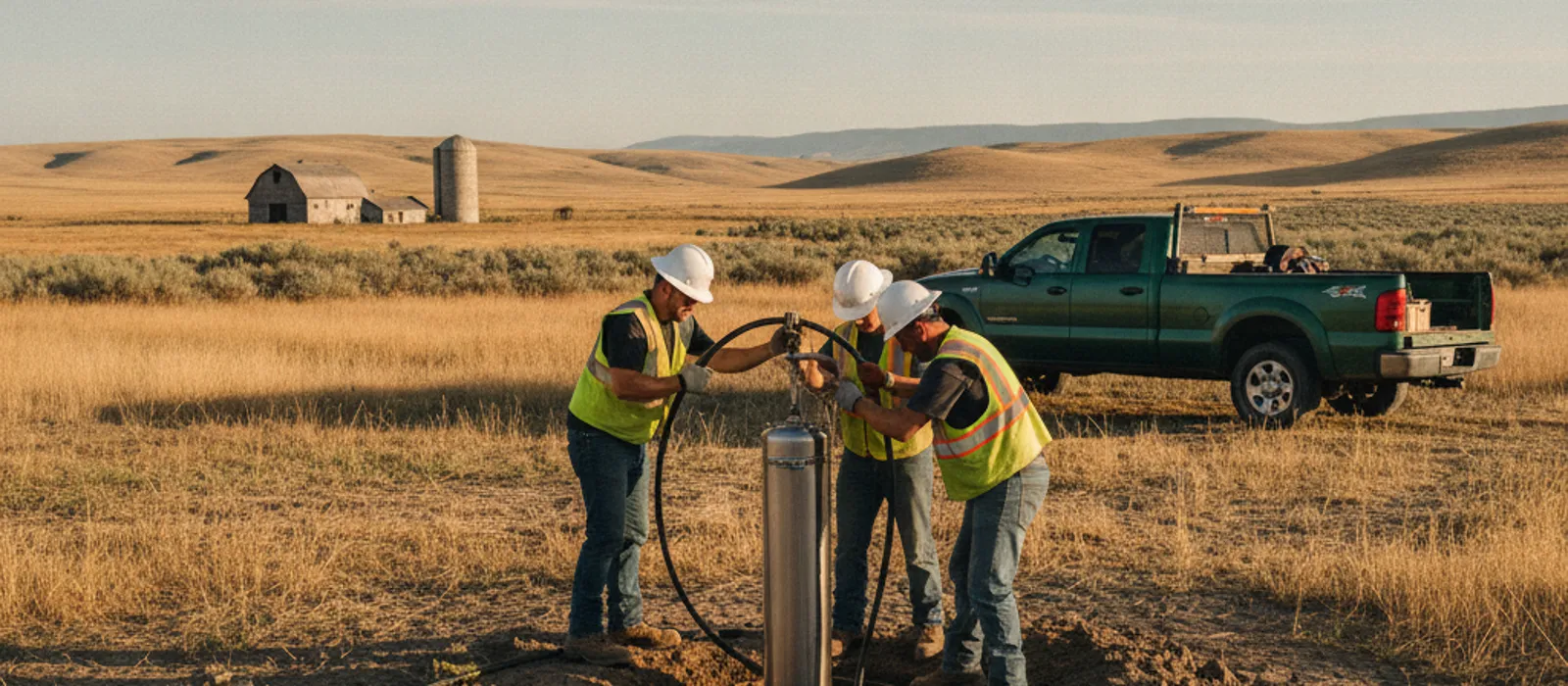
A $60 piece of plastic or aluminum is often the only thing standing between your family’s drinking water and every mouse, earwig, and spider in your yard. That’s it. That’s the whole barrier.
Most well owners around Wenatchee couldn’t tell you what their well cap looks like, and honestly, that’s normal. It sits out by the orchard or behind the shop, doing its job quietly for years. But when a cap cracks, loosens, or loses its seal, contamination can start within days, and you won’t taste it, smell it, or see it until a water test comes back ugly.
The good news? Well cap replacement is one of the cheapest, fastest fixes in the entire well world. In this article we’ll cover what your cap actually does, the warning signs it’s failing, what a new one costs in North Central Washington, and when a bad cap is hinting at a bigger problem down the hole.
What Your Well Cap Actually Does (And What Gets In When It Fails)
Your well casing is a steel or PVC pipe that runs from the surface down to the aquifer. The cap seals the top of that pipe. Its job sounds simple: keep everything out except air.
A proper cap does four things. It blocks insects, rodents, and snakes from falling into the well. It keeps surface water, dust, and orchard spray drift from running down the casing. It protects the electrical wiring that feeds your pump. And it vents the well through a screened opening so the water level can rise and fall without pulling a vacuum.
When the seal fails, your well becomes an open invitation. The EPA’s guidance on private wells lists a damaged or missing cap as one of the most common contamination pathways, and we see it constantly out here. Mice love the warmth around well wiring in October. Earwigs and spiders nest under loose caps all summer. One dead mouse in a well can push coliform and E. coli counts through the roof.
Here’s the part that surprises people: in our service area, the cap takes real abuse. Wenatchee summers bake plastic caps at 100 degrees until they get brittle. Winters drop below zero and crack them. Orchard mowers clip them. Sprinklers hammer them with hard water deposits. A cap that would last 30 years in a mild climate might give out in 15 here.
If you haven’t looked at your well cap in the last year, go look at it today. And if something seems off, request a free well checkup and we’ll take a look, no charge and no pressure.
A Quick Story From Cashmere
Marv, an orchardist outside Cashmere, called us last spring because his water “tasted a little earthy.” Nothing dramatic. We pulled his cap, a 1990s slip-on style, and found the gasket completely rotted and a mouse nest tucked against the wiring. His water test came back positive for total coliform.
The fix: a $95 sanitary cap and a shock chlorination treatment to disinfect the well. Total bill around $450. If he’d caught the cap five years earlier, it would’ve been a $200 service call. If he’d waited another year, he might’ve been looking at a contaminated pump and pressure tank too.
6 Signs You Need Well Cap Replacement
You don’t need special tools to inspect your own cap. Walk out there and check for these six things.
1. Visible cracks or warping
UV exposure and freeze-thaw cycles destroy plastic caps over time. Look for spider cracks, chalky faded plastic, or a lid that’s warped enough that the edges don’t sit flush. Aluminum caps fare better but can corrode at the bolts.
2. The cap wiggles or lifts by hand
Grab the cap and give it a gentle twist. A sanitary cap should be bolted down tight. If it spins, rocks, or lifts off with no effort, it’s not sealing, period. We’ve found caps in Quincy and Moses Lake sitting on the casing held down by nothing but a rock.
3. Missing or torn vent screen
The vent must be screened with fine mesh, pointed downward. If the screen is torn or missing, insects walk right in. This is the single most common defect we find on otherwise decent caps.
4. Bugs, webs, or rodent droppings under the lid
If you pop the cap (power off at the breaker first, always) and find spider webs, earwig clusters, or droppings inside, the seal failed a while ago. Time for a new cap and probably a water test.
5. The cap sits low or the casing is damaged
Washington code wants the top of your casing at least 6 inches above grade, and 12 inches is better. If soil or landscaping has crept up around your wellhead, runoff can pool against it. Sometimes the real problem is the casing itself, in which case you may need well casing repair rather than just a cap.
6. Unexplained water quality changes
Cloudy water after rain, a musty taste, sediment that wasn’t there before, or a failed coliform test. These don’t always mean a bad cap, but the cap is the first thing any honest well contractor checks because it’s the cheapest possible culprit.
Two or more of these signs? Don’t sit on it. Call us at (509) 300-5151 and we can usually swap a cap within a day or two, same day if you’re in the Wenatchee or East Wenatchee core.
Standard Caps vs. Sanitary Well Caps: Know the Difference
Not all caps are equal, and this is where a lot of older wells in Chelan, Douglas, and Grant counties fall short. Plenty of wells drilled before the mid-90s still wear the original slip-on cap.
A standard cap slips or threads over the casing. There’s no gasket, just metal or plastic resting on metal. It keeps out rain and big debris but does almost nothing against insects, and a determined mouse can squeeze through a gap the width of a dime.
A sanitary well cap has a rubber gasket compressed between the cap and casing, bolted down from the sides, with a screened vent. It creates a true vermin-proof seal. Washington’s well construction rules, administered by the Department of Ecology, require new wells to be finished with caps that keep contaminants out, and sanitary caps are the standard way to get there.
If your well still has an old slip-on cap, upgrading to a sanitary cap is the best $200 you’ll spend on your water this year.
What Well Cap Replacement Costs in the Wenatchee Valley
Here’s the honest math. The part is cheap. You’re mostly paying for the trip, the know-how, and making sure the wiring and seal are done right.
| Item | Typical Cost (Parts) | Installed Cost | Notes |
|---|---|---|---|
| Basic plastic well cap | $20 to $40 | $125 to $200 | Fine for irrigation-only wells |
| Aluminum sanitary cap, 6” casing | $50 to $90 | $175 to $300 | Most common residential size here |
| Sanitary cap, 8” casing | $80 to $140 | $225 to $350 | Larger irrigation and shared wells |
| Cap with conduit fitting rework | $90 to $150 | $300 to $450 | When wiring entry needs updating |
| Cap replacement + shock chlorination | n/a | $400 to $600 | If contamination got in |
| Cap replacement + casing extension | n/a | $600 to $1,200 | When casing sits too low |
Compare that to the downstream costs of ignoring it. A contaminated well needs disinfection, retesting, sometimes weeks of bottled water. A mouse that chews pump wiring can kill a pump motor, and a full well pump replacement runs $1,800 to $4,500 around here. The cap is the cheapest insurance in your whole water system.
Linda in Quincy Learned This One the Hard Way
Linda runs a small place outside Quincy, surrounded by row crops. Her well cap got clipped by a brush mower in July and cracked along one side. She figured she’d deal with it after harvest. Then the fall irrigation runoff came, three months of dust and spray drift settled around the wellhead, and her annual nitrate test jumped from 2 ppm to 7 ppm.
Nitrates in farm country are a real concern, and a compromised cap gives surface contamination a direct path. She ended up spending about $1,400 on a new cap, a casing extension to get the wellhead higher above grade, and follow-up testing. The cap alone, fixed in July, would’ve been $250.
If you’re in farm country, this matters double for you. Pair any cap work with regular well water testing so you actually know what’s in your glass.
Can You Replace a Well Cap Yourself?
Sometimes, and we’ll be straight with you about when.
If your well has a simple cap with no wiring passing through it, and you’re just swapping like for like on a clean casing, a handy homeowner can do it. Buy a proper sanitary cap matched to your casing diameter (measure the outside, usually 6 inches for residential wells here), seat the gasket evenly, and torque the bolts in a star pattern so it compresses square.
But stop and call a pro if any of these apply:
- Pump wiring runs through the cap. Most submersible setups route the pump wires through a conduit fitting in the cap. That means working inches from 240-volt conductors over an open well. Kill the breaker, sure, but if the wiring is brittle, spliced, or undersized, this is not the place to learn. Wiring damage is one of the top reasons we get called out for well pump repair.
- Anything could fall down the well. A dropped bolt, tool, or chunk of old cap can wedge against your pump or drop line. Retrieving objects from 200 feet down costs far more than a service call.
- The casing is corroded, dented, or out of round. A new cap won’t seal on a damaged casing, and forcing it can crack the casing lip.
- You find evidence of contamination. Droppings, dead insects, or a sour smell means the well likely needs disinfection, not just a lid.
Our cap-only service calls in the Wenatchee, East Wenatchee, and Cashmere area usually run $175 to $300 all-in, and we inspect the wiring, the vent, and the top of the drop pipe while we’re in there. That ten-minute look has caught failing pumps early more times than we can count. Book a free estimate here and we’ll give you a firm number before any work starts.
How to Make Your New Cap Last 25 Years
Once you’ve got a good sanitary cap on, keep it that way. This is five minutes, twice a year.
Walk the wellhead each spring and fall. Check that the cap is tight, the vent screen is intact, and nothing has piled up against the casing. Keep grass, mulch, and snow berms at least a couple feet back. Make sure the ground slopes away from the well so spring melt drains off instead of pooling.
Flag the wellhead before mowing season. A $5 driveway marker has saved a lot of caps from a lot of brush hogs. In winter, don’t let the snowblower throw ice chunks at it, and if your wellhead sits inside a pump house, good pump house insulation protects the cap, the wiring, and the pipes all at once.
And put the cap on your annual checklist next to your water test. Around half the wellhead problems we find were visible for at least a year before anyone called. A glance in April and a glance in October is all it takes.
One more local note: Greg, up the Entiat side of Lake Chelan, had us out in January for a no-water emergency. The well was fine. His vent screen had corroded out years earlier, and ice had formed inside the cap around the wiring, eventually shorting the pump circuit. New cap, repaired connections, water back the same afternoon. Two minutes of inspection any previous fall would’ve caught it. If you ever do wake up to nothing at the tap, our emergency well service runs 24/7, because no water in January isn’t a wait-until-Monday problem.
Frequently Asked Questions
How much does well cap replacement cost?
In the Wenatchee area, expect $125 to $350 installed for most residential wells, depending on casing size and whether wiring runs through the cap. The cap itself is usually $20 to $140. If the well needs disinfection or a casing extension, the total can reach $400 to $1,200.
How do I know what size well cap I need?
Measure the outside diameter of your steel or PVC casing at the top. Most residential wells in Chelan, Douglas, and Grant counties have 6-inch casings, with 8-inch common on irrigation and shared wells. Buy a sanitary cap rated for that exact diameter, since an oversized cap won’t compress its gasket and won’t seal.
Should I test my water after replacing a damaged well cap?
Yes, every time the old cap was cracked, loose, or missing. Test for total coliform and E. coli at minimum, and add nitrates if you’re near orchards or row crops. If anything comes back positive, the well should be shock chlorinated and retested before you drink the water.
How long does a well cap last?
A quality aluminum sanitary cap typically lasts 20 to 30 years. Plastic caps in our hot-summer, cold-winter climate often fail in 10 to 15. Inspect yours twice a year and replace it at the first sign of cracking, a loose fit, or a torn vent screen rather than waiting for a failed water test.